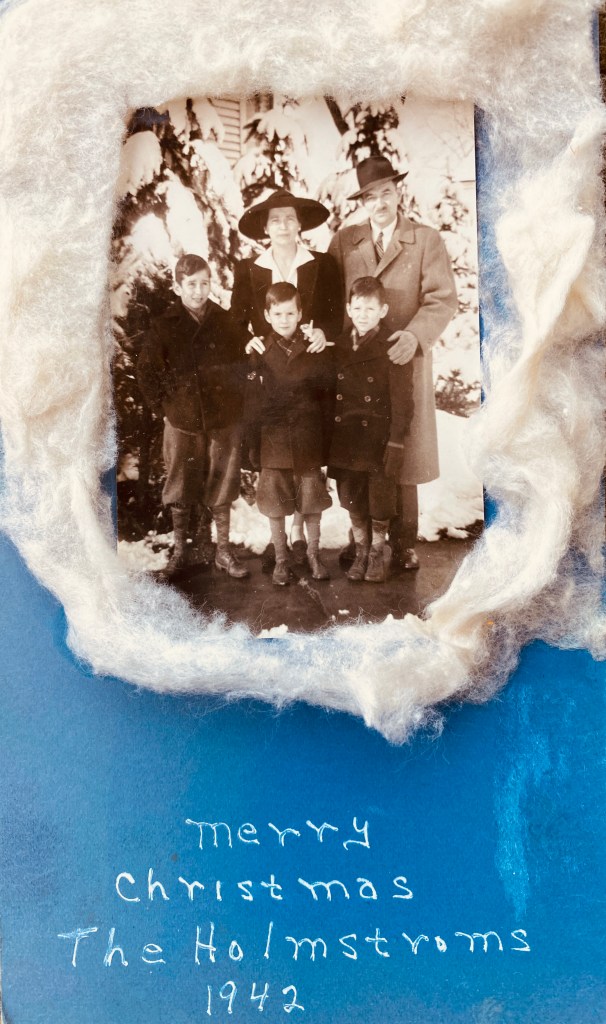
with his family in 1942.
In the spirit of the holidays, I’m sharing an essay my dad first wrote in 1967. It was printed in The Christian Science Monitor newspaper in 1994.
When my father penned this piece he was newly divorced (his first marriage, which lasted a year) and living in a small apartment north of Boston, Massachusetts in the seaside town of Lynn. Far, far away from family and his beloved California.
I don’t know much about this time in my father’s life, but I always felt as if he underwent an unusual amount of self-growth because of the end of his first marriage. Given that he was a privileged white male in the culture of the late 1960s United States he could easily have drifted into convention or resentment.
I believe the experience of divorce made him a better husband to my mother (they were married thirty-four years until her passing), and a more optimistic, empathetic, expressive human. Learning what he didn’t want must have been a key takeaway, as well as gaining a better understanding of the role a dynamic, loving partnership can play in one’s life path.
On that stormy Christmas Day my dad found that he could be happy with cider and silence. His essay on a holiday spent solo reminds me of something he used to say frequently: “It’s not what happens to you, it’s what you do about it.”

A Christmas To Remember ~ First published in 1994
By David Holmstrom
It was not that I couldn’t afford a tree, but rather, that I couldn’t afford not to be innovative. Christmas trees – festive and sweet as they are – are much the same each year. And because I was 3,000 miles away from home, young as a green tomato, alone, and quite frankly glad I was alone, I made a tree of coat hangers.
It was more important to me to be innovative rather than sentimental.
In my sixth-floor apartment by a rocky coast, I bent, twisted, and shaped what I thought was an ingeniously engineered tree, about three feet tall. I hung it from a ceiling light, like a mobile, attached a dozen spoons, three dozen large dangling paper clips, many bows of red ribbons, very small Christmas tree bulbs, and one red sock half-filled with jellybeans as an anchor.
The ugliness of it assured its beauty.
My conviction then was that Christmas should be a prod. It comes to ask questions such as: During the year, have you lived spiritual precepts as fully as the bestowal of God’s goodness? Have you finally, once and for all, stopped being so serious?
Have you been innovative, or have you lived sloppily on residual power, playing out the familiar while you turn gray inside? Have you loved when everything and everyone around you seems sad and broken?
One of my answers was the Christmas tree of hangers, a symbolic defiance of the status quo.
On Christmas Day the coastline was pounded by a storm – great black waves pounding against the rocks – and swirls of light snow. I called home to thank one and all for love, for gifts, for support. Then I drove to a spit of land where the waves hit rocks and sent spray shooting into my face.
Drenched but exhilarated, I went home for hot cider and silence.
As I opened the door of my apartment, a gust of wind caught the tree of hangers and sent it spinning. The spoons clanged, the paper clips were tinny. Listen, I said to anyone and everything that might have been listening, this is the Merry Christmas of all time and place.
Would you care for a jellybean or a spoon?
 Still...however...maybe...
You must be logged in to post a comment.