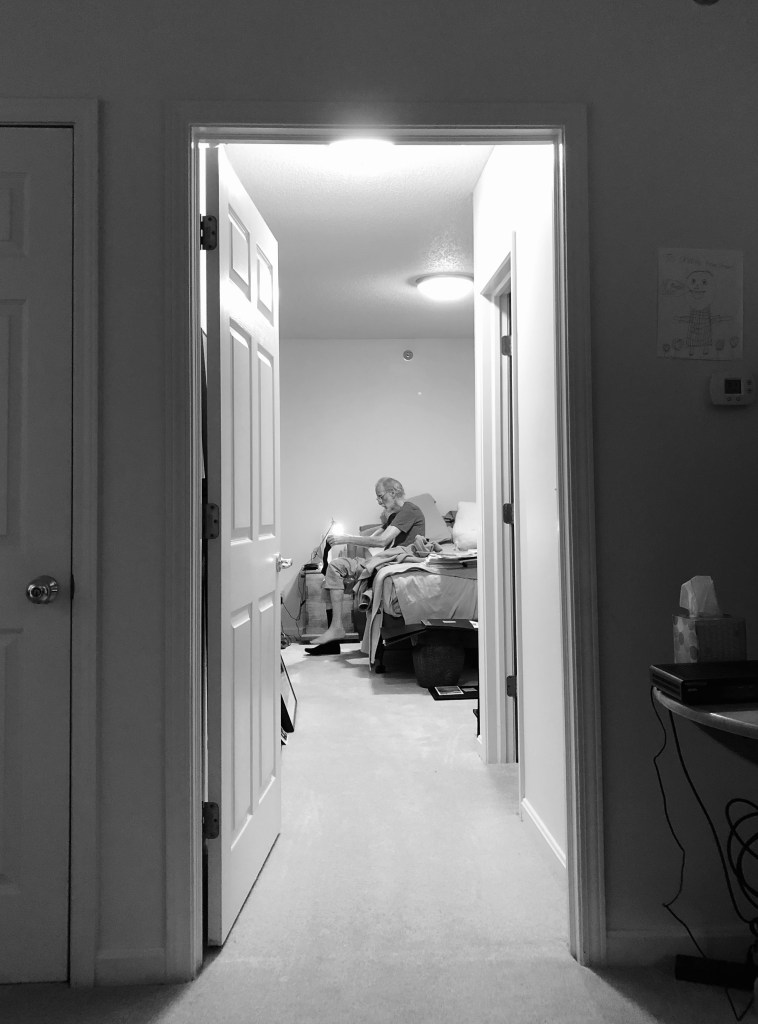
“Hi Kiddo…remember how I told you about those little people streaming up the walls, the ones getting into the light fixtures and whispering? They’re back today, I’m going to call the front desk and see if they can put in new lights. Hoping that helps.”
—Excerpt from a voicemail my father left me in late November 2020
Reading the message above, you might imagine that the person behind those words was out of their mind, paranoid, even dangerous.
What you are probably not imagining is that the person who left that message for his (horrified) daughter was also an accomplished writer, a loving, devoted, and encouraging father. Or that this hallucinating man was once serenaded by the great Maya Angelou because she so adored his interview questions. Well, it’s true.
It’s also true that even after two years of me caring for my father it took that particularly alarming voicemail for me to finally accept a hard truth: my dad and I had entered unknown territory, and we would likely never return to normal (whatever that is).
Everything that had come before, the father/daughter relationship I’d relied upon and frequently taken for granted every day of my forty-nine years, had been undergoing a seismic shift—but I’d been in thick denial for a long time. Despite taking over almost every aspect of my father’s care I had to hear his irrational call for help to truly understand how much had changed, and how screwed we both were.
The familiar, healthy reciprocal relationship between father and his daughter was no longer. In its place was a perpetually ill-fitting dynamic that neither of us was prepared for.
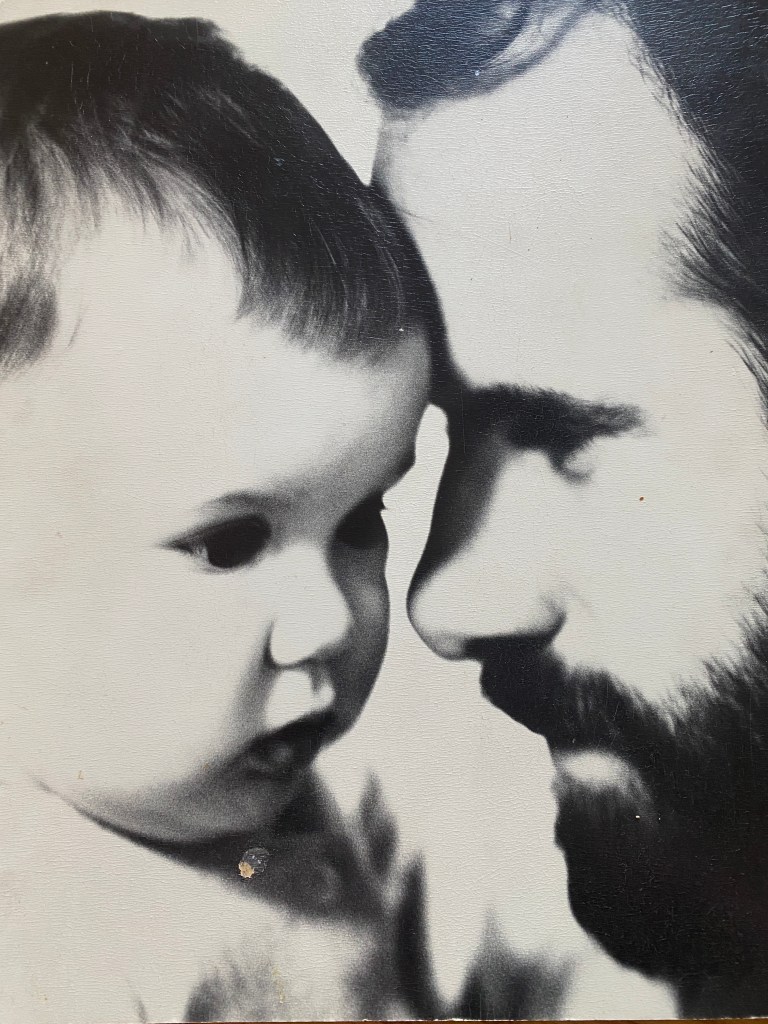
“For a son or daughter to assume autonomy over a parent’s life and say, “I’m making the decisions now,” is a role reversal for which there is no preparation.”
-Patti Davis in the New York Times Sep 1, 2023
Many around my generation (I’m in my early fifties) are facing the decline of their parents, and the beginning of their careers as caregivers, and it isn’t pretty. Yesterday I spoke with a close friend who recently moved her mother across nine states to live with her. Her mother’s memory is in steady decline and my friend’s life changed overnight—she is now providing 24/7 care, in her own home, for her mother. When we spoke, my friend had just spent an entire hour trying to convince her mom to go for a walk with a new hourly caregiver. My friend was hoping to get a two-hour break, her first in weeks.
As we were talking my friend was watching her mom sit in the passenger seat of the caregiver’s car across the street. My friend knew her mom was uncomfortable, searching for any way to get out of the situation and away from the unknown driver and the unfamiliar car she found herself sitting in. This mother had no idea her daughter was watching her from a few yards away, the daughter’s voice trembling as she wondered how she was going to make this all work, how she could possibly keep her mother safe, run her business, maintain her sanity.
“Call me anytime to talk,” I told my friend. She thanked me and then said, “But if you haven’t heard from me could you call and check in on me?” I knew what she meant, caregivers need real, on the ground help. My friend doesn’t need people inquiring if she’s okay, she needs someone to come over, make her mom laugh, make them both nourishing soup, and relieve her for an hour so she can walk down a trail and listen to birdsong and cry.
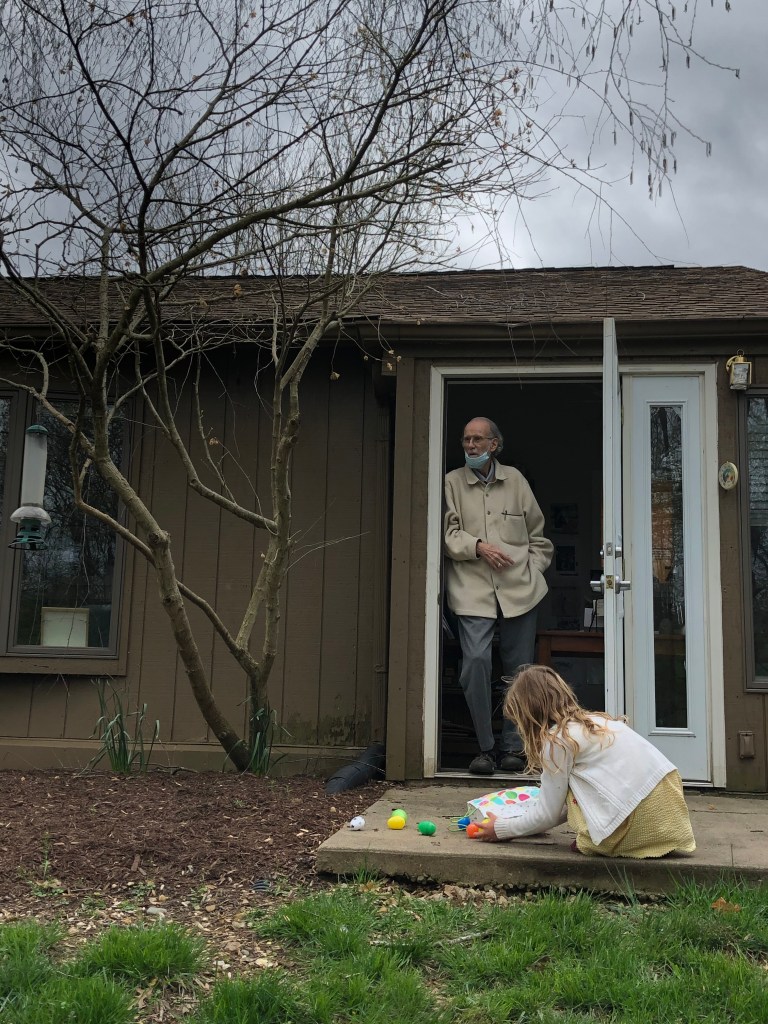
Over the past two weeks I’ve connected with three friends who are embarking on the caretaking of a parent with memory issues. Three different friends, three levels of memory loss, one painfully familiar story. There are common threads: all our parents were accomplished, active people, and NONE of them are losing their memory gracefully or following along any sort of expected memory-loss timeline (spoiler—there isn’t one, every memory loss diagnosis and journey is unique).
Not only that, but here is a little-known fact: memory loss does not follow a linear timeline, it shifts and dips and peaks. One day your loved one might recall their favorite high school class and how they felt before their wedding, and another day your ailing dad might buy the New York Times at a bookstore and then return to the register to try and purchase it again two minutes later.
For many, the term “caregiver” suggests a simple scenario in which a person REQUIRING care RECEIVES that care from someone qualified to provide it. For many of us, the reality of caregiving is something else entirely. Take my father, for example. This fiercely independent world traveler and investigative journalist was LOATH to accept the help of a caregiver, or, as he insisted on calling anyone who came into his apartment, a “nurse.” “Why do I need a nurse?” he asked me repeatedly. “Why is she going to watch me shower…I don’t need her to spoon food into my mouth…why on earth do I need any of that. It’s a waste of money.”
“Okay Dad,” I’d say from the kitchen as I finished washing his dishes, or from the hallway as I stuffed his clothes into the dryer, or from the front walkway as I swept slick leaves away from the entryway.
Slowly, without either of us fully grasping what was happening, I became my father’s full-time caregiver. Fetching prescriptions, filling the pillbox, setting up medical appointments, attending medical appointments, corresponding with doctors and insurance, paying his bills, checking his voicemails, doing his grocery shopping, taking him to church, to the bookstore, to the library, on walks. I devised a system of leaving daily notes in prominent places around his apartment every morning (taped to his bathroom mirror, on the seat of his reading chair) and evening with daily reminders about what to eat and what medication to take, what was going to happen that day. It was a highly imperfect and flawed system.
I finally landed on the phrase “You know how you’re always saying you wish you could help make my life less busy, Dad? Well, YOU accepting help helps ME.”
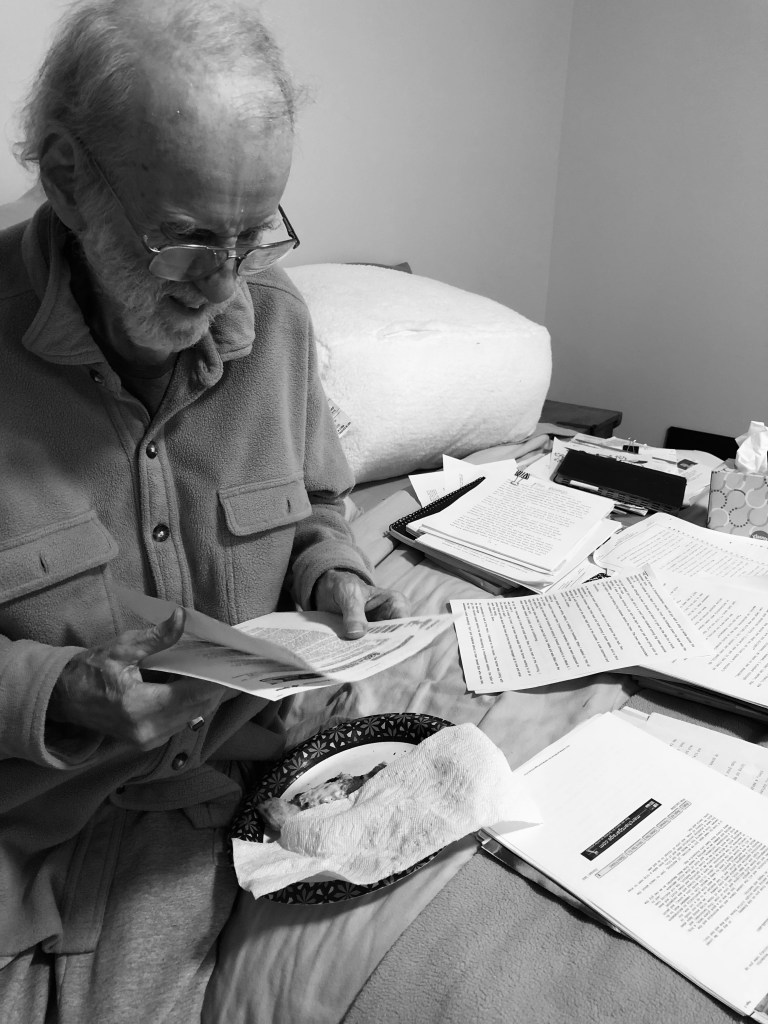
“Some of this is pretty good!” he’d say, chuckling.
After those words left my mouth, he’d look at me quizzically, then nod and say “Okay Kiddo, I’ll accept help, just for a few hours.”
Inevitably, the next day when the hourly caregiver showed up, he’d tell them he was all set, and send them on their way.
Somehow, my dad and I made it work, day in and day out. And we were fortunate: my father had the means to live independently, had access to good medical care, and had a caregiver (me) who was able to devote most of her time to his care (at the expense of many, many things in my life but that’s another story). Plus, we were banking off a lifetime of good feelings between us.
What I haven’t mentioned is that I’d act as my Dad’s primary caregiver all over again in a heartbeat. I loved (and love) my dad completely and with a fierceness that overwhelms me. Every single thing I did for him was done out of love. He had cared for, protected, and celebrated me throughout my entire life. He named my childhood cats after feminists! Taking my turn to care for him was a privilege. No one else could have cared for him as well as I did (maybe my mother, but honestly, I’m glad she never had to).
I wish I had hope that the landscape of caregiving in my country will change, that resources will get easier to access, that Alzheimer’s and Dementia will loosen its grip on us, but I think we all know the reality.
It’s not going to get any easier, and as I listened to my friend’s story yesterday, I felt the heavy weight of all she is facing, and will face in the coming months and years.
We can rely on one thing, though. The steady love our parents shared with us continues to flow forward, lifting us up in ways we don’t expect, and allowing us to achieve what often feels impossible. Because we caregivers have no other choice.

 Still...however...maybe...
3 responses to “Caregiving: A Reality Check”
Such poignant thoughts on a journey none of us wants to take. Thank you for writing this. -Jodi
LikeLike
Brilliant- just brilliant! Thank you for sharing your story/experience with the world, everyone should be reading this ♥️ You have a knack for relaying your own (impossible, tragic, extremely hard) experience in a beautiful way- it’s a gift and I thank you for it. Love you dearly ♥️
LikeLiked by 1 person
Ps. I think you dad had this gift too 🥰
LikeLike