Recently, I saw true love. Love intertwined with my own personal history, sheltered in a place rich with meaning.
This love was not romantic, but held longevity and fierce loyalty.
A mother and a daughter, Jennifer and Nancy, are living together on their land in California. A place I know intimately, inhabited by two humans I adore. Women tenderly trading love back and forth like cherished heirloom jewelry.
We are not blood-related, but I have known Nancy and Jennifer since I was seven. Nancy and her husband Bob were my parents’ closest friends. Over the years, we have spent countless days together, shared many holidays, and taken family trips. Nancy was like a second mother to me, especially during my formative years. Children need people who believe in them, and Nancy believed in me. She recognized my hidden academic potential. She drew out my true creative self, and gently prodded me when I got too serious or withdrawn.
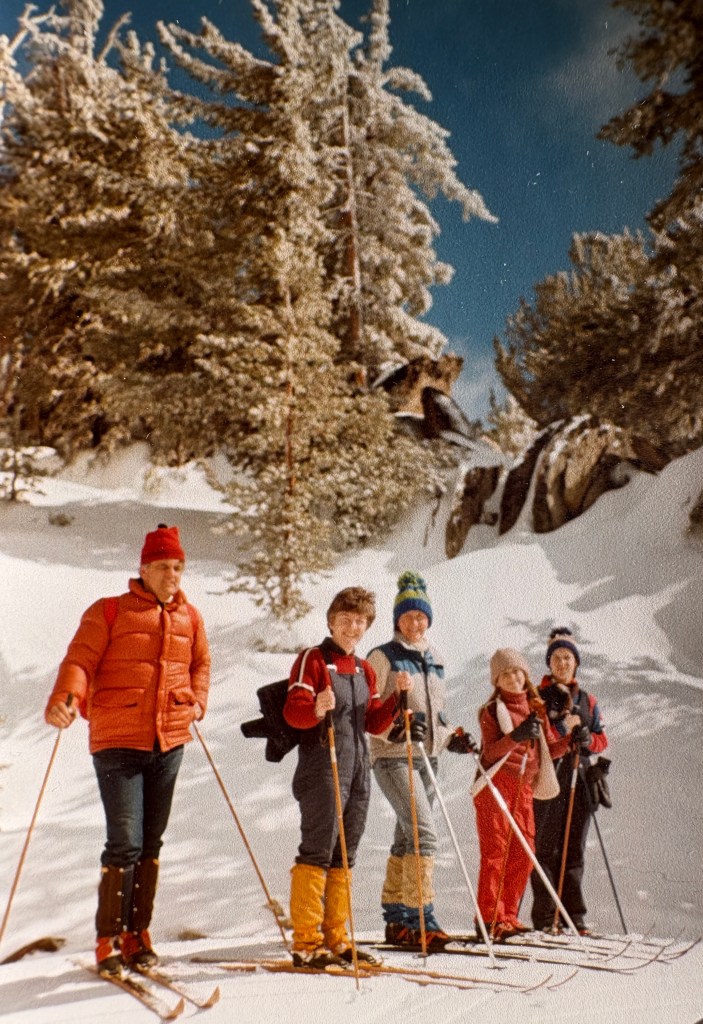
Tahoe, 1980. My family joined Nancy, Bob and Jennifer for a cross-country ski trip.
Recently, her daughter Jennifer shared with me that Nancy was having some health difficulties. If I were going to visit, this was the time. Jumping on a plane and flying across the country, I imagined my visit. I would spend time helping around the house, explore the garden and sit with Nancy.
What I did not expect was to be so moved by the depth of love and devotion between two people. Viewing my own history through fresh eyes, I gained a deeper appreciation of the role that beloved elders have played in my life.
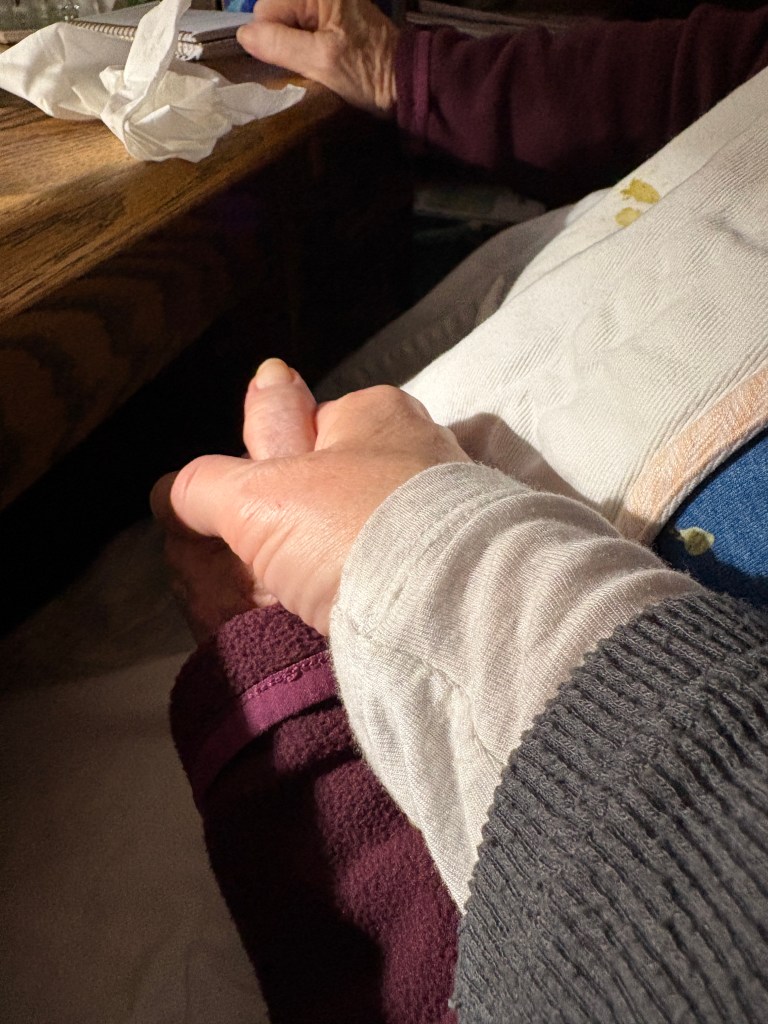
Holding Nancy’s hand.
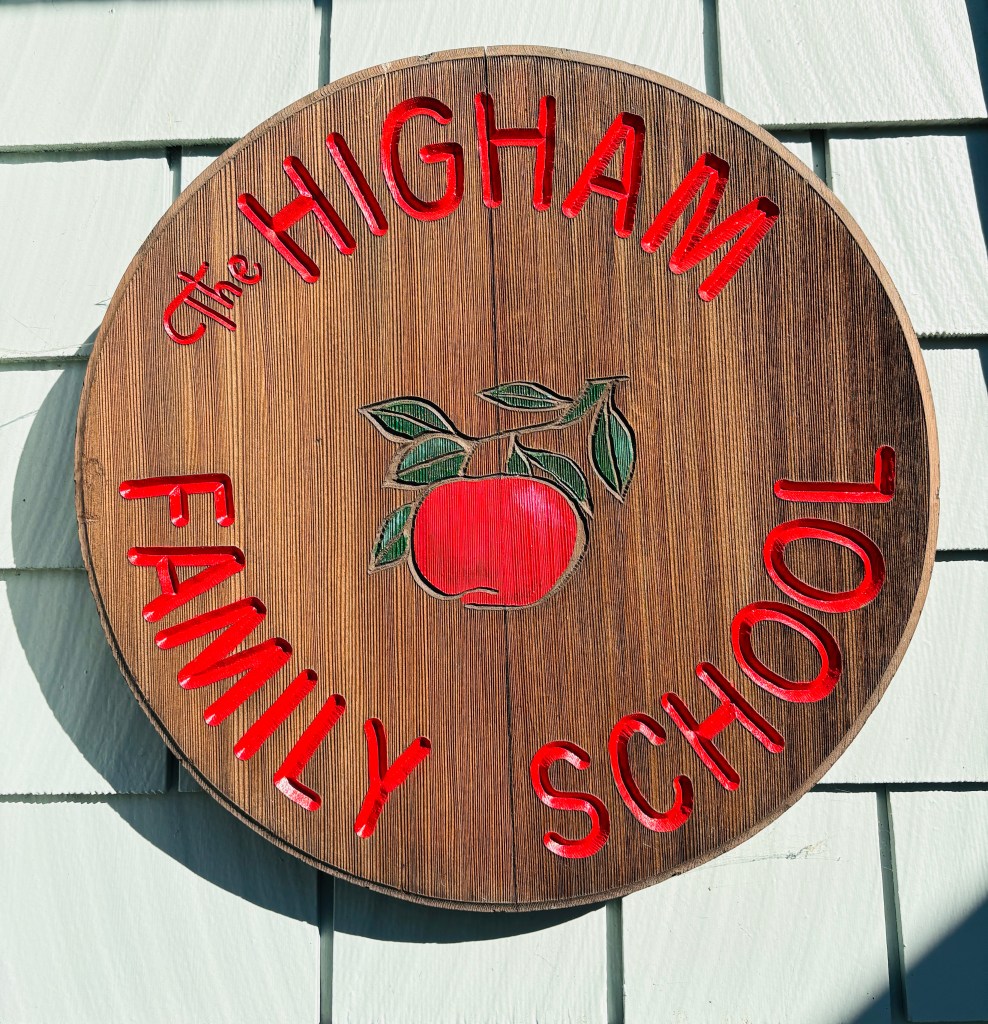
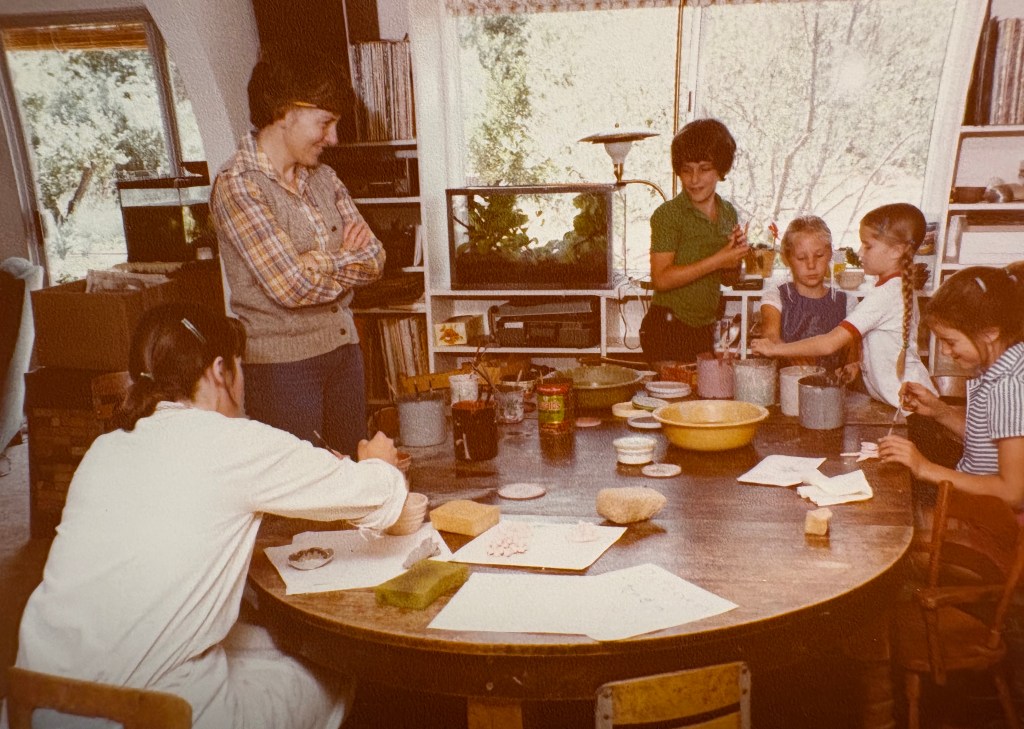
In my 5th grade year, I attended The Higham School, a private garden and arts school Nancy and her husband Bob ran out of their Santa Rosa home, the same home she remains in today. The school was a creative haven for children who gathered every morning to sing songs from The American Songbook and beyond. We learned (alongside reading and writing), pottery, art, puppetry, and mask making by a variety of Sonoma County artists.
We took field trips to the redwoods and the Pacific Coast and made apple cider in an old-fashioned press. Bob decreed that you would not be excused from lunch unless you had eaten the apple you picked off a tree that morning, down to the core. Only the stem and bitter seeds in their casings should remain. In my mind, Bob still looks over my shoulder when I bite into an apple, ensuring nothing goes to waste.
Nancy oversees a class art project, 1982. I am on the right in the striped shirt.
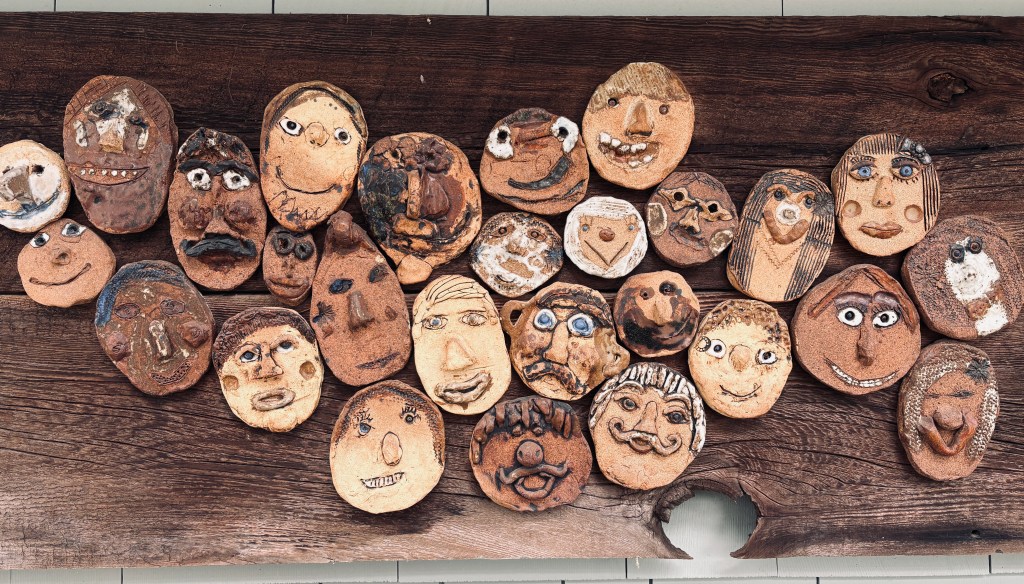
Memories of The Higham Family School can still be found in Nancy’s house today. Clay faces created by students peer out from a wall and Nancy’s library still holds the Beverly Cleary and Shel Silverstein books I once savored. The ancient apple press sits unused in the garage.
Through the years, Nancy’s sharp educator’s mind (she’s a UC Berkeley graduate), sense of humor, and practical nature have provided a steady stream of wisdom and unfussy guidance to me and many other young people. She still participates in a book group with women she has known since college (they call themselves the “Bookies”). Now that I am a teacher (a profession I fell into willingly but unexpectedly), I often find myself thinking “What would Nancy and Bob do?”
It wasn’t just in my childhood that Nancy played an important role. When I was a young professional in San Francisco, Nancy often hosted my fiancé and me for Easter and Thanksgiving. Later, knowing that I was an eight-month pregnant soon- to-be mother missing her own mother, Nancy flew to Indiana and designed and implemented an entire landscaping and garden project for my now husband and myself. My two children only met Nancy and Bob a few times, but loved them and and didn’t want to let go.
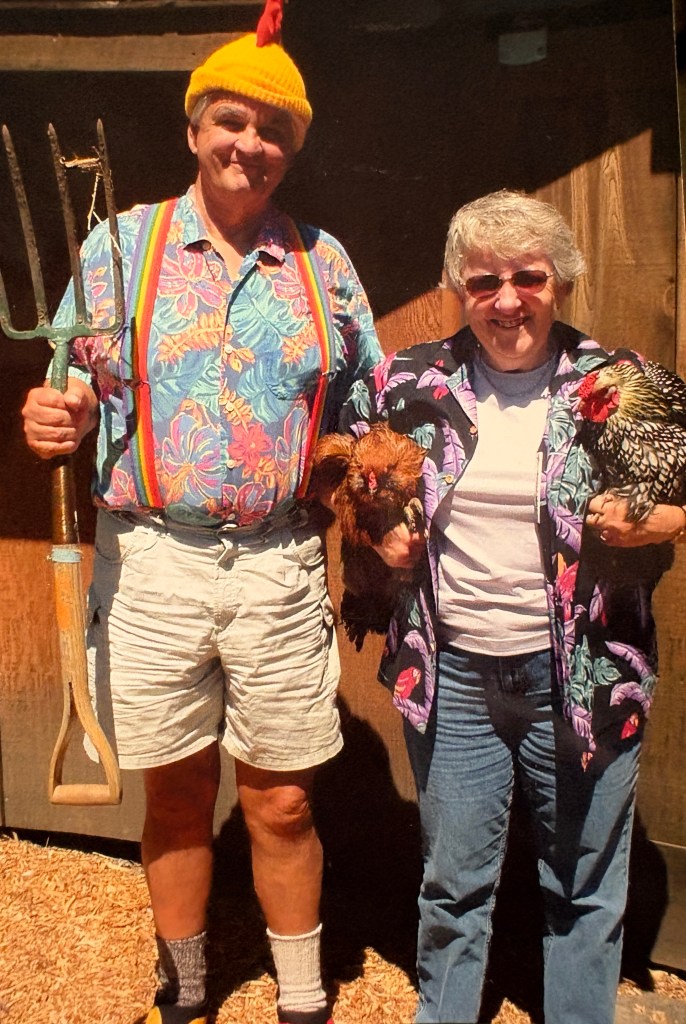
Nancy and Bob Higham, 2004.
The last few years have been difficult for Nancy and Jennifer. Nancy’s beloved husband (and Jennifer’s father), Bob, passed away, joining their son who had died far too young. Bob’s absence leaves a gaping and very quiet hole in the house, and Nancy misses Bob terribly. Health issues have piled on top of both ladies like the manure heap in the back corner of the garden.
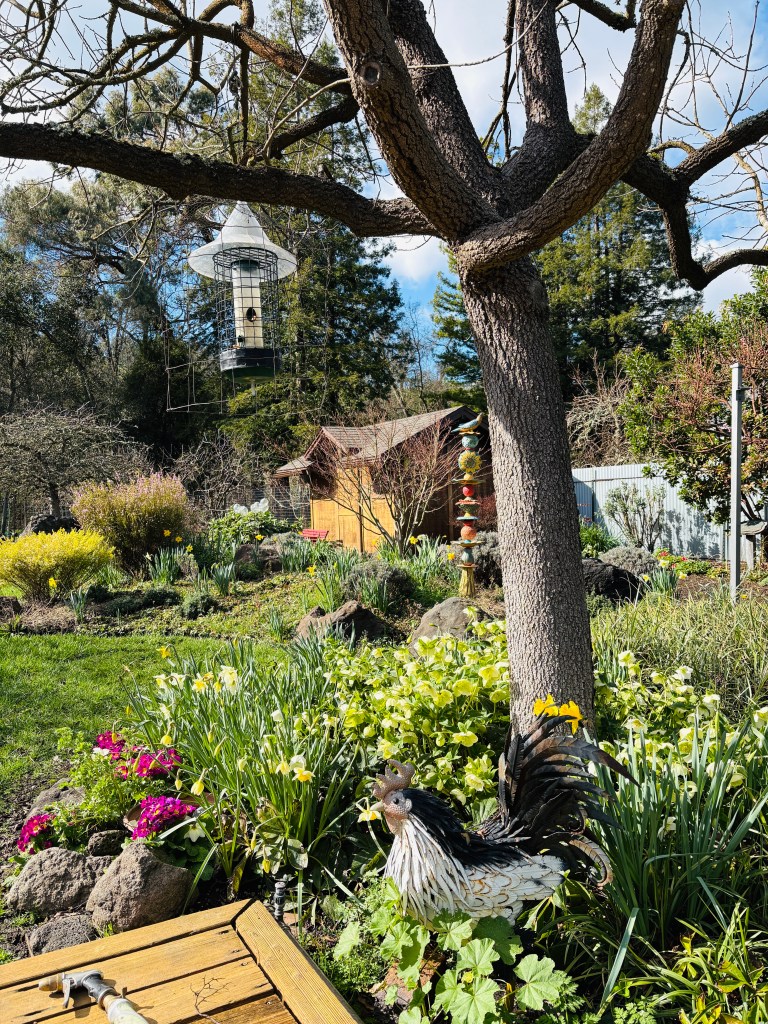
Still, I know no other human who is more fiercely connected to and defined by her home, garden, and surrounding land than Nancy is, and Jennifer has given Nancy the gift of staying in her home, of “aging in place” with exquisite 24-hour caregiving. And even though two terrifyingly destructive fires in recent years have burned many surrounding houses to the ground, Nancy’s still stands. Despite exhaustion and an unknown future, so do mother and daughter.
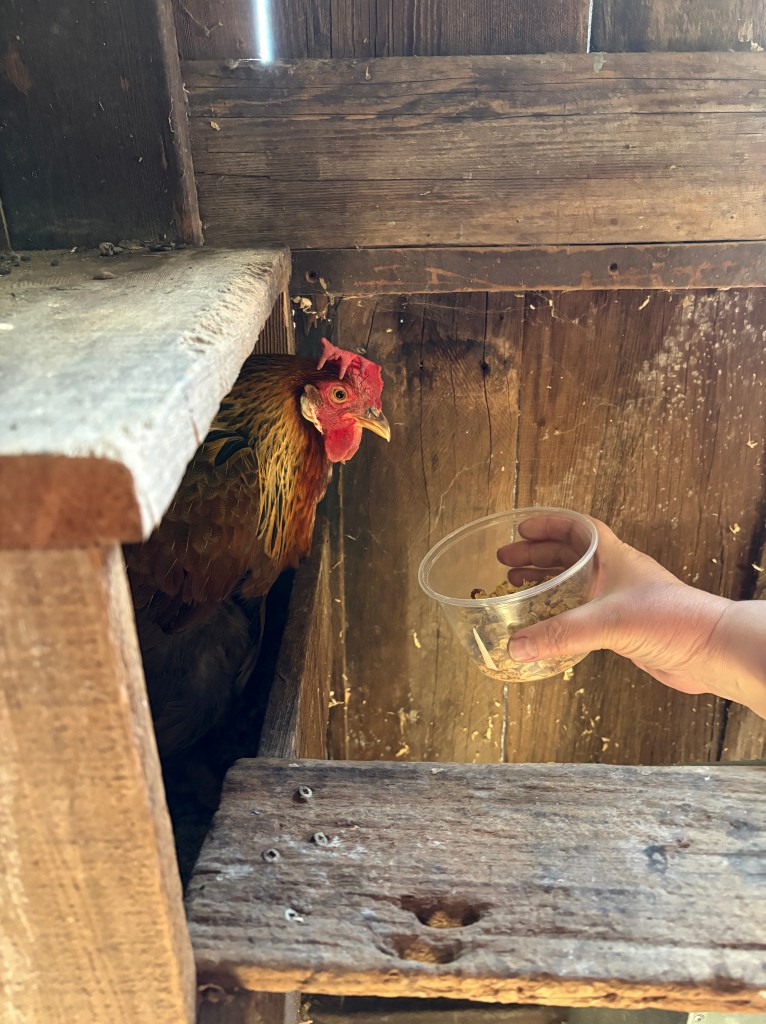
Nancy and Jennifer have learned to cultivate small joys – enjoying fresh and preserved food from the garden, arranging flowers from the beds outside, savoring ice cream and fresh bread from a local bakery, watching home improvement shows, reading out loud, and tending to their pet (the only remaining chicken from the once robust flock in the garden), an 11-year-old miracle chicken named Sweet Pea who prefers her granola handfed. This year, Nancy and Jen decided that they enjoyed the lights of the Christmas tree so much it would stay up into February.
Sweet Pea enjoys lunch.
True love can be hard to find in our world today. We wonder whether love is genuine, if there is an agenda, and if it will disappear tomorrow. Spending those days in Nancy’s house, sitting quietly and holding her hand, watching Jennifer’s patient caregiving, I was shown how Nancy’s love and guidance have impacted my life.
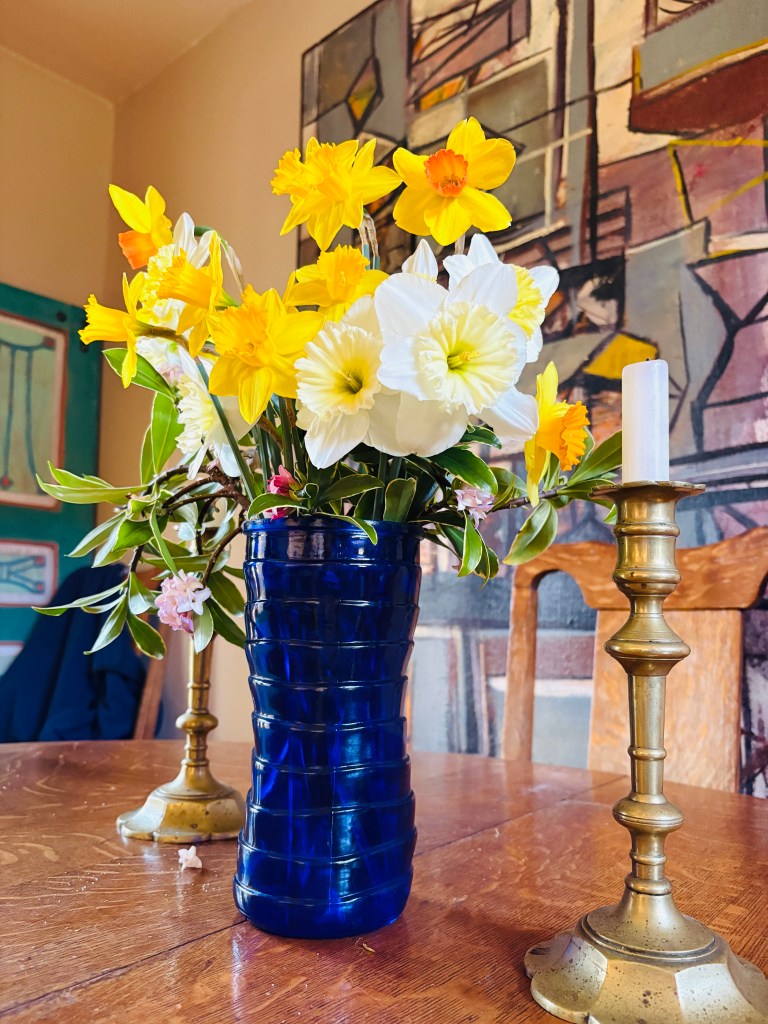
Arrangement of daffodils picked from Nancy’s garden.
I saw that no health challenge, no passing of time, no fire or painful loss can cancel the knowledge and devotion shared by family, or family of choice.
Inside a home that housed a school, the place that helped shape so many young hearts and minds, a woman shares her final chapter with her daughter. What I experienced during my four-day visit refreshed my belief in the power of presence and devotion.
May we all know such an enduring impact, such true love.
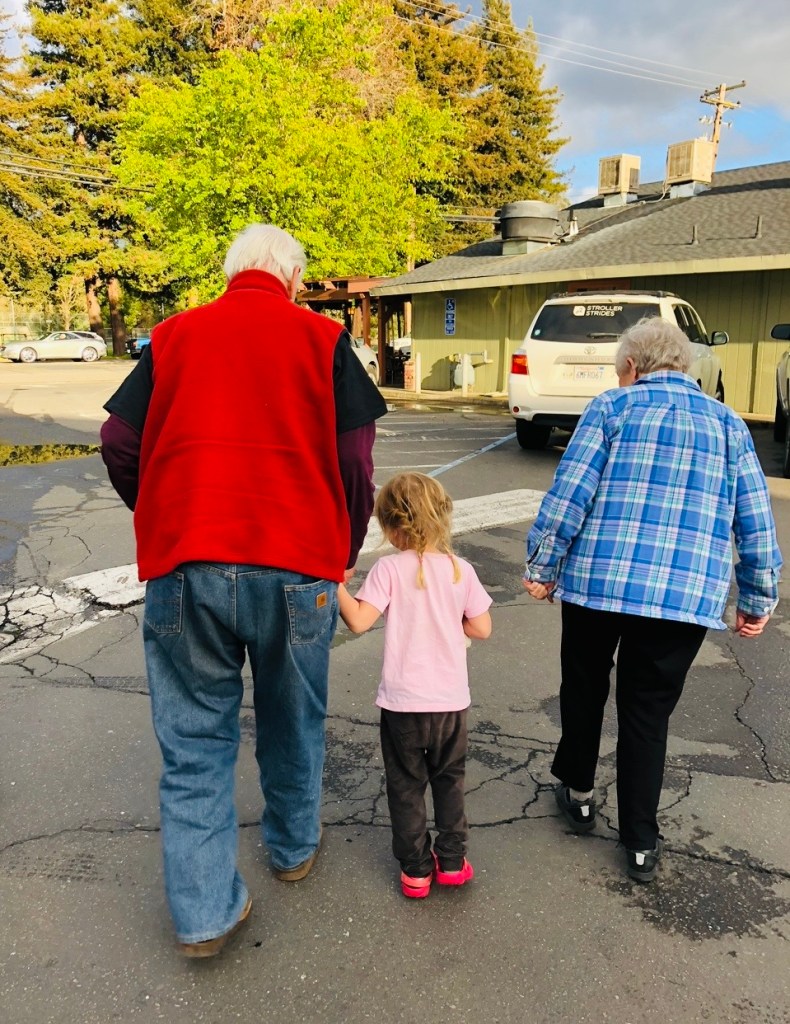
Bob and Nancy, walking into the future with my daughter.
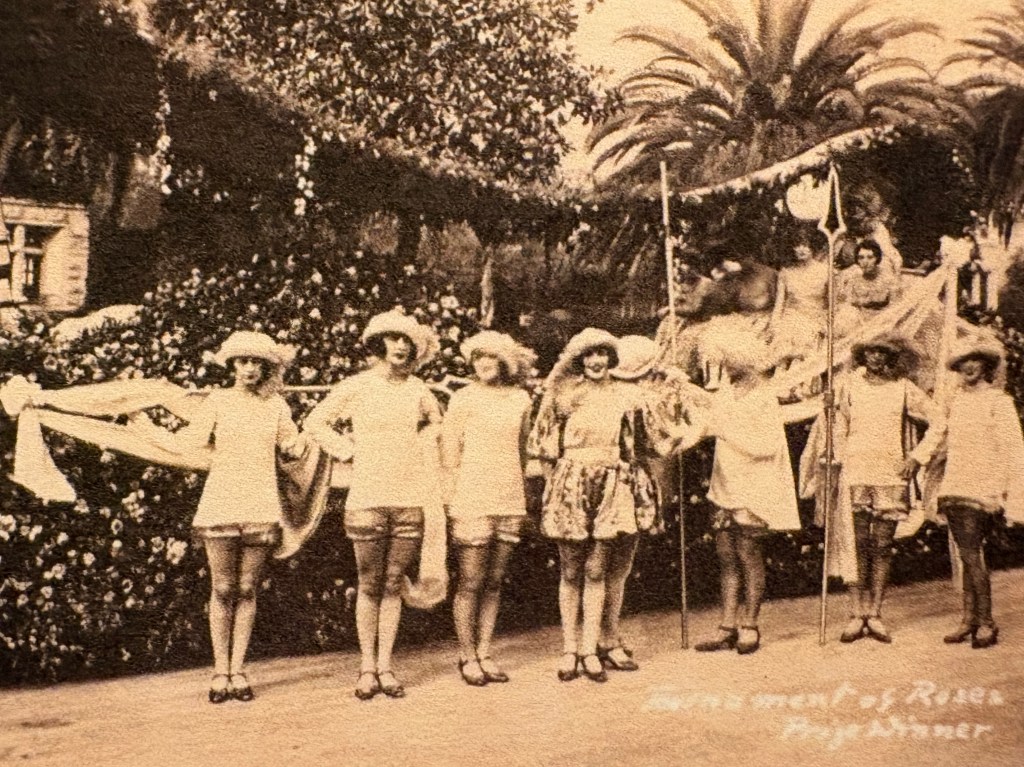
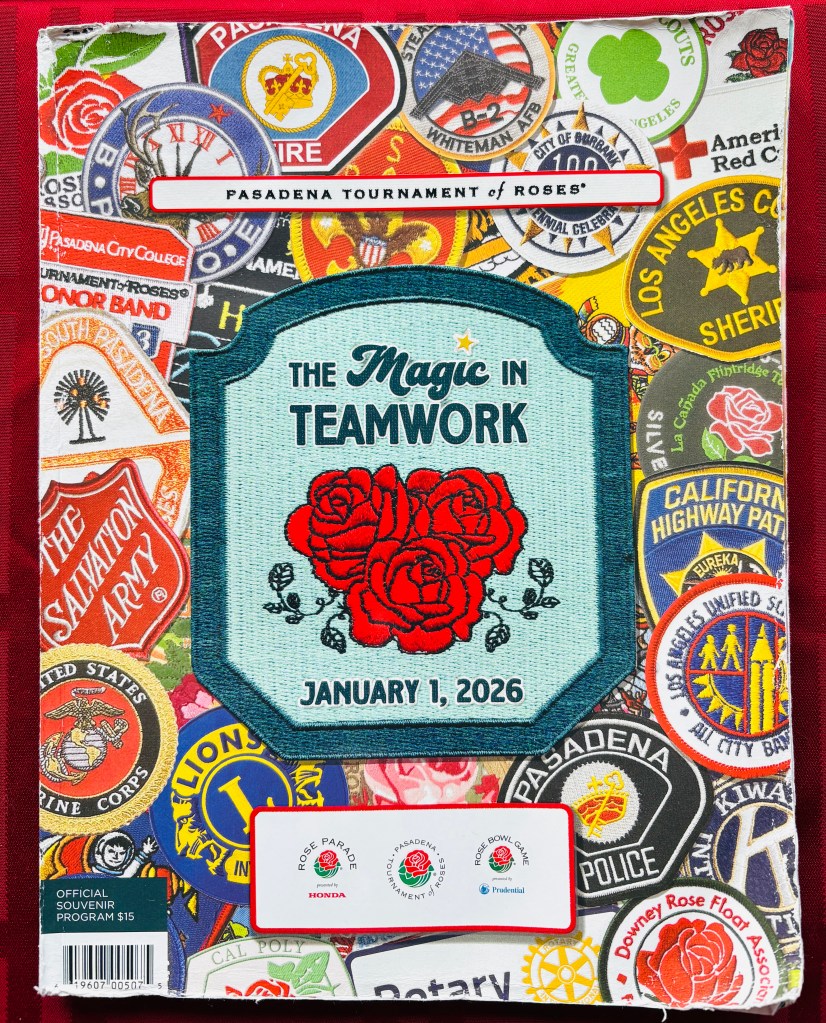
1926 Tournament of Roses “Prizewinners” pose, 50 and 100 years before our story takes place
Pasadena, California, January 1, 1986, 5:15 AM:
I wake to the sound of my dad’s voice—hushed and gravely. “Kiddo, time to get up. We’ve got to get out there early so we can get seats. Melba has some cereal for you in the kitchen.”
Sleeping on the polished wood floor of my grandparents’ tidy Pasadena bungalow hasn’t exactly made for a restful night. Slowly, I roll over and open my eyes to the darkness of the living room. As I wiggle out of my sleeping bag, I remind myself that there’s a lot to look forward to. Today is the first day of 1986! I’m turning 15 in a few months! I get to watch the Rose Parade in person! And unlike my chilly, often rainy-in-the-winter hometown in Northern California, today will be sunny and warm. This is LA, after all. I head to the kitchen to eat Wheaties with my dynamic, turquoise-collecting, organ-playing step-grandmother, Melba.
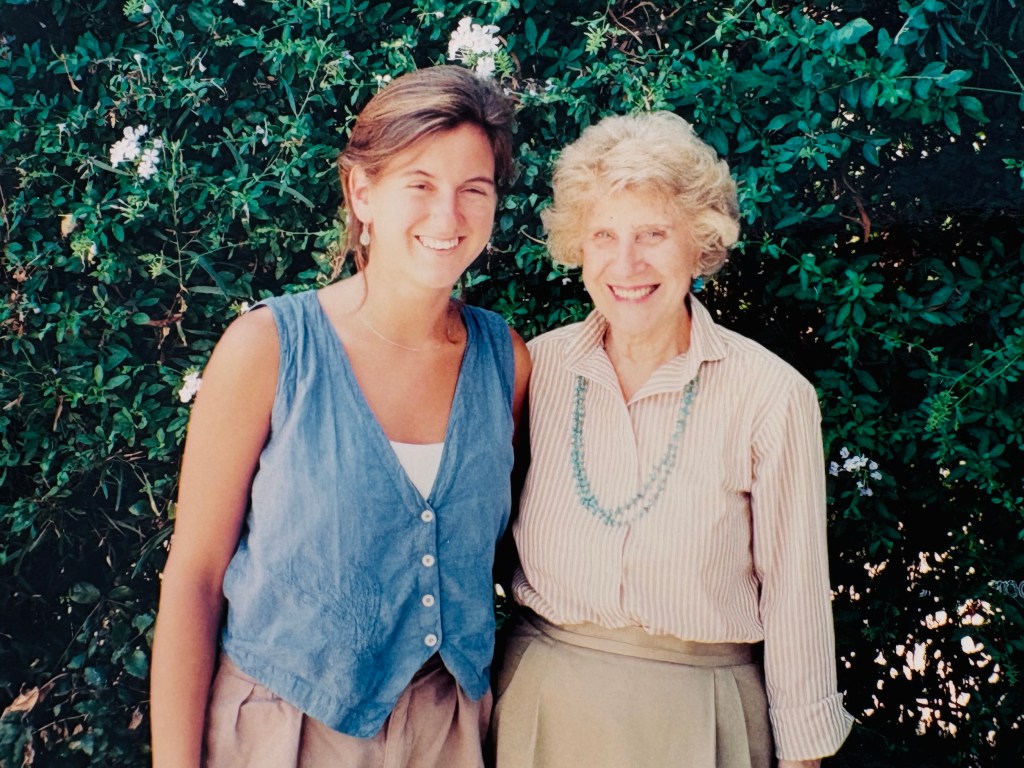
Me and Melba (a few years later, in 1995)
Pasadena, California, January 1, 2026, 5:15 AM:
A few seconds after swiping the bar to silence my cell phone alarm, I roll over and gently nudge my 12-year-old daughter’s shoulder. “Time to wake up, Bunny…it’s the first day of 2026! Dad’s got a blueberry muffin for you in the kitchen.” Groaning, she shakes off my hand. She’s not easy to wake up on the best of days, but this morning I fear that the combination of the 3-hour change from our Midwest home, plus an ungodly wake-up time, might make it impossible. The driving rain outside doesn’t help either. Not fair, we’re in LA!
To claim our prepaid parking spot for the Rose Parade, we must arrive by 6 AM. The sun won’t rise for hours over the spacious modern house we are staying in—a house belonging to good friends who are out of town. And thanks to the unusually heavy rain sweeping across the Los Angeles basin, we won’t feel the sun on our skin for almost the entire day. With the promise of an early visit to Starbucks, our daughter finally rises. Blurry-eyed, mostly silent, yet eager to experience the parade. She refuses the muffin.
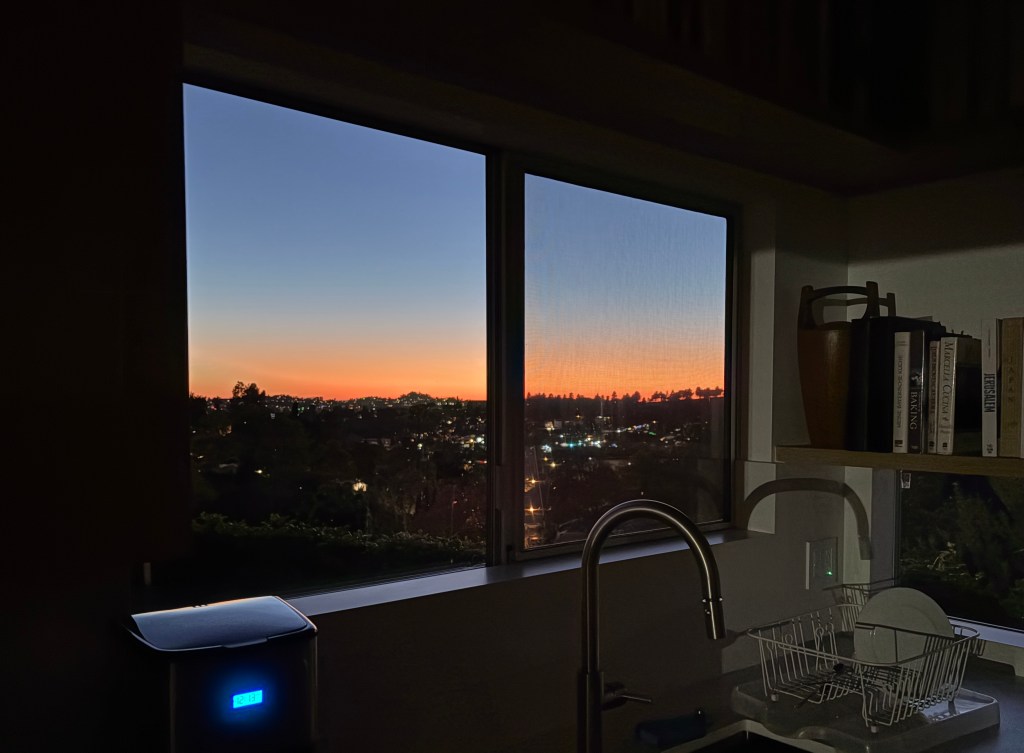
Los Angeles sunset as seen from the modern house’s kitchen
1986, 6:30 AM:
After piling into our blue Honda Accord, my dad steers the three of us (Mom, Dad, and me) the few miles from my grandparents’ house on Arden Drive to Colorado Street in downtown Pasadena. We are meeting our family friends, Kathy and Phil, at the parade. I am particularly fond of Kathy and Phil. The two of them live (child-free) in a house on a steep hillside above the Russian River, where banana slugs leave thin gossamer trails. However, they also once lived out of a school bus full of intricately handmade wooden cabinetry stocked with Mexican beads that was parked in our driveway for a month.
Kathy Toomire, 1982
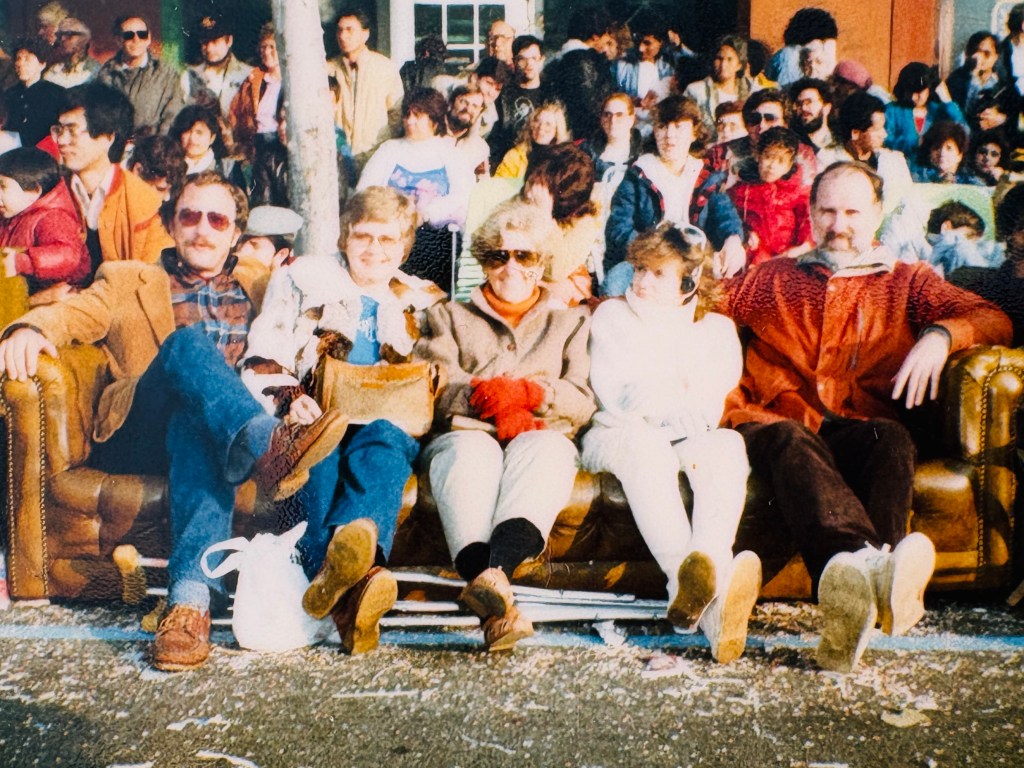
It’s early enough that we easily find a parking space, but incredibly, many of the prime viewing spots along the parade route have already been claimed. My parents good-naturedly refuse to pay for “overpriced bleacher seats.” As our group stands on the curb discussing what to do, a truck suddenly pulls up next to us, and a burly guy leans out of the driver’s side window. “Hey, we got couches for rent,” he yells. “We’ll drop it off on the street right here and pick it up at the end of the parade. Thirty bucks!” The grownups look at each other, unsure about the offer. I quickly pipe up, “Oh please please please, that’ll be so fun!” Everyone agrees, and the five of us soon find ourselves sitting thigh-to-thigh on a fake leather couch, unexpectedly granted a rather cushy front-row seat to the 1986 Tournament of Roses Parade.
Seated on our parade-viewing couch, from left: Phil, Kathy, Mom Patricia, me, Dad David
2026, 6:30 AM:
“Two hot chai lattes with oat milk, one hot cocoa, and a croissant, please.” As one of the few cars in line, we quickly move along the Starbucks drive-through and are soon pulling into our assigned parking space, right on time. Our (uncovered) bleacher seats are only two blocks away, and the parade starts at 8. There’s only one hiccup—it’s raining. Hard.
We are prepared. The day prior, after trying four separate stores, we were finally able to purchase plastic rain ponchos (never mind that we now appear to be huge LA Rams fans). We are also equipped with plastic garbage bags to sit on, snacks, and a change of clothes. My husband, who is attending the Rose Bowl football game after the parade, has his own see-through bag packed complete with regulation-sized water bottles and a towel. We waive off the friendly lady weaving through the nearly flooded parking lot, offering Rose Parade seat cushions for $20 each.
Sitting in the dark, we listen to the rain drum on the car windows and sip our warm drinks. Our breath builds steam as we stretch out with the ease of the early hour. I’m grateful to share this cozy time with my daughter and husband. These quiet moments with our girl are fleeting—she’ll turn into a teenager this year. I can feel her consciously shaping her own identity apart from us, no longer attached to my hip or sharing every detail of her life with me the way she once did. She got her first phone for Christmas this year. Turning to ask her something, I see that she’s stretched out across the backseat, her head resting on a rolled-up sweatshirt, sleeping soundly.
1986, 8:00 AM:
The Pasadena City College band marches by, mere inches from our crossed ankles, the blaring horns and drums making my head throb. “Did I ever tell you I went to Pasadena City College before I went to Principia?” asks my Dad. I roll my eyes (a common occurrence), “Yes, Dad, many times. I know you played baseball for them, too.”
He clears his throat, then his thoughtful gaze shifts to mine. “What would you think about taking the Honda over to the Rose Bowl parking lot tomorrow? If it’s not too crowded, you could practice the stick shift a bit.” My eyes grow wide. “Really?” I ask incredulously, even though I know he wouldn’t ask if he didn’t mean it. My dad never goes back on his word.
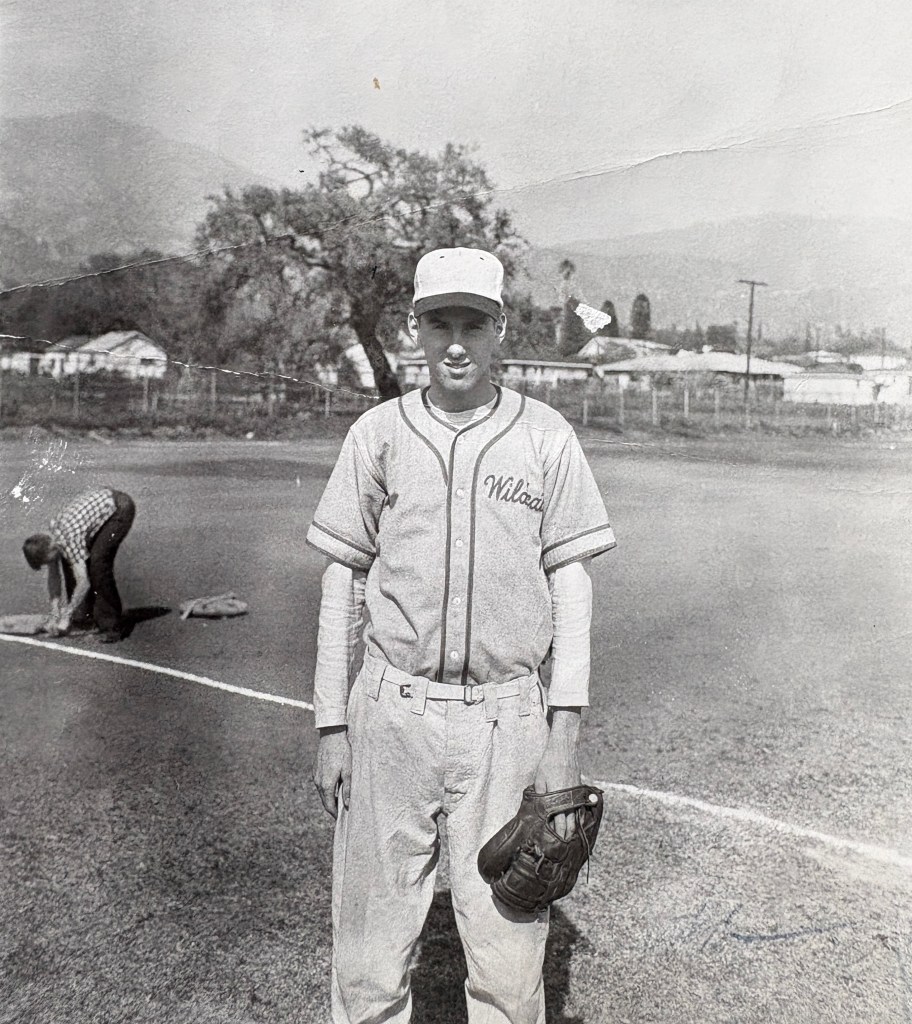
My father the pitcher, Monrovia, CA 1956. His greatest claim to fame was not his sucessful career as a journalist, it was the time he once pitched a no-hitter.
This Grand Marshal of this year’s 133rd Rose Parade is Mickey Mouse, tying in perfectly with the theme: A Celebration of Laughter. I’ve been to Disneyland once, when I was three, but not since. My dad is a freelance writer, and our vacations are almost always centered around visiting family or camping. I know better than to ask for a trip to Disney—there isn’t a budget for that.
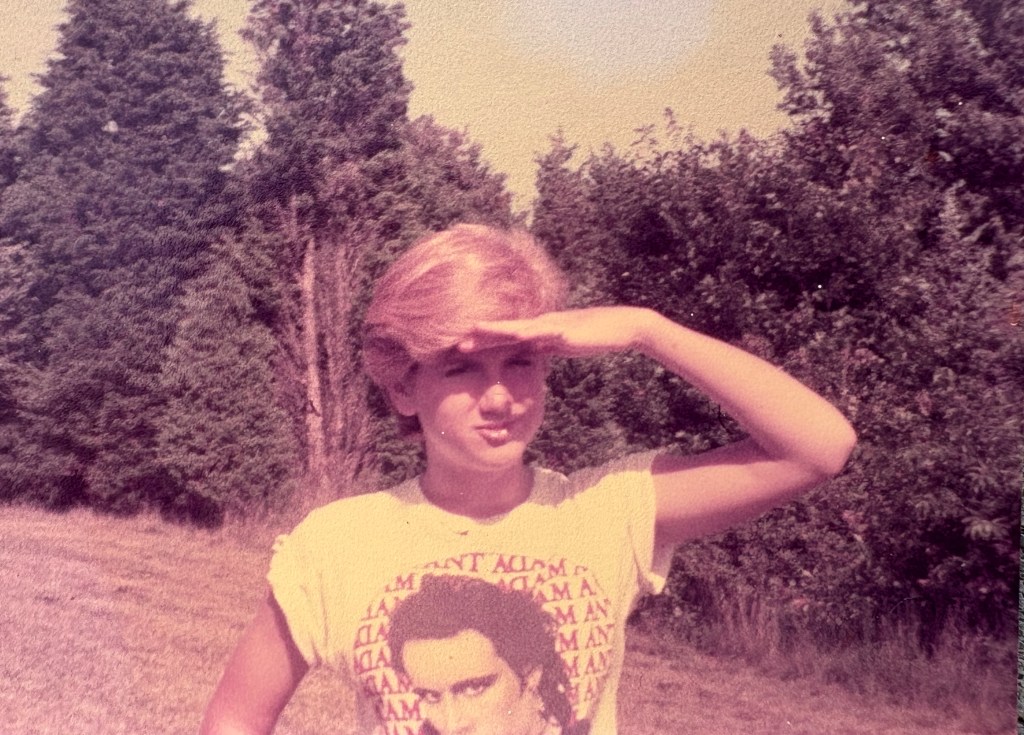
Mom, Dad, Kathy, and Phil point out the flower-covered floats, plentiful prancing horses, and celebrities. The sun is out and beginning to warm the excited parade crowd. After a while, I lean against my mom, close my eyes, and turn up the volume on my Walkman. The parade is entertaining, but I’m tired. I’ve never been much of a morning person. Right now, I’d rather be at home, calling my friends on the phone and listening to Adam Ant.
Adam Ant fan, 1984
2026, 8:00 AM:
Still in the car, we’ve been waiting for a break in the rain, but it hasn’t arrived yet. Parade start-time is approaching, so we pull on our ponchos, ready our bags, and step out into the downpour. At least it’s daylight now. Suddenly the festive atmosphere surrounds us. I get the sense that this is about as friendly a scene as you’ll find in Southern California.
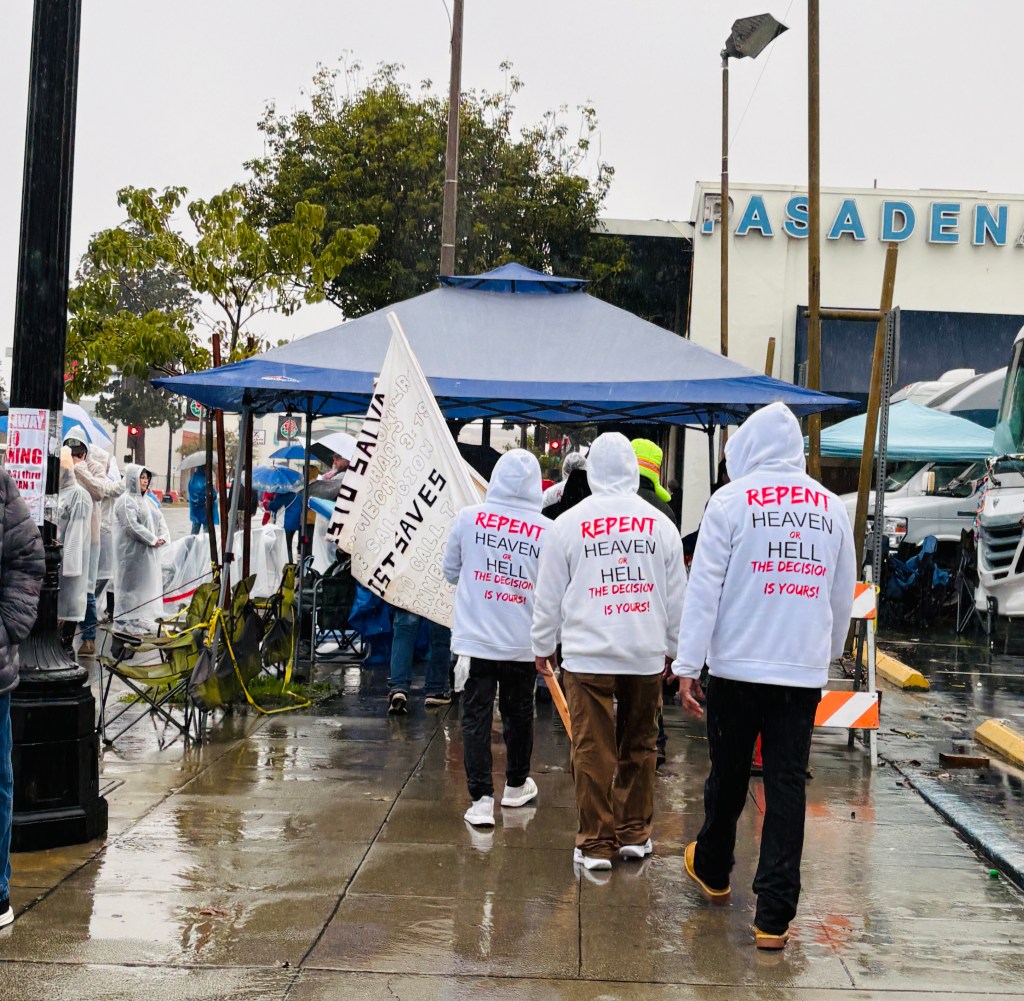
We walk the two blocks to our assigned bleacher seats, avoiding puddles and trailing behind a group of young Latino men yelling into a microphone about the importance of fearing Jesus (what would the all-loving Jesus say about that advice, I can’t help but wonder).
Above us, a large squawking flock of Pasadena parrots flies by, a welcome distraction from the rain. This flock is much higher in number than the flock that used to fly above our San Francisco cottage.
Look closely to see the parrott fly-by
We’re up in the 20th row of metal bleachers ($336 for three seats, parking, and one program). The garbage bags we brought have come in handy, and we place them across the soaked seat. Behind us, a young girl is on the lookout for her dad, who plays the clarinet in one of the marching bands. Directly in front of us is a couple sharing our love for the Indiana Hoosiers, playing in the Rose Bowl football game in just a few hours for the first time since 1968. How wonderfully strange it is to travel across the country only to be surrounded by people connected to our own Midwest hometown and team.
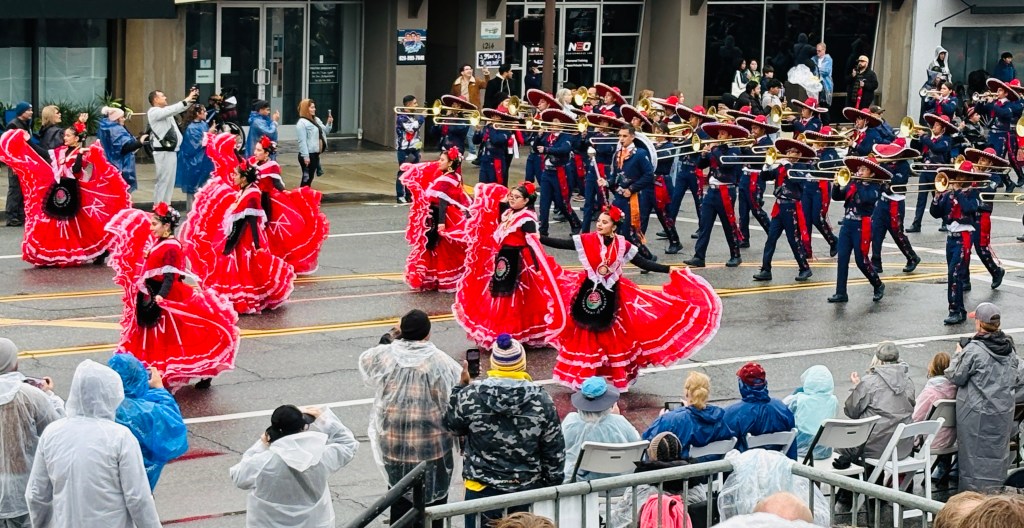
Around us, the damp crowd stirs as the first rose-bedecked motorcycles cruise by. The 137th Rose Parade is starting! One clever, vibrant float after another sails by, horses of every breed and color (from the Budweiser Clydesdales to mini therapy horses from Calabasas) and the most impressive, inspiring marching bands we’ve ever seen in a parade.
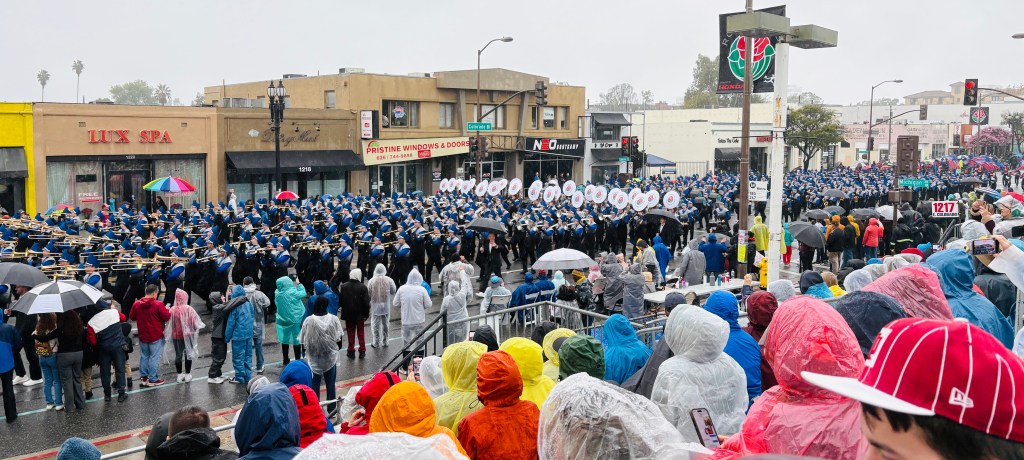
One band, the Allen Eagle Escadrilles from Allen, TX, includes so many members (600) that they create a royal blue sea stretching down the road as far as the eye can see.
The Allan Eagle Escadrilles from Allen, TX take over Colorado Street
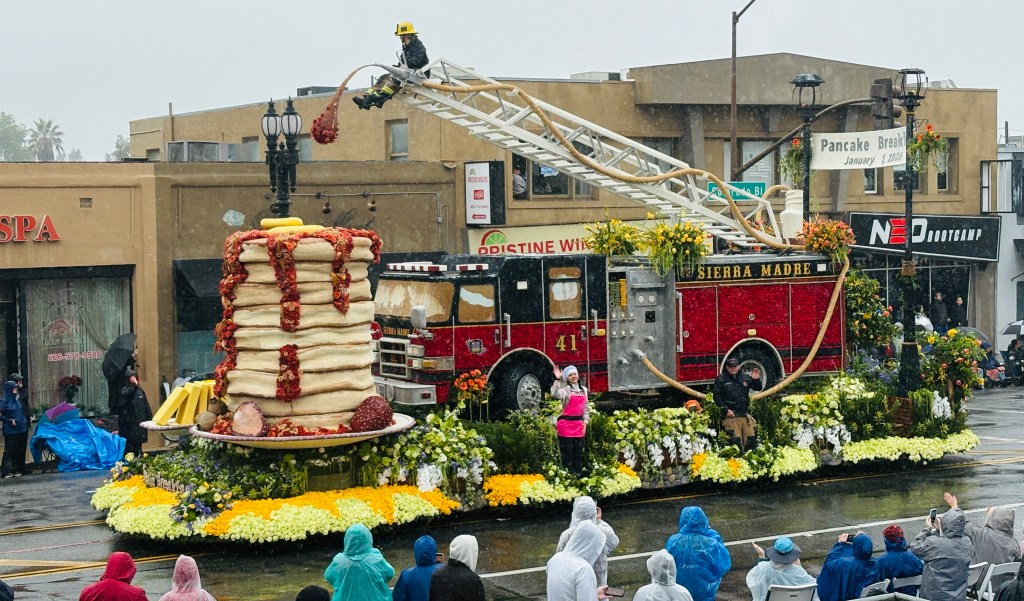
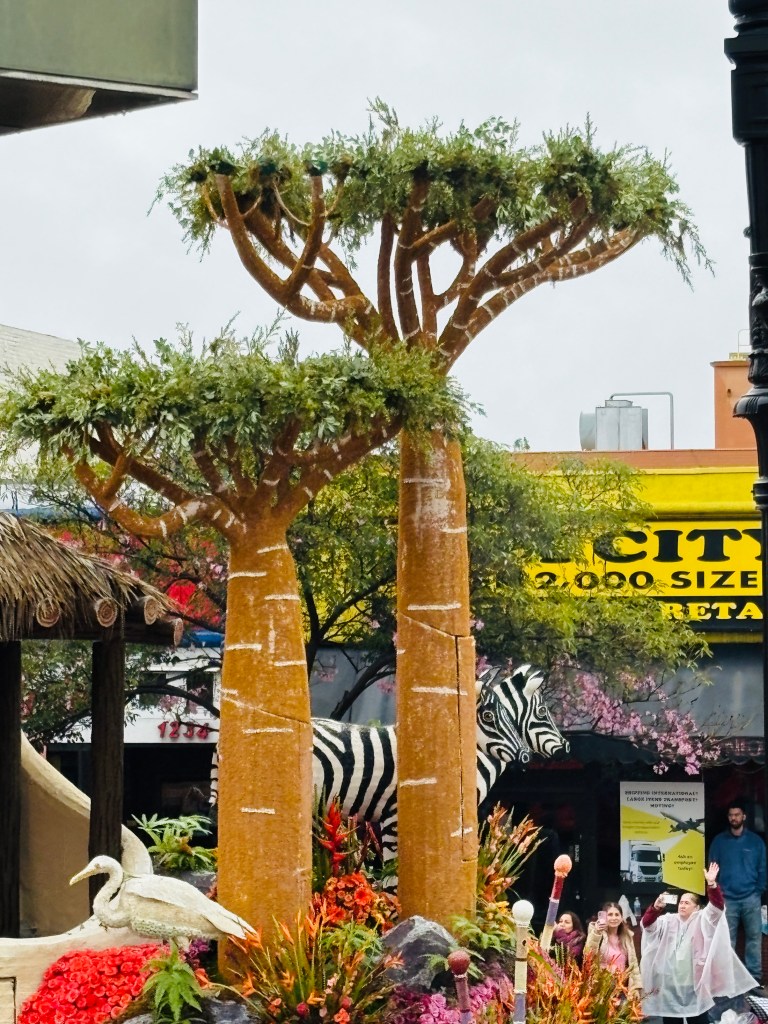
My daughter is particularly impressed by the perpetually waving lovely 2026 Rose Court, the elephants on the San Diego Zoo Safari Park (announcing the park’s new Elephant Valley attraction), and the stack of hot syrupy pancakes featured on the City of Sierra Madre float.
City of Sierra Madre float
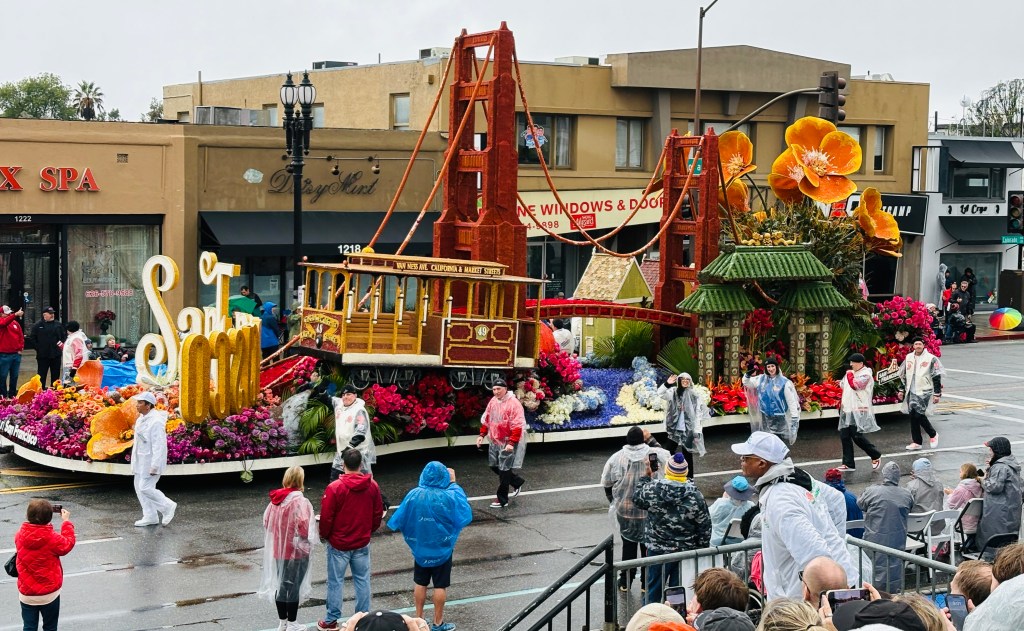
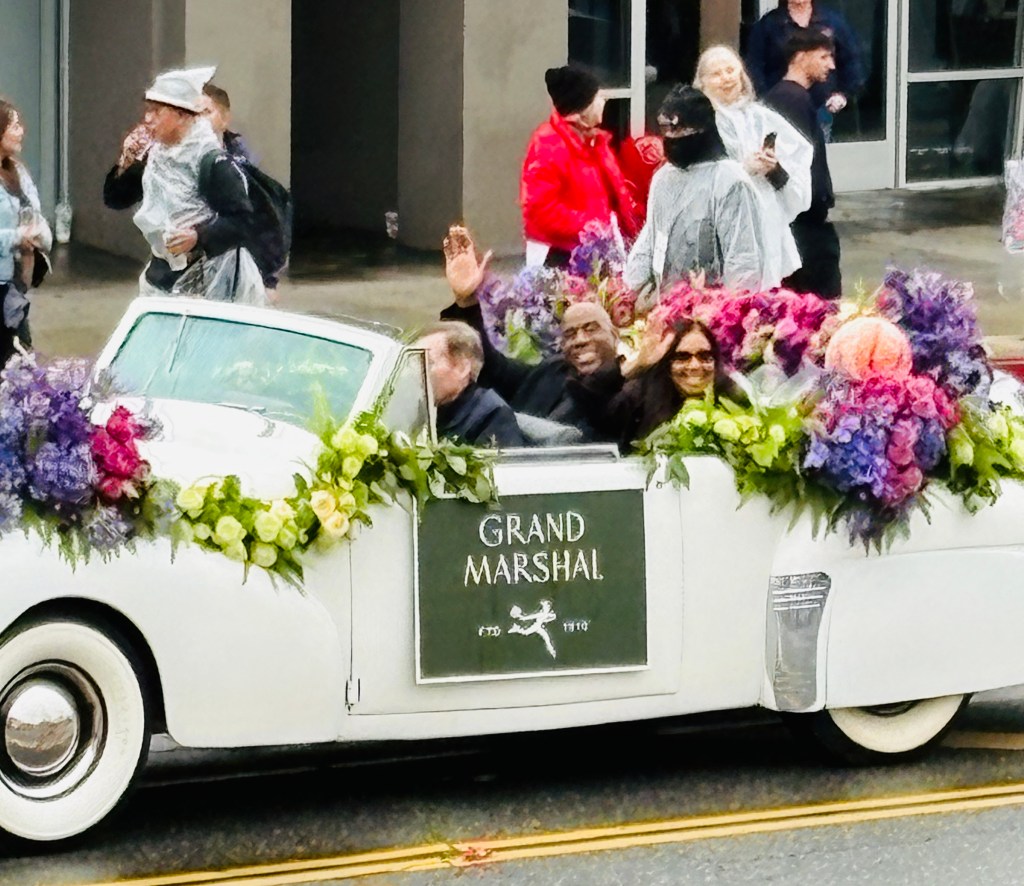
My husband and I enjoy the gorgeous City of San Francisco float (our former hometown), the Star Trek 60 “Space for Everybody” float featuring a grinning George Takei and Tig Notaro, Apple TV+’s Shrinking float (one of our favorite shows, shot in Pasadena—where are Harrison Ford and Jason Segal and Jessica Williams??), and a glimpse of the great Earvin “Magic” Johnson, the 2026 Pasadena Tournament of Roses Grand Marshal, still going strong at 66 years old.
City of San Francisco float Impressive Baobab trees on the San Diego Zoo Wildlife Alliance float Delfines Marching Band from Xalapa, Veracruz, MexicoParade Marshal Earvin “Magic” Johnson, basketball legend. His hand is the right size for effective waving.
Through the rain, the brave parade participants wave, drive, clop, and march. Under her poncho, my daughter texts her friend, “Can’t talk now, I’m at the Rose Parade.”
1986, Noon:
Walking up the low concrete steps leading into my grandparents’ home, the five of us feel hungry, tired, and overstimulated. My step-grandmother Melba has made us soup and sandwiches, and we eat together in her immaculate kitchen, bright Los Angeles sunshine reflecting off the yellow walls. Phil regales us with stories of his wayward youth in San Diego. Across the room, my towering Swedish Grandfather winks at me, his kind blue eyes crinkling at the corners.
Afterward, collapsing on yet another couch, I lean heavily against my mom. I might be fourteen, but in many ways I’m still her little girl.
2026, Noon:
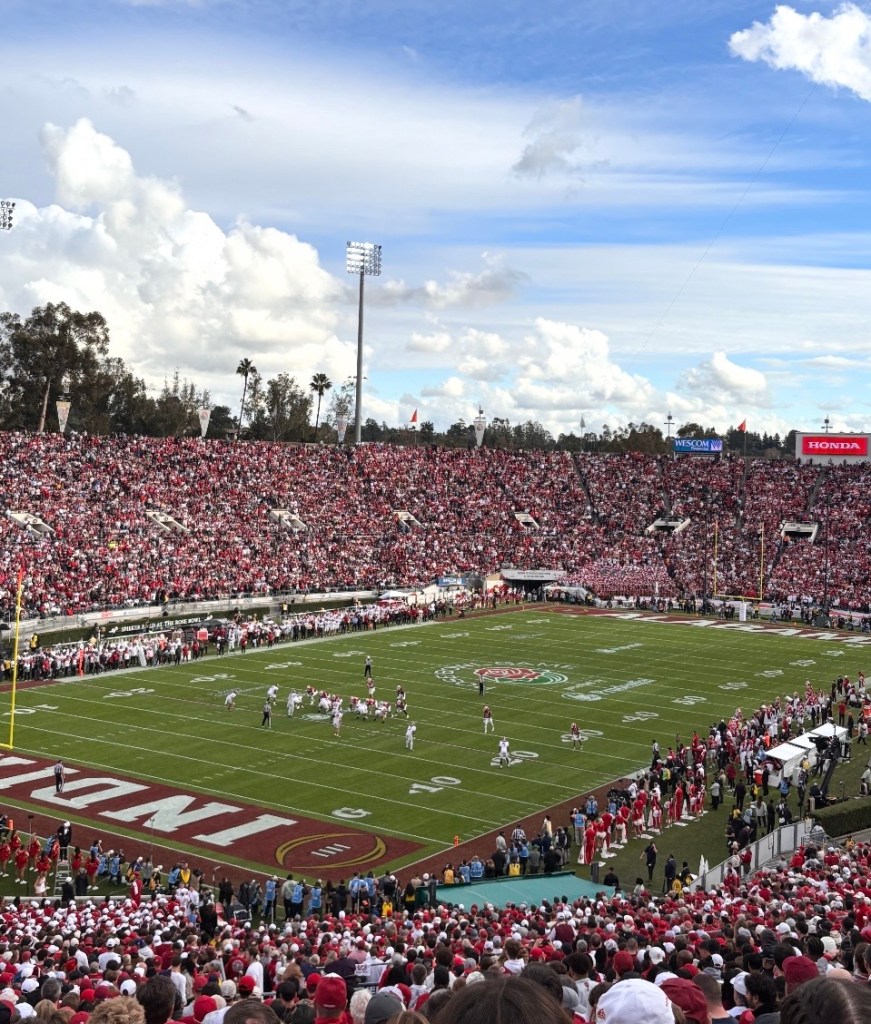
The parade has ended, and for the most part, so has the rain. Walking carefully down the bleachers, we make our way to the street, where we part ways with my husband. Father and daughter hug tightly, and we tell him to enjoy an experience he has been dreaming about since he was a child, his Indiana University team playing in the Rose Bowl. (Not exactly a) spoiler alert—they won.
The Indiana Hoosiers’s second appearance at the Rose Bowl since 1967 Photo Credit: Tom Stryker
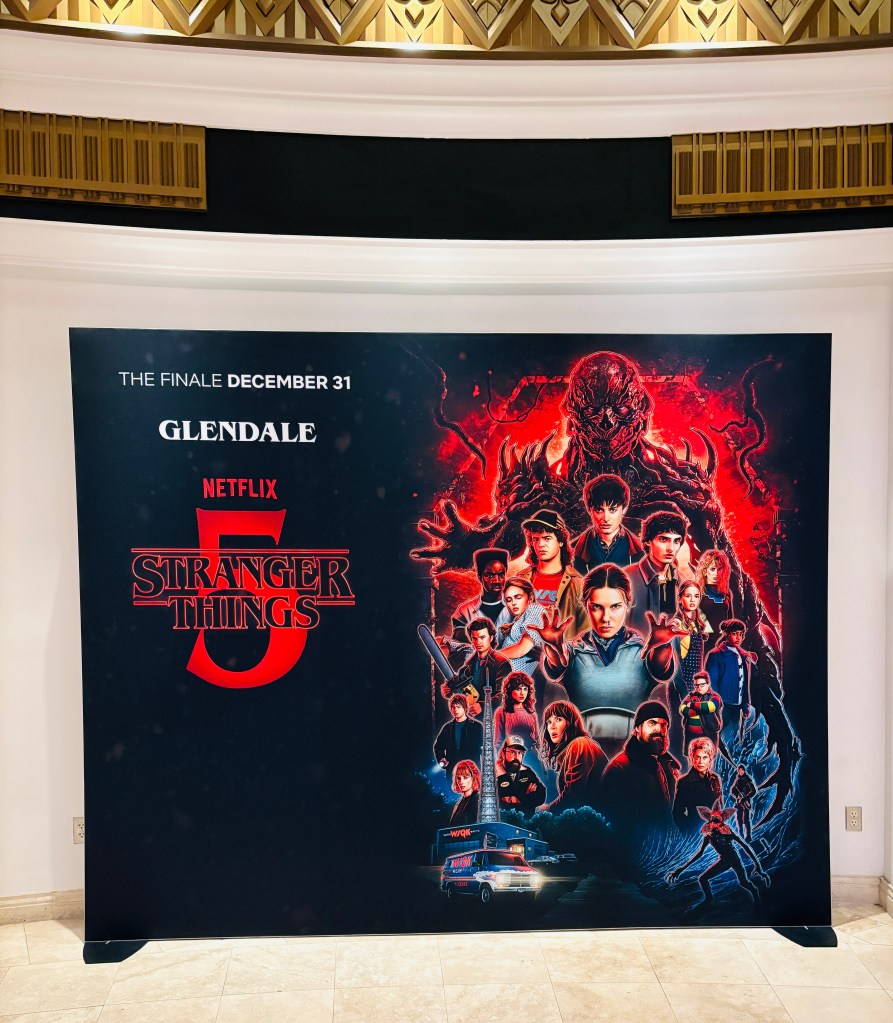
Weaving through the parade stragglers, we head in the direction of our car. The two of us are hungry, tired, and overstimulated. While her dad walks down Colorado to catch the shuttle to the Alabama vs Indiana Rose Bowl Football game, my daughter and I head to Glendale where we have tickets to see the final episode of Stranger Things on the big screen.
A few hours later, reacting with emotion to her favorite character’s shocking demise, my daughter leans heavily against me in the dark theatre. She might be twelve, but in many ways she’s still my little girl.
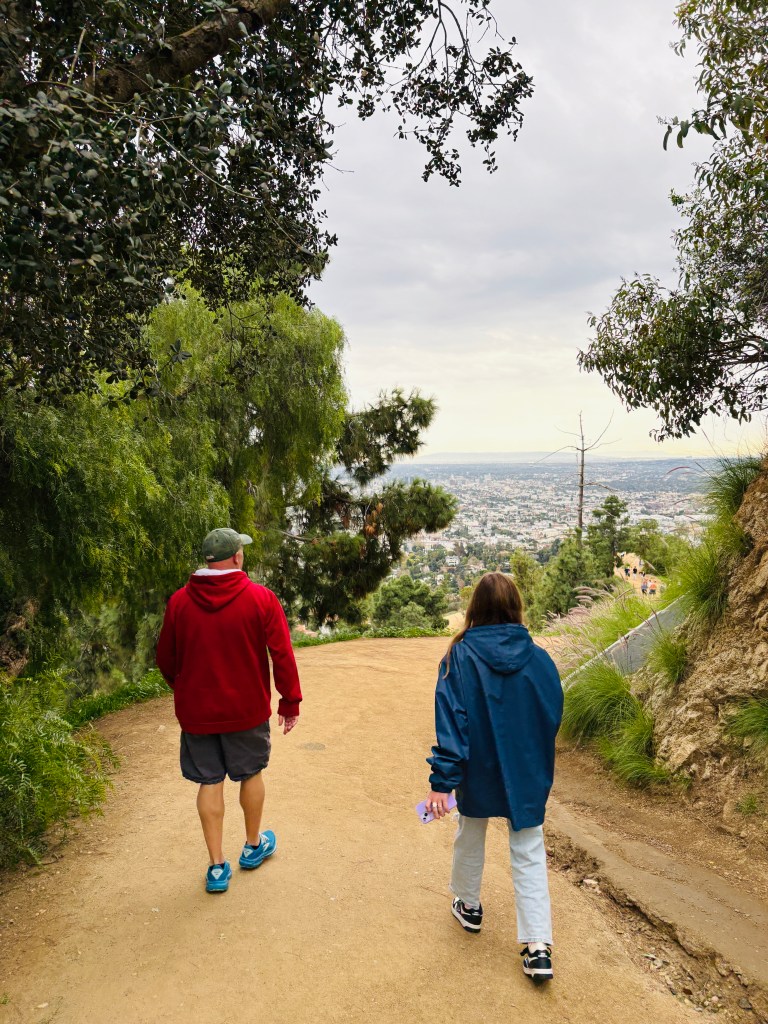
Daughter and Dad explore Griffith Park, December 30, 2025
Thanks for the memories California, you know how to throw a parade, no matter what year it is. We’ll be back soon. Hopefully the sun will be out.
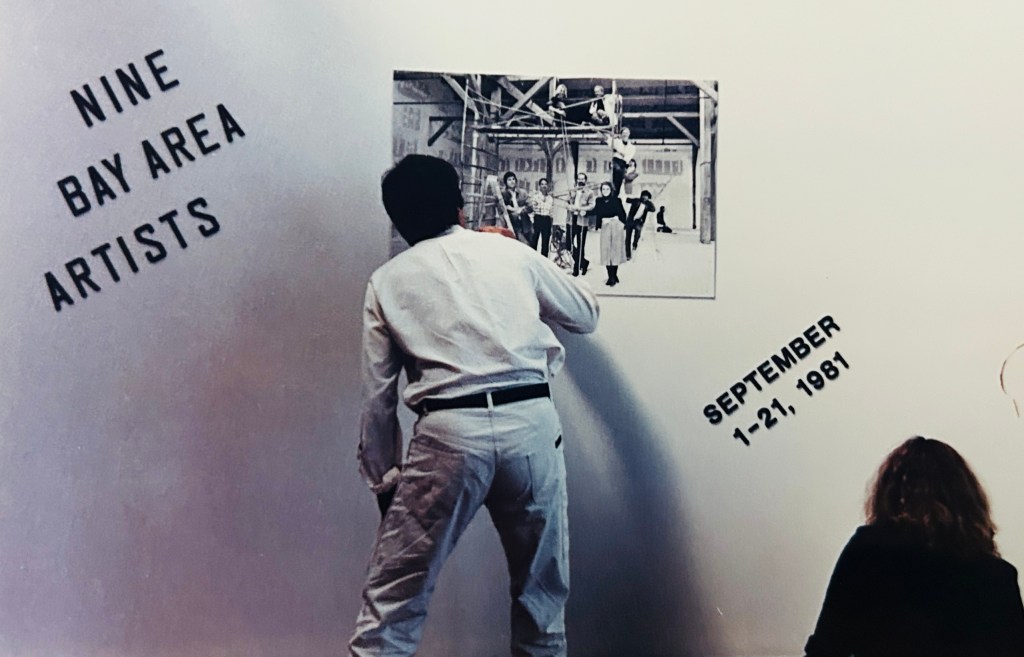
The time: Tuesday, September 1, 1981. Late afternoon.
The place: An art gallery in the South of Market neighborhood, San Francisco, California.
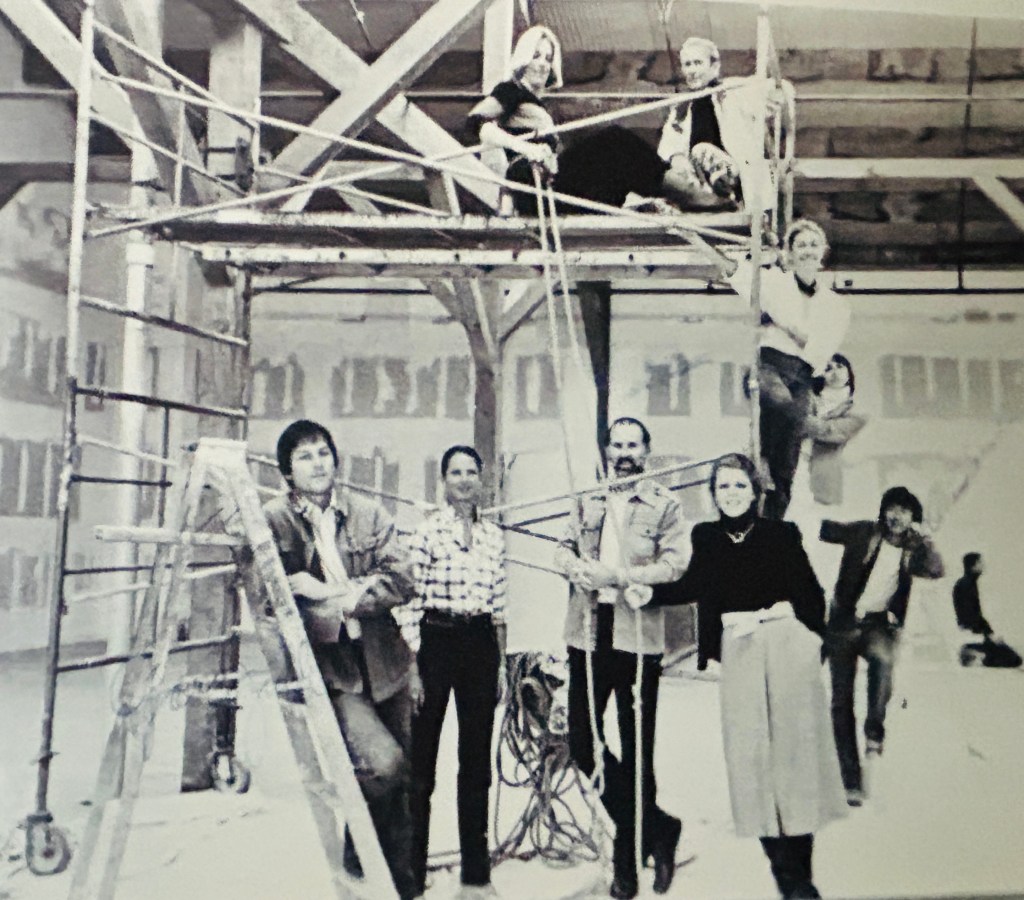
Some of the artists, dressed mostly in black, are huddled together, looking out a window. I can tell something is wrong. Wandering a little closer, I try to listen to their conversation while pretending I’m looking at a large blurry painting of a blue car (at least I think it’s a car).
The nine artists featured in the show.
“Look at him smoking pot out there on the street corner … he won’t come up here,” I hear Jill Coldiron say. “I mean, he doesn’t like his placement, but I don’t know why he’d sabotage himself this way during the reception.”
I head over to the food table to grab some more grapes and that yummy, crusty sourdough bread. I have no idea what Jill is talking about, but I do know that if anyone can solve a problem, she can.
Jill is the organizer of this art opening and a good friend of my parents. I like being around her because she’s smart, loud, and funny. Sometimes my mom and I drive south across the Golden Gate Bridge and into San Francisco to have lunch downtown with Jill—I love doing that. She and my mom laugh so hard when they’re together it makes my ears ring. When Jill invited my dad to be in this group art show he yelled to my mom from the other room “Good news Patrish … Jill wants my cars in the San Francisco show!”
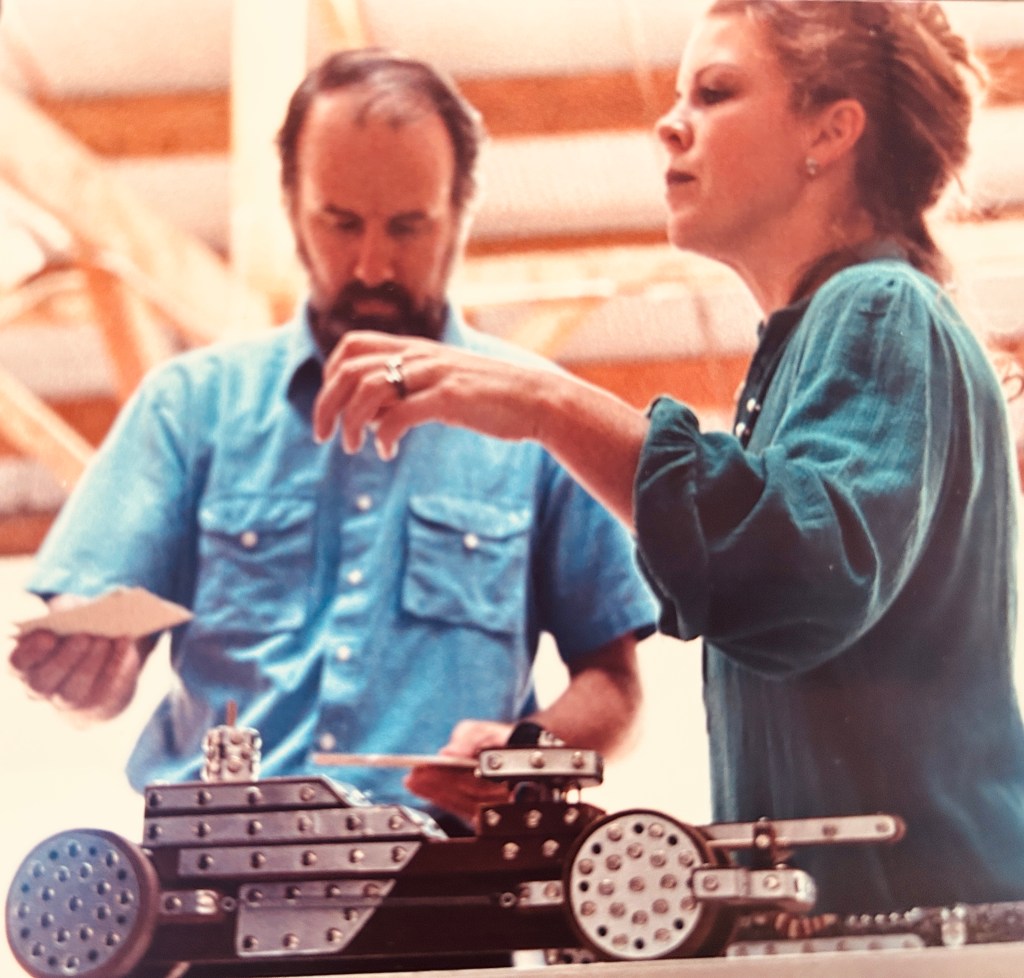
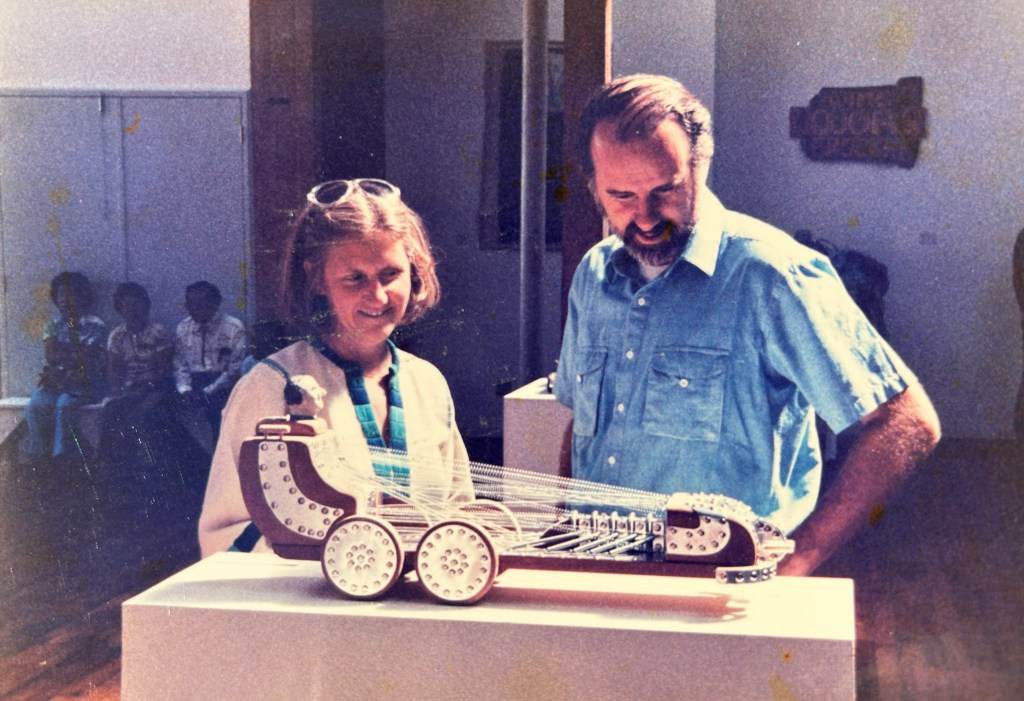
Curator Jill and my artist father discuss arrangement of his cars in the show.
The warehouse gallery is full of bright light, and the high ceiling is echoey with the sounds of clinking glass, people talking, and live music played by some nice musicians in the corner.
I’m the only ten-year-old here, something I’m pretty used to since I’m an only child. I don’t mind because I’m good at secretly spying on adults, just like Harriet the Spy.
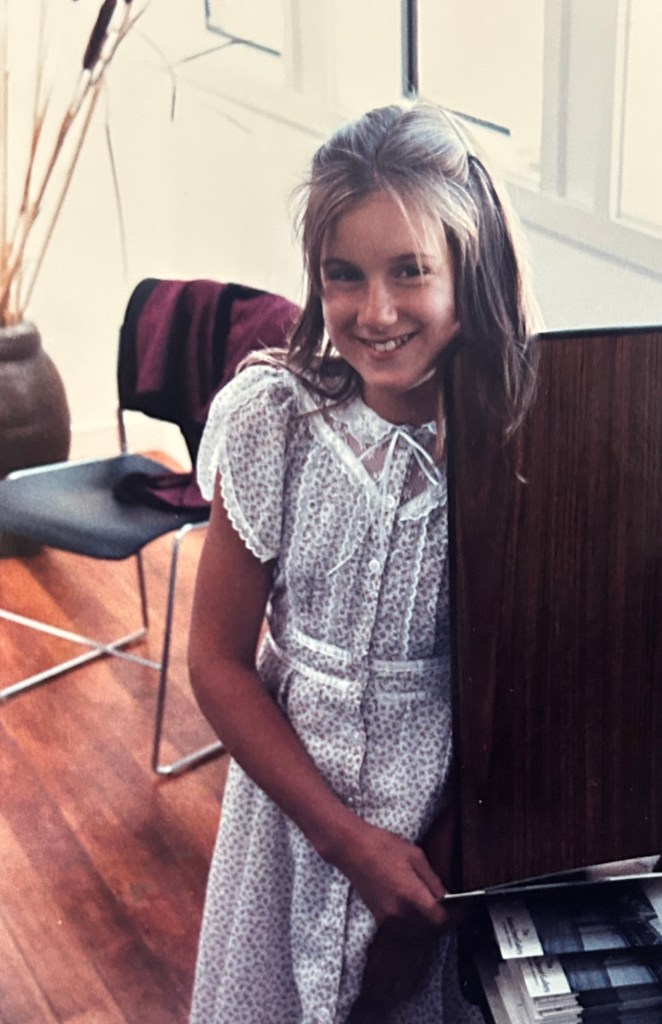
Ten year-old art critic and part-time spy.
Slightly wobbly in my wavy-soled high-heeled hand-me-down Famolare shoes and flowered Gunne Sax dress, I walk around looking for my parents. Spotting them across the gallery, I see that they’re standing next to one of my dad’s art cars. They look happy. That’s how they usually look.
Mom and dad, artists and appreciators.
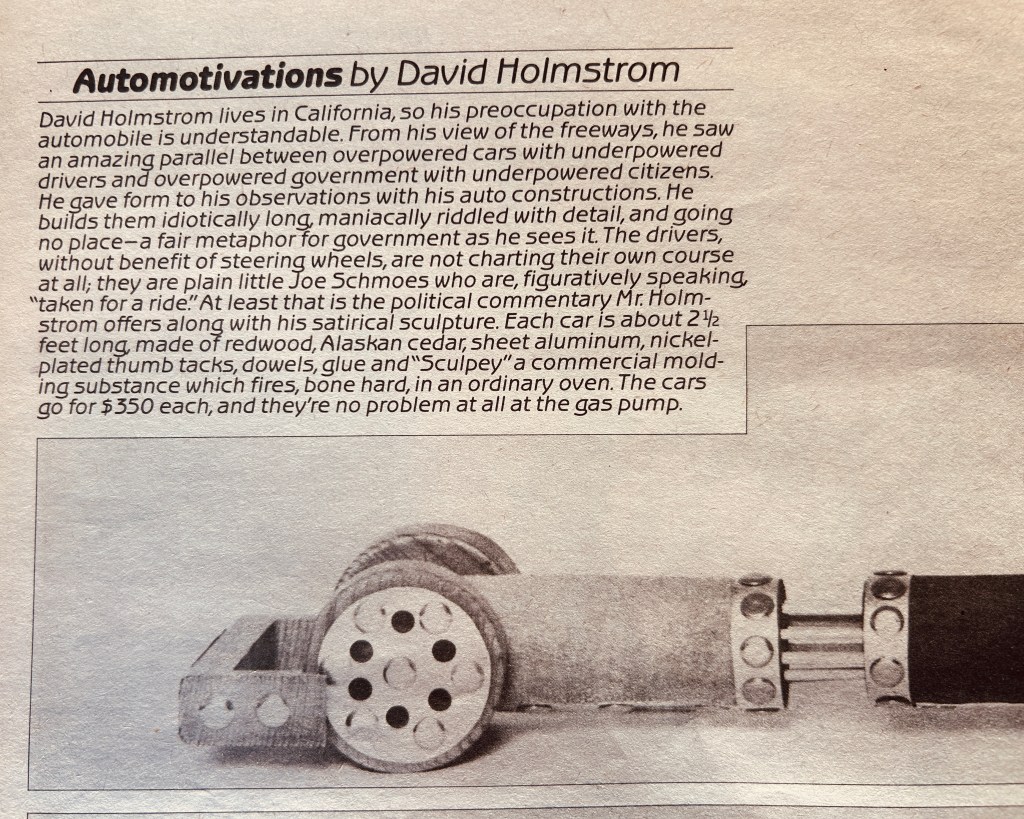
Lately, when he’s not writing, my dad works on his cars. Most of his art, both the large wooden constructions, and the cars, make some sort of point about politics. I don’t understand the messages, but I like what he makes. A lot of other people seem to like his art too since there have been articles about him and his art in magazines and newspapers.
Excerpt from an article about my father’s art cars.
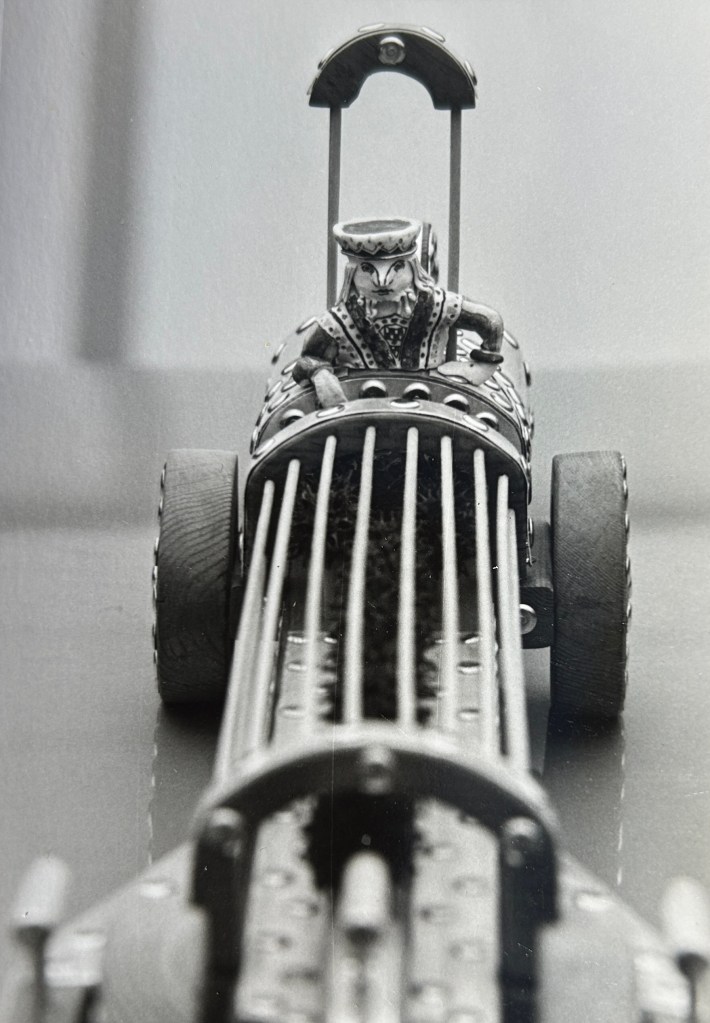
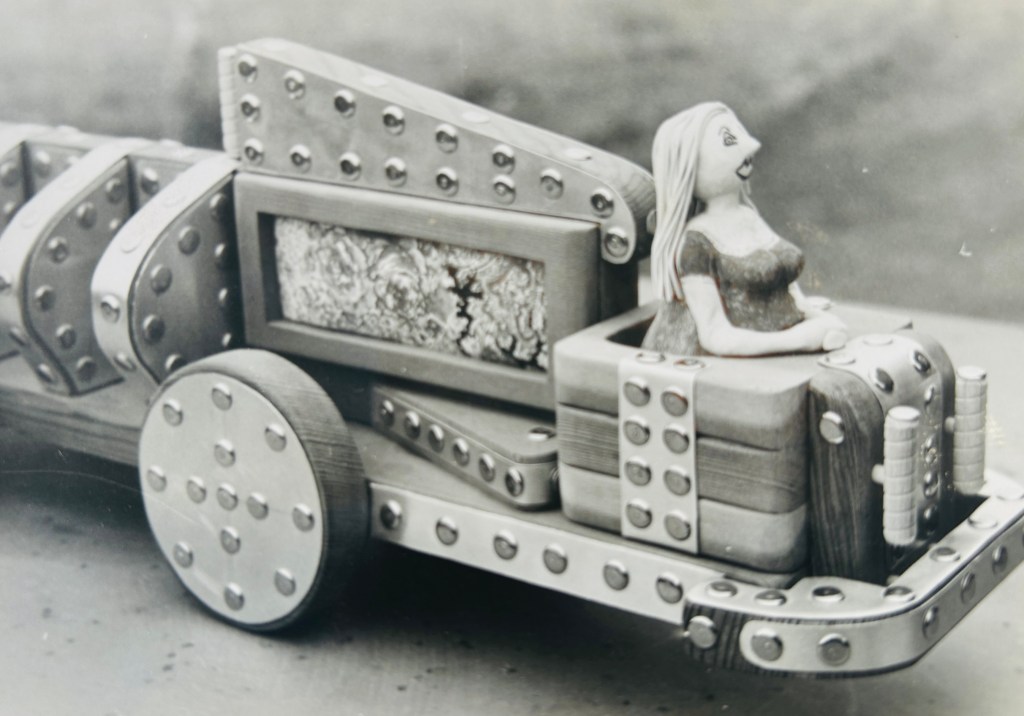
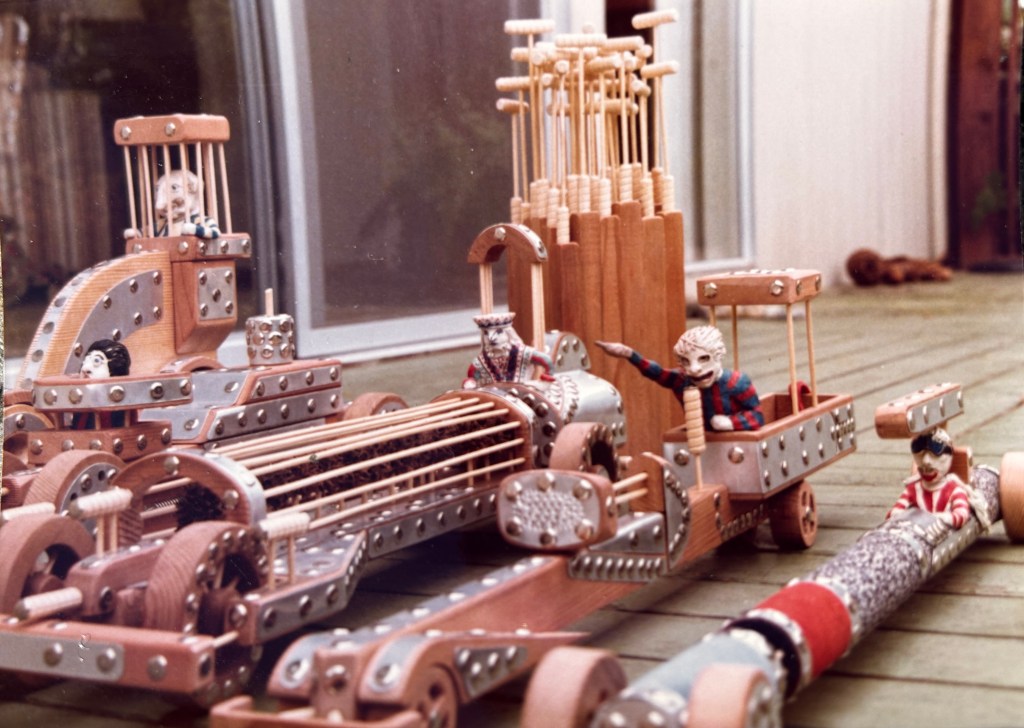
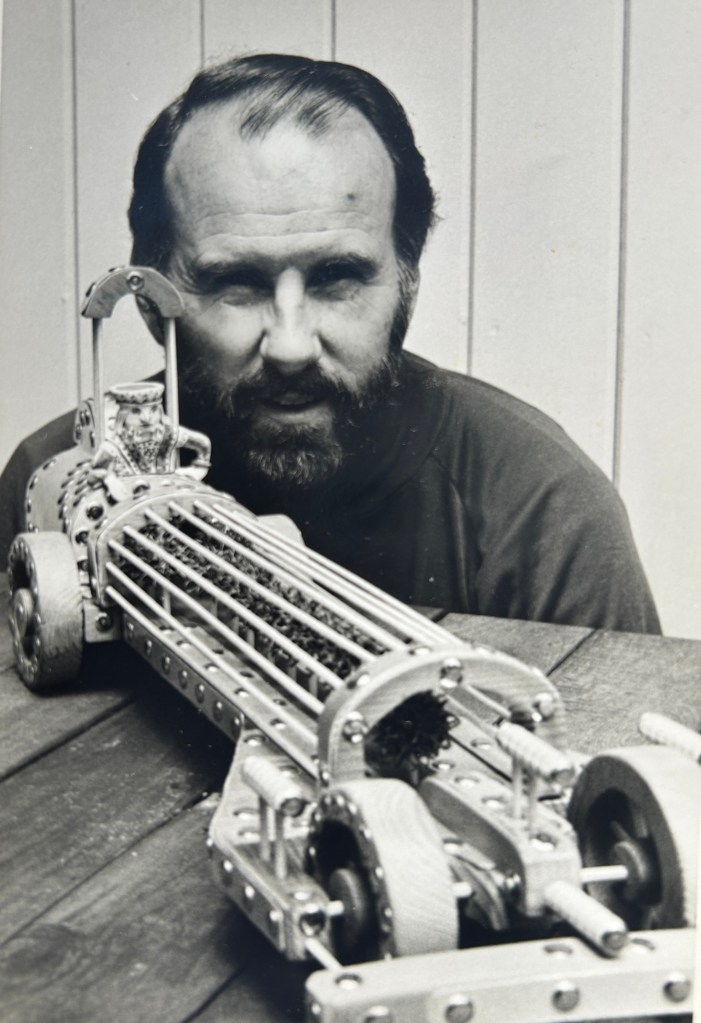
The cars are shaped out of wood and have shiny parts made of sheets of aluminum that he hammers thumbtacks into. There are funny looking characters in the driver’s seat that he shapes out of clay. The cars have names I can’t pronounce, like Senator Kincade’s Private Secretary, Compulsory Arbitration, and The Subcommittee Investigator.
“The I.R.S.”“Senator Kinkaid’s Private Secretary” A selection of my father’s wooden art cars, circa 1983.
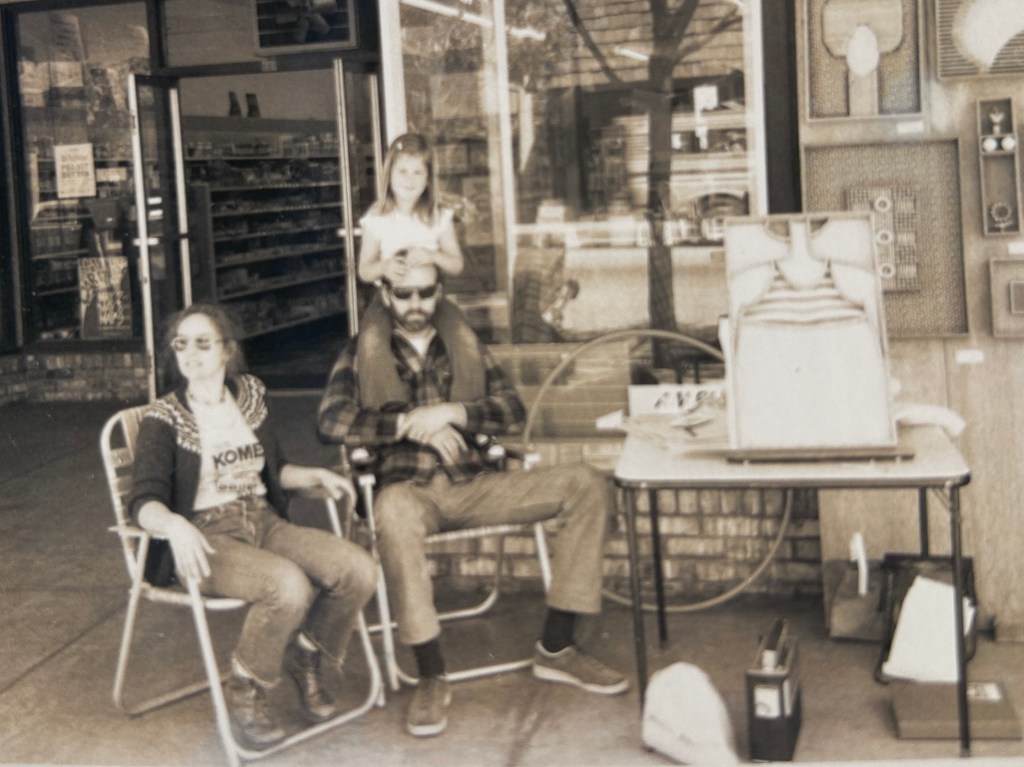
I like it when my dad’s art is in shows, mostly because I get to spend extra time with him. Once he had his art in a street fair in Palo Alto and my cousin Laurel and I helped him set everything up. People stopped by and talked to us and bought some of his work. Normally, I’m not allowed to have sugar, but that day I got to have some cotton candy.
Supervising the Palo Alto street fair art booth with dad and cousin Laurel, 1978
We know a lot of artists. I like to make art too, but I don’t think I’m very good at it. My mom makes pottery on a big wheel that I can spin, and my best friend Portia’s parents are both silkscreen artists—when I sleep over at her house we sneak into their studios. We’ve seen stars through the skylights. We shake the brightly colored paint bottles and run soft paintbrushes across our cheeks. Sometimes Portia’s mom drives us to the art supply store in Santa Rosa in her tan VW bus. She lets us pick out pastels in colors we like.
When is this art opening going to end? My feet are getting tired, and my stomach hurts from eating all that fruit. The artist who was outside earlier is back inside the gallery now, talking to Jill in front of his sculpture that looks like huge melted Tinkertoys. His eyes are red and he still looks mad.
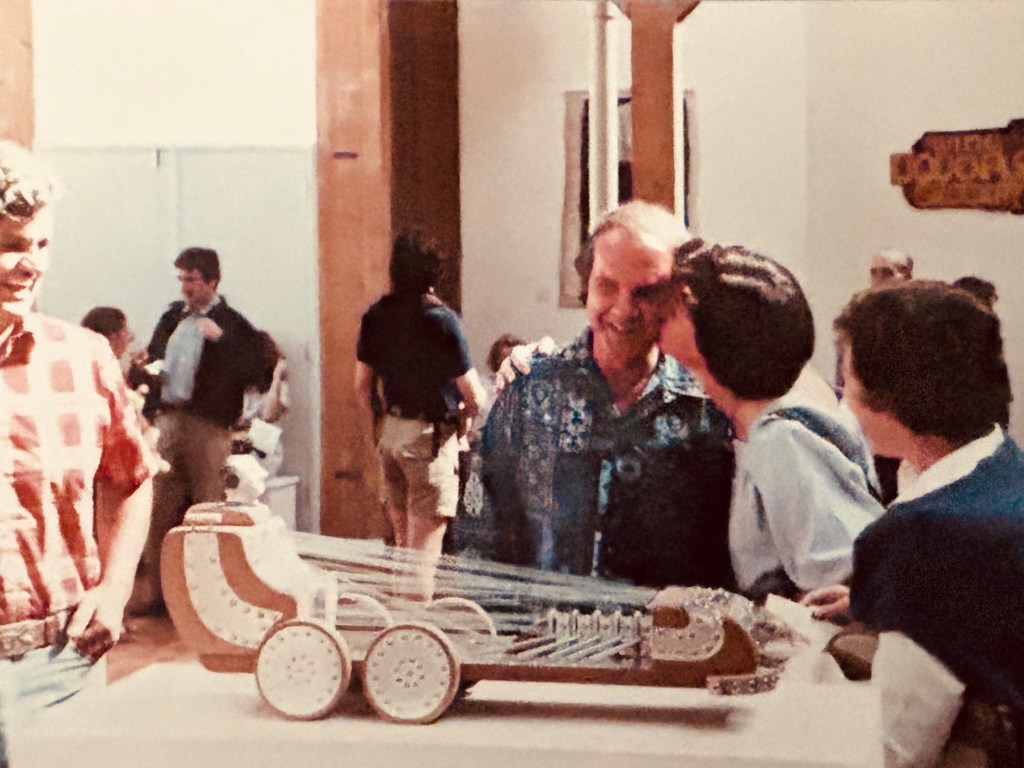
Now lots of people are gathered around my dad’s cars. A lady who is a friend of my parents commissioned (that’s a fancy word for “bought”) one of my dad’s cars for her husband. She’s giving it to him as a surprise. The musicians play a happy song while my dad announces that he made the car especially for the lady’s husband. There’s even a head that looks like his head driving the car. Everyone claps loudly. The man looks surprised and smiley, and his wife gives him a big kiss.
Unveiling of the art car commission.
Time to ask mom and dad if we’re leaving soon. I’m too full of art and fruit.
I’m thinking about how art seems to make adults happy—when they’re making it and when they’re looking at art that other people made.
Except for that one artist, I guess.
Artist David Holmstrom (aka my dad) poses with one of his art cars.
This is a story of dreams and reality colliding, in the best kind of way.
It is 7:30 AM Pacific and my husband and I are walking up a steep island road at a steady pace, breathing in the grassy scent of hillsides warming in the sun, the tropical foliage spilling into the road, and the sharply pungent Eucalyptus pods crushing beneath our feet. No one else seems to be around.
A few minutes earlier, we were tiptoeing around our dark hotel room searching for walking shoes and quietly moving stacks of clothing, damp bathing suits, and multiple pairs of Crocs. Our 11 and 12-year-old kids are still sound asleep, iPads and heads thrown to the side. Thanks to our wonky vacation schedule and a hefty time change, we have been granted an early morning reprieve from their boundless energies.
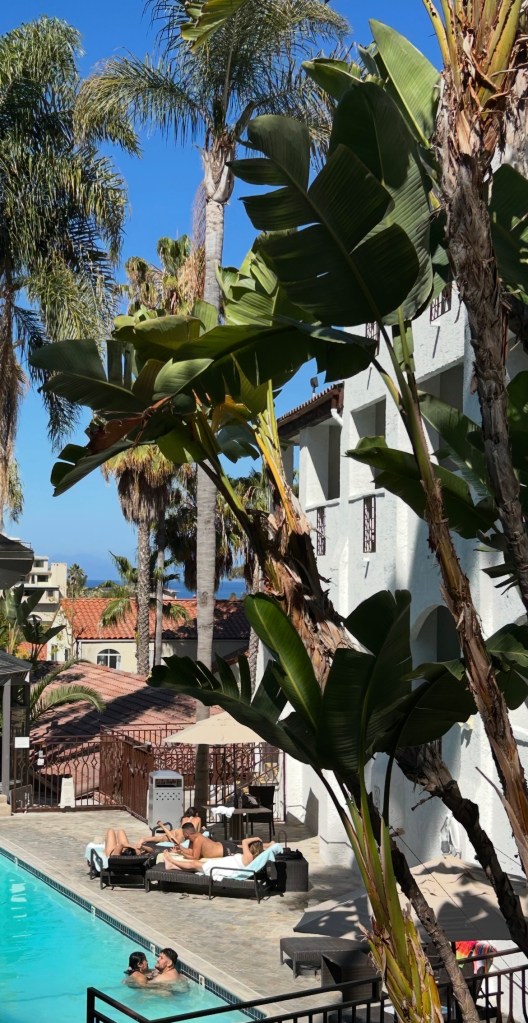
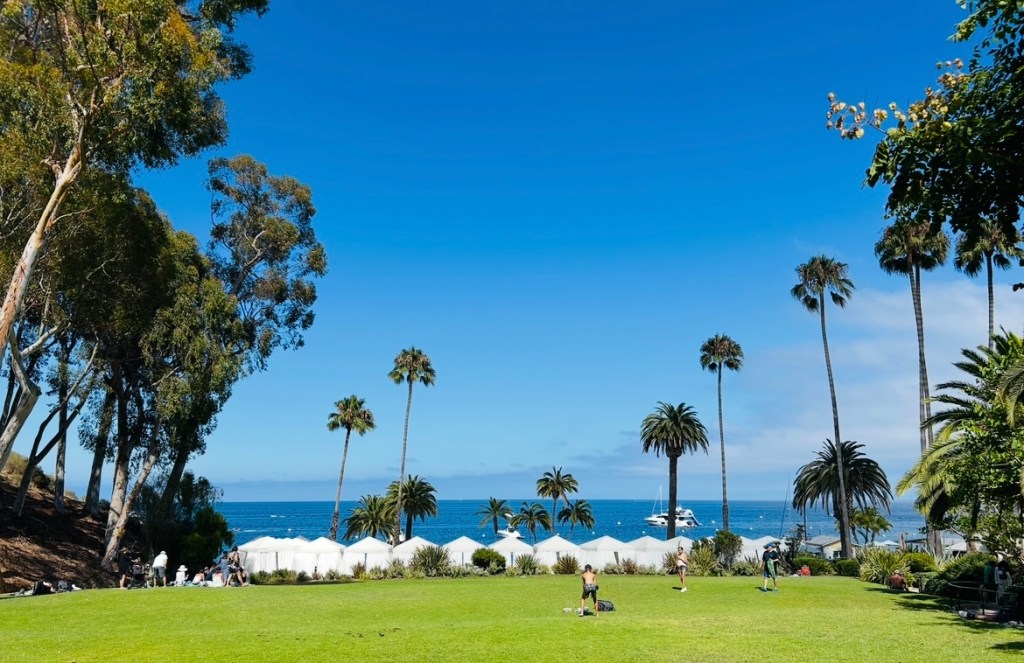
View from our Catalina hotel room patio, Pacific Ocean in the distance.
“How about walking up the road instead of down?” I suggest to Tom as we lock the hotel door behind us. He agrees, so we head right. Over the past two days of our visit to Southern California’s Santa Catalina Island, we have only exited our Spanish-style inn (on foot) and taken an immediate left. This move brings us down the steep road for the pleasing fifteen-minute walk leading to Avalon, the island’s main (and pretty much only) town. There are approximately 4,000 permanent residents on the 75-square-mile island, and almost all of them live in Avalon.
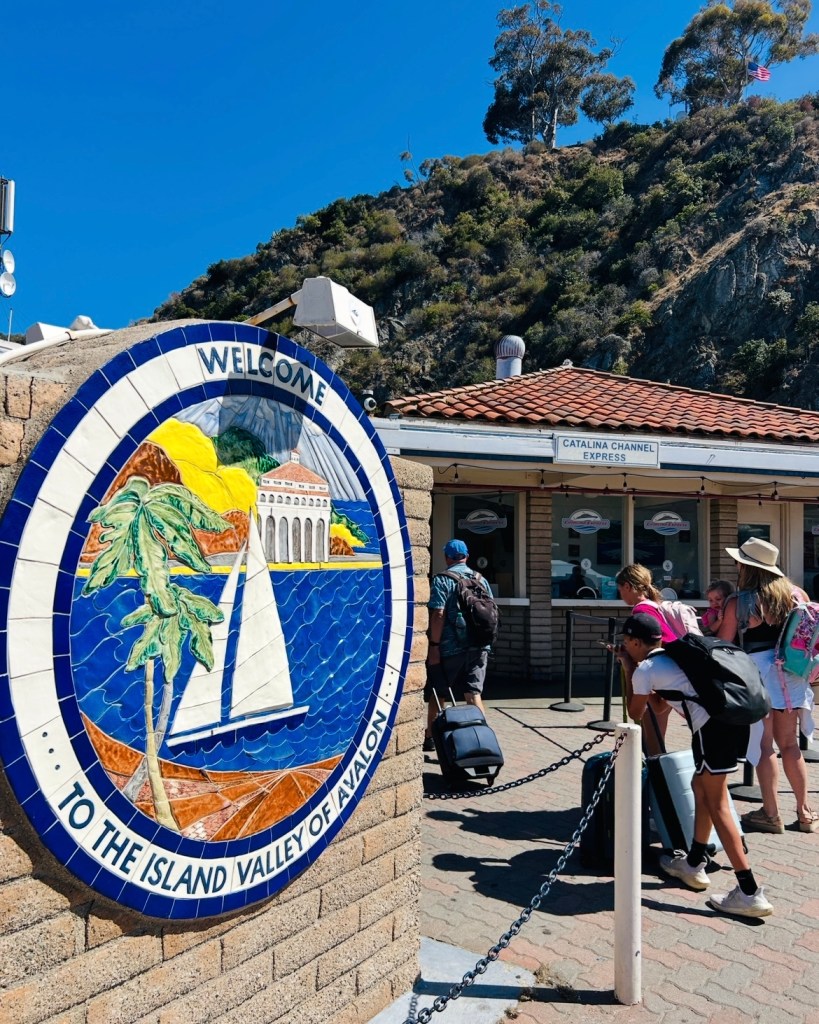
Welcome to the Island Valley of Avalon.
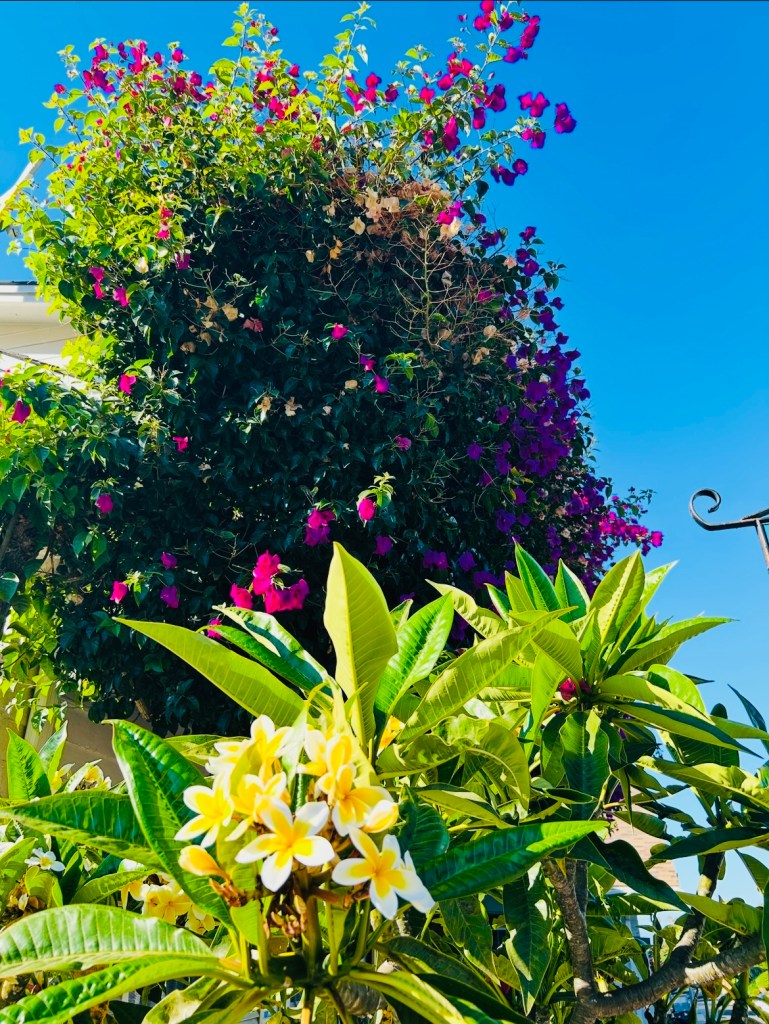
“This place is like the best of California all rolled into one,” I marveled out loud as our ferry sailed smoothly into the Avalon harbor two days prior. The ravined mountainsides loomed in the distance, stunningly clear ocean water sparkled, and palm trees swayed. Was that the vanilla-like scent of plumeria blossoms in the air?
Bougainvillea and plumeria abound in Avalon.As does water so clear you can see the bottom, along with California’s state fish, the bright orange garibaldi.
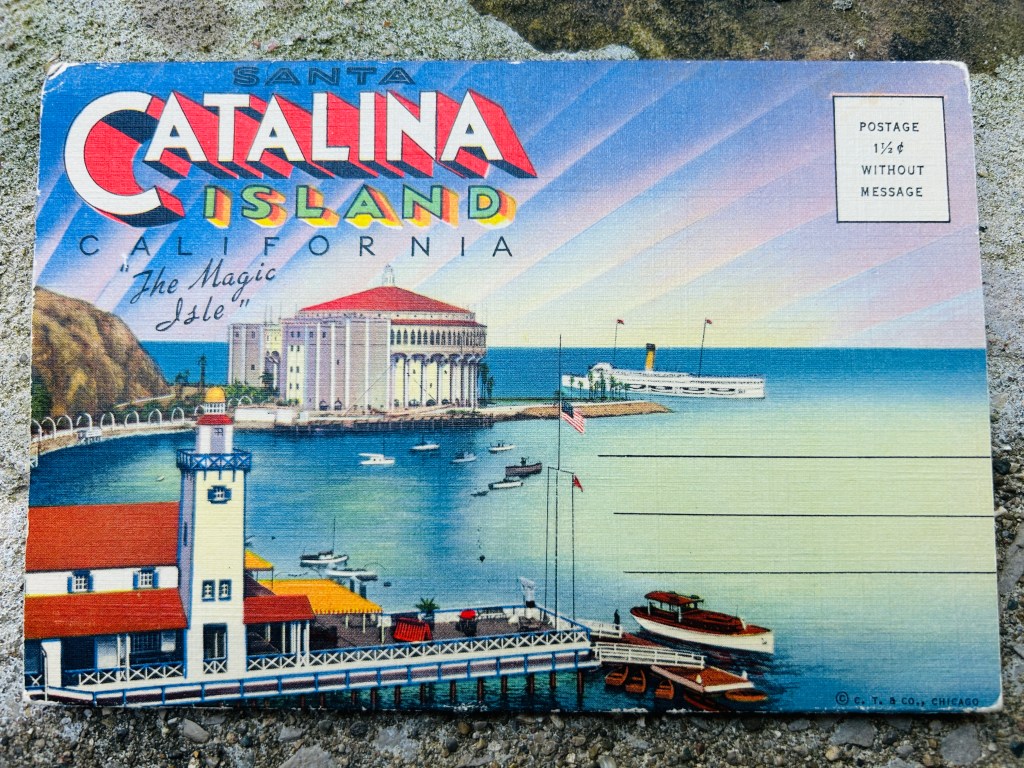
My father grew up in Los Angeles, and my paternal grandparents enjoyed their honeymoon on Catalina in 1929. I’ve been hearing about the island all my life. This, however, is my first visit.
Postcard packet purchased by my paternal grandparents on Catalina Island (never sent).
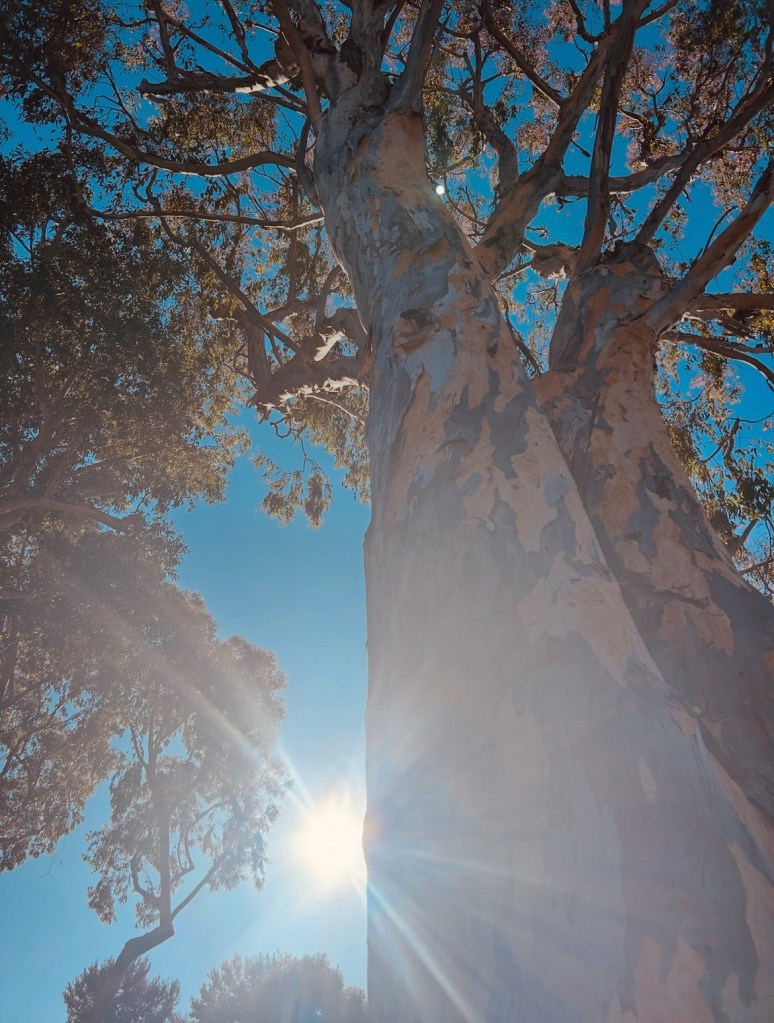
So far, our family of four has investigated Catalina via golf cart, paddleboard, and foot, but we have yet to see what lies above our Spanish-style Catalina Canyon Inn, perched at the top of a steep canyon and topped off with a view of the deep blue Pacific beyond. I’ve been eyeing the Eucalyptus-lined curving road above the inn, hoping for a glimpse into the less touristy side of Catalina. As far as I can tell, there are zero hotels up there, only some quaint and funky-looking houses that I imagine are inhabited by locals.
Eucalyptus trees, a favorite since childhood. Catalina has some especially gigantic specimens.
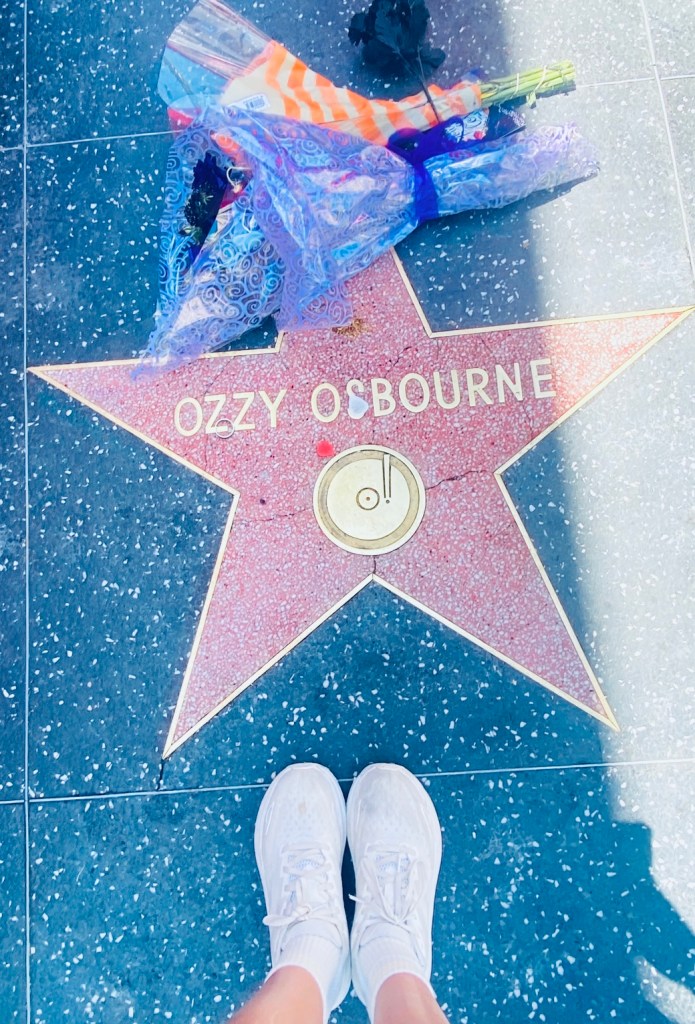
For me, this morning stroll is a slice of heaven. We had already been in California for a few days before journeying to Catalina. Experiencing Los Angeles with two preteens meant the itinerary looked a lot like their TikTok feeds: strolling the Santa Monica Pier, ogling the Hollywood Walk of Fame (featuring a flower-strewn star honoring the recently deceased Ozzy Osbourne), stops at Funko and Nike and LuLulemon, and an inaugural (for the kids) meal at the Eagle Rock In-N-Out.
But while we walked the crowded LA sidewalks, I found myself thinking about what was missing from this family adventure. As a native Californian who reluctantly left for the Midwest nearly 15 years ago, I am yearning for the California of my heart. The creative, kind, eccentric Californians that peopled my upbringing. The infinite, golden possibilities that lie around every corner. The bright orange of California poppies lining dusty roadsides, the sight of a graceful lone oak perched on the top of an emerald mountain in the springtime. This California lives on in my dreams, but these days, news stories paint lurid pictures. And as I lead an entirely different life 2,250 miles away, I wonder if the soul of that California still exists.
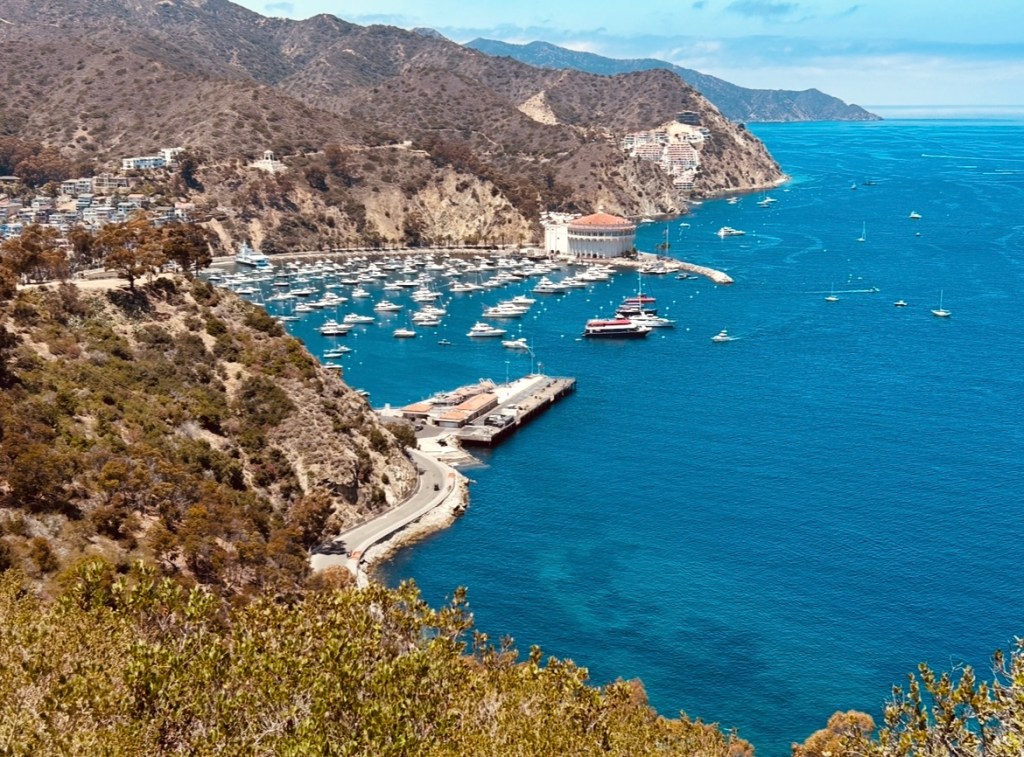
Idyllic Catalina view.
Reaching the top of what I am now calling “Eucalyptus Road,” we follow a hairpin curve and find ourselves on an upper stretch lined by houses on each side. The structures remind me of parts of Northern California towns Berkeley or Mill Valley, narrow wooden constructions, close together and very, very steep.
Suddenly, a man and his dog appear in front of us. Smiling broadly, the man greets us, as does his friendly, tail-wagging pup. “Nice morning, isn’t it? Have you had your coffee yet … just put a pot on … can I offer you some … my house is just up here.”
It might have been the perceived safety of an island, or the idyllic early morning atmosphere, but there are times when you sense that a human being you are meeting for the first time is a good one. This is one of those times. Nodding in unison, we accept the stranger’s offer without hesitation.
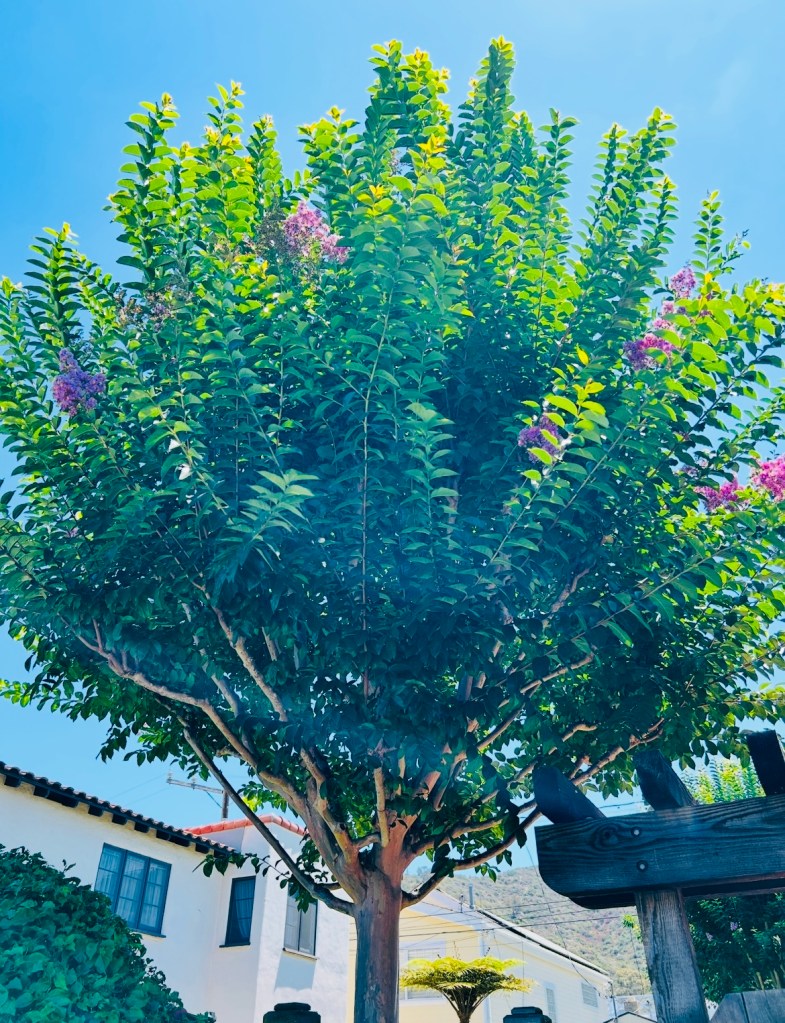
Some have maples in their front yard, others have this glorious flowering marvel.
Minutes later, we are trudging up the steep wooden stairs to the main floor of our new friend Bob’s house. There, in his elegant, sun-splashed kitchen/dining room, which smells of cinnamon and flowers, he hands us each a mug of strong coffee. We sip, admiring our surroundings, chatting about the artwork adorning the walls. Bob then proceeds to give us a tour of his lovely home, combined with a fascinating people’s history-style lesson about the island (for example, many islanders apparently believe actress Natalie Wood’s 1981 drowning in the Catalina harbor was an accident afterall, thanks to copious amounts of alcohol consumed that night).
At one point in the tour, I stand on Bob’s third-floor open-air pillow-strewn sleeping porch, looking down at the crescent moon town of Avalon, which is exquisitely framed by the blue expanse of the Pacific Ocean.
A shiver goes through me. “It’s still here,” I think to myself. The California of my dreams.
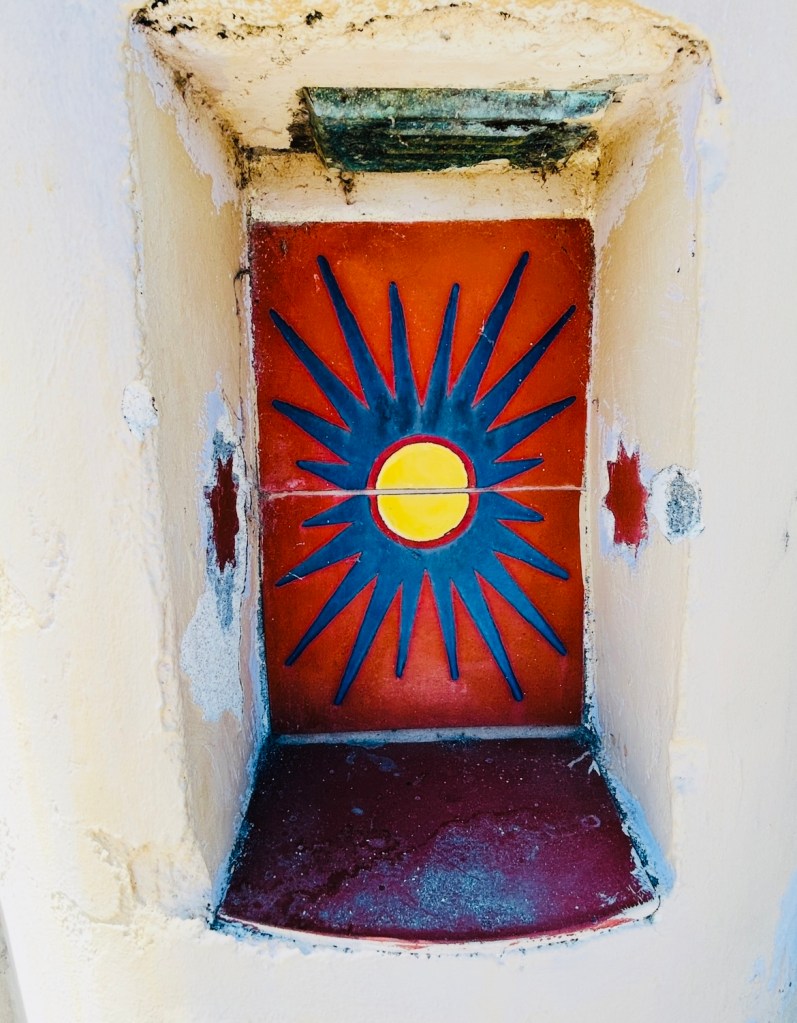
Hidden sunburst along a Catalina sidewalk.
Turns out, Bob is a retired bond trader turned poet. Of course he is.
And in his creaky wood-floored, weathered office, sailing ships adorning the walls, he reads us a poem. Closing my eyes, I allow his words to wind their way through me.
To change one’s mind/To open one’s heart—/One leaves the known behind
To take a different path/Than the one well-worn,/Opens the world /And opens the soul
Excerpt from “Pilgrims,” Songs of Redemption Poems by Bob Baggott www.offtheDesk.com
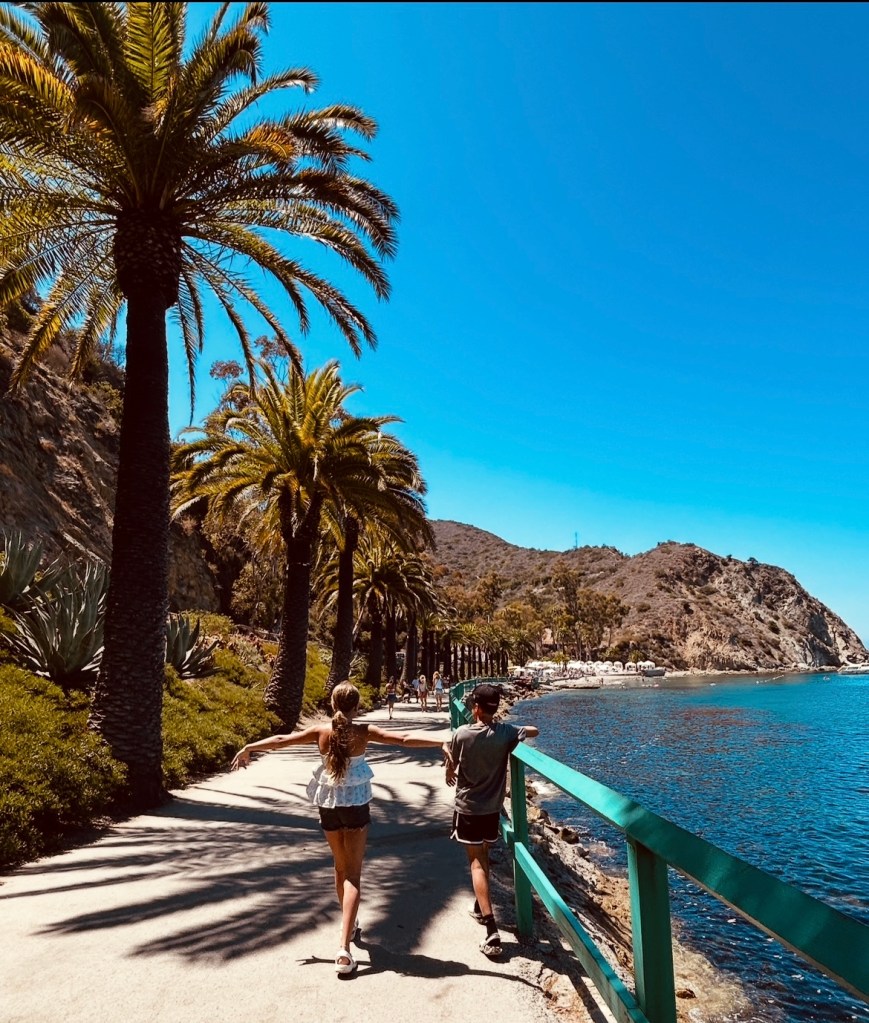
Walking California’s paths … into the future.
The soul of California hasn’t gone anywhere.
And sometimes, when you least expect it, you are reminded that infinite possibilities still exist.
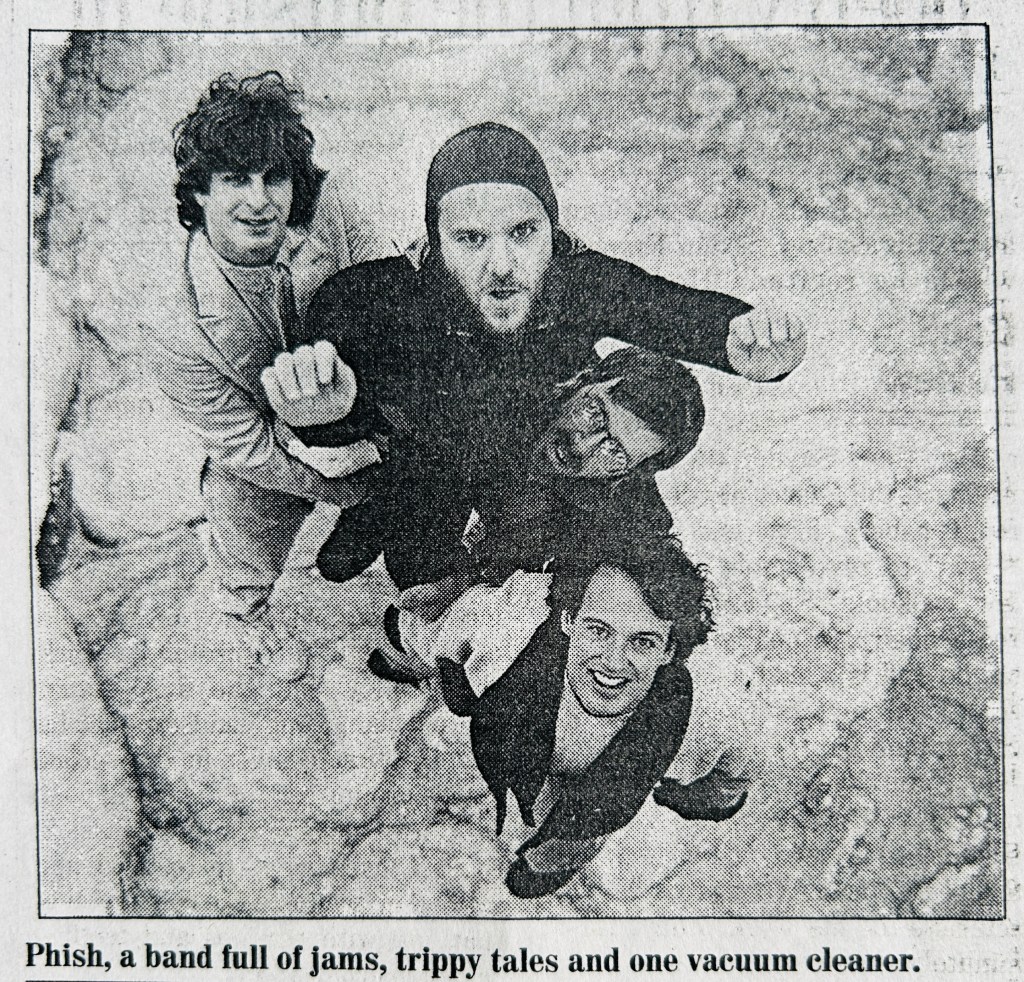
Phish, pictured in The Boston Globe, January 2, 1993
“When I jumped off, I had a bucket full of thoughts
When I first jumped off, I held that bucket in my hand
Ideas that would take me all around the world”
-Phish, Back on the Train, Farmhouse
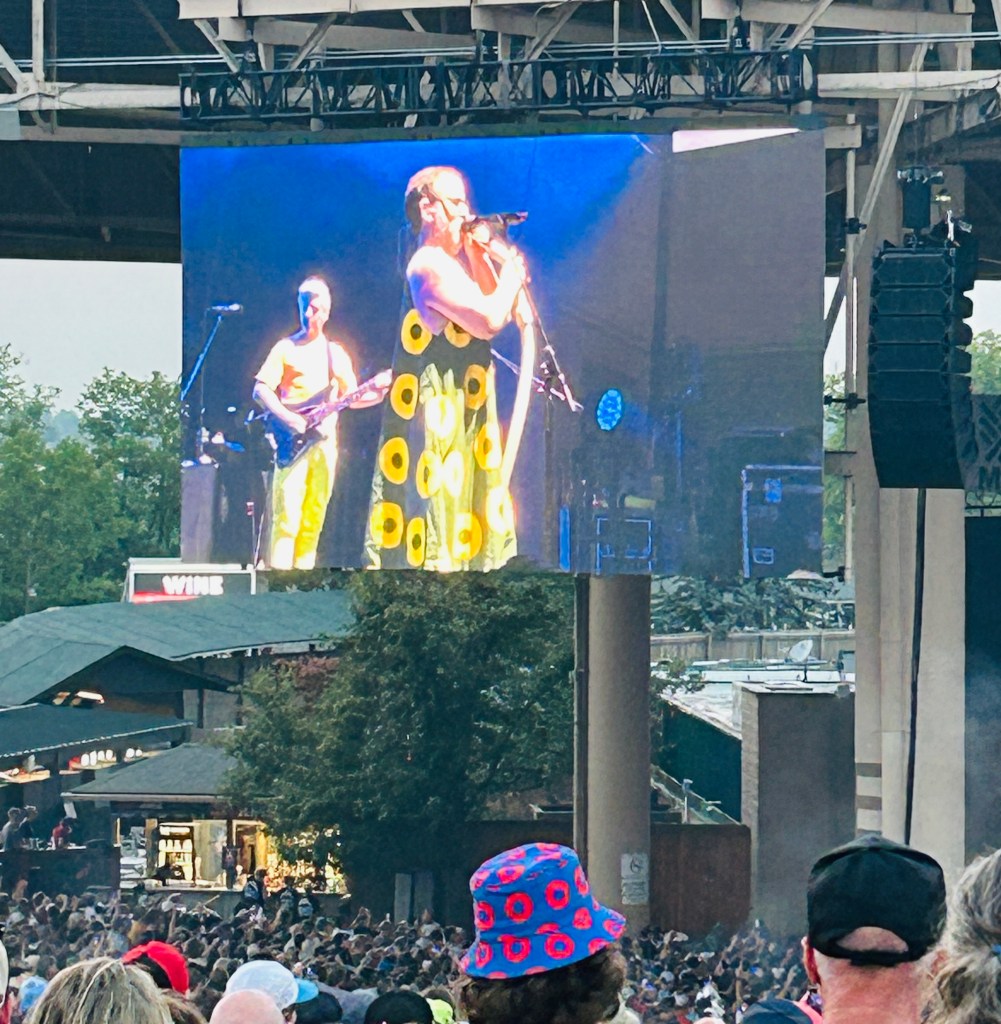
August 3, 2024, Noblesville, Indiana. A quizzical anticipation washes over the restless amphitheater crowd as the short, bespeckled man strides across the stage, dragging a vintage vacuum behind him. The man’s light cotton dress ruffles as the familiar red (or yellow this time?) circles dotting the fabric glow in the oppressively humid evening air.
My eyes remain glued to the giant hanging screen to my left as I watch the band’s namesake, Fishman, carefully place his lips to the end of the vacuum’s hose and … blow.
Jon Fishman makes the Hoover sing.
Imagine a cross between a flatulent Kermit the Frog and a beached seal’s whistling lamentation and you might come close to the sounds that emit from the microphone. As the crowd roars in appreciation, I stand on a narrowly folded picnic blanket, stagnant air trapping me, my husband, and our two friends in a sea of drifting marijuana smoke and patchouli-scented, undulating, frequently tie-dye adorned Phish fans.
Suddenly, the darkening sky above me appears to divide between the present and the past. I’m traveling back in time. Waaay back. Thirty-five years in fact.
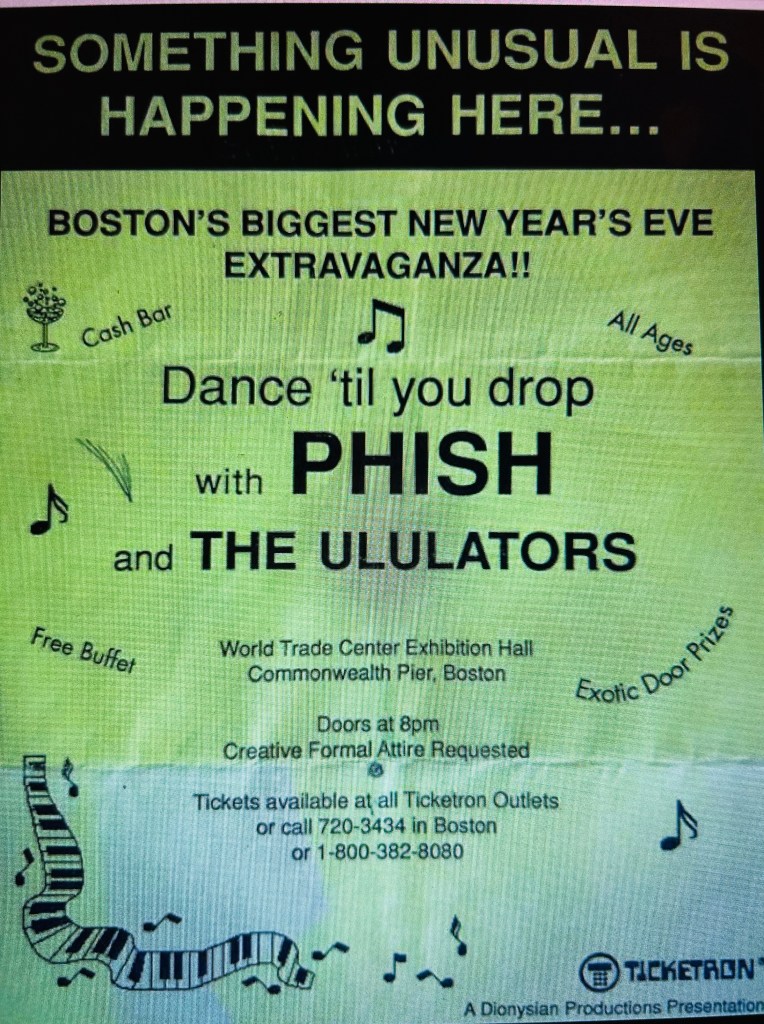
January 31, 1989, Boston, Massachusetts. I am nineteen years old, a recent college dropout sitting on the arm of a floral couch talking to my cousin on the phone, the receiver heavy in my hand. “We’re seeing Phish tonight,” she announces excitedly, “with a P, not an F … they’re hard to describe but I think you’d love them … this is their first New Year’s Eve show ever.” Impulsively (how else does a nineteen-year-old make a decision other than impulsively?) my high-school boyfriend and I decide to see the mysterious, aquatically-monikered band play in Boston that evening.
At that point, the future stadium-fillers only had a handful of fans. Jenny, my older by six months cousin, was first exposed to Phish’s music while attending a very alternative boarding school in Vermont (so alternative that her “roommates” at the institution consisted of her boyfriend and their pet rat—or was it a ferret—and their “dorm” a dilapidated cabin on a wooded Vermont hillside).
That final, frigid night of the 1980s found a group of us stomping along city streets, cold air winding its way under my velvet scarf and straight through my silvery tights as we searched for Boston’s World Trade Center Exhibition Hall, tucked away at the end of a pier. Once inside the wide, dark space we gripped our drinks and watched as the opening band, the popular Ululators, warmed up the festive, eclectic crowd.
Soon it was time for the main attraction to take the stage. A group of four grinning young guys walked out, not much older than us. The two guitar players wore tuxedos and top hats, and the drummer sported nothing but a G-string with tuxedo tails streaming out behind his bare rear.
As soon as the four launched into “I Didn’t Know,” I knew.
While it was clear that these guys were gifted musicians, but something else was also going on, fresh and wholly different. Lyrics were whimsical, clever, and funny. Guitar riffs melodic and transporting, with piano and drums providing both a classic and fresh accompaniment, rousing and soothing the crowd. This was rock music, but it was also a kind of entertainment, a university of the musically absurd.
I’d never seen a band enjoying themselves as much as the crowd facing them. Audience participation was encouraged, as important to the life show’s life as the performers on stage. As the four burned their way through instant classics like “Bathtub Gin,” “Split Open and Melt,” and “Fee” the energy created was reciprocal, as evidenced by the ecstatic grin splashed across the face of the man I later learned was Trey, the enthusiastic, head-bobbing red-haired guy who appeared to be leading the charge.
The notes built and crested and shattered as they rolled around in my head, sometimes all at once. But the highlight, the episode we talked about for days after, was when the red-circle-on-grey-fabric-dress-wearing Fishman (who in my opinion should receive more national credit for normalizing men wearing dresses) rolled a cylindrical vintage vacuum out on stage.
“Maybe he’s going to do a little cleaning,” I thought, “Hoover up the confetti?” Instead, he raised the hose to his willing lips and began to enjoy himself playing the vacuum like an instrument. Our mouths opened in wonderment, the crowd laughingly danced around the room and shook our heads in disbelief. That was it – I’d wager that everyone at that show became a Phish fan for life.
Some of the motley crew that attended the first New Year’s show in 1989
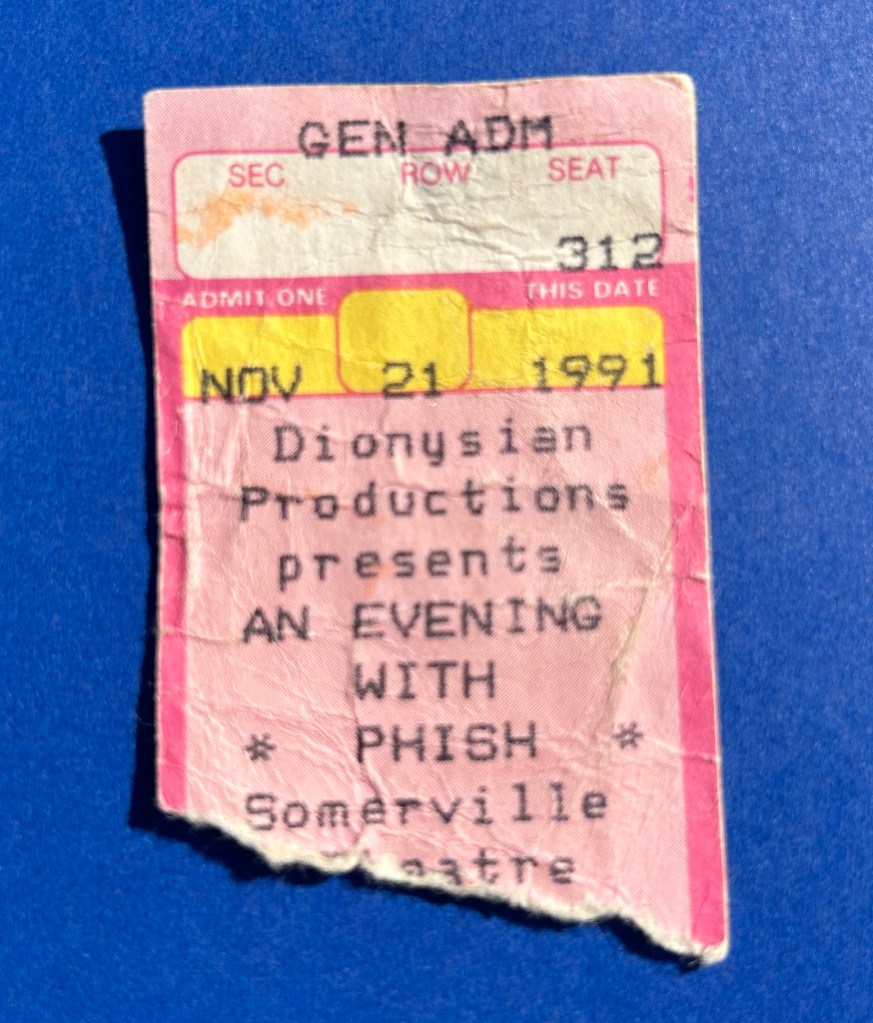
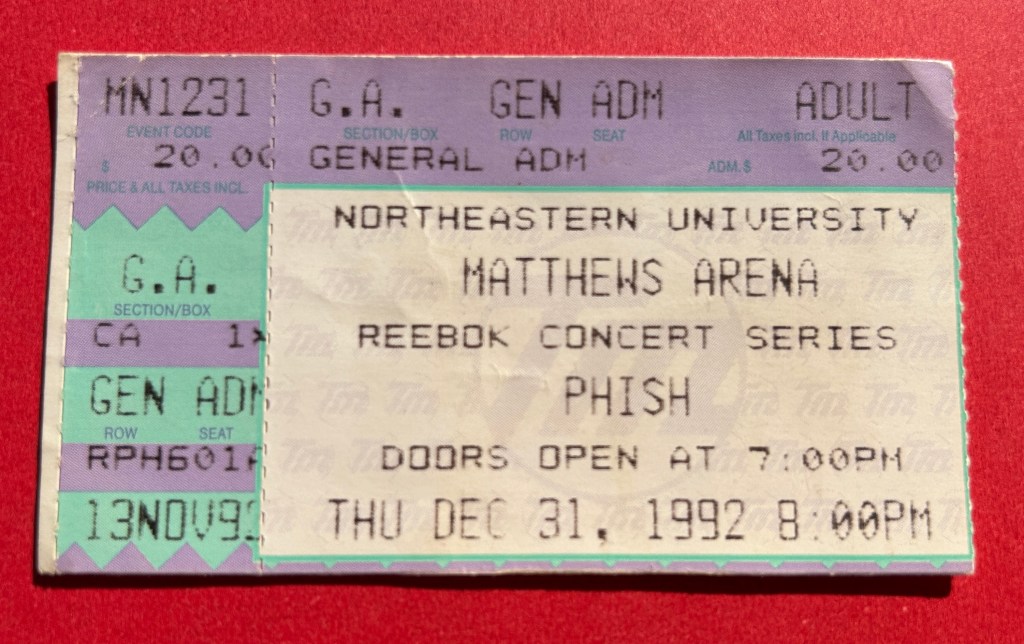
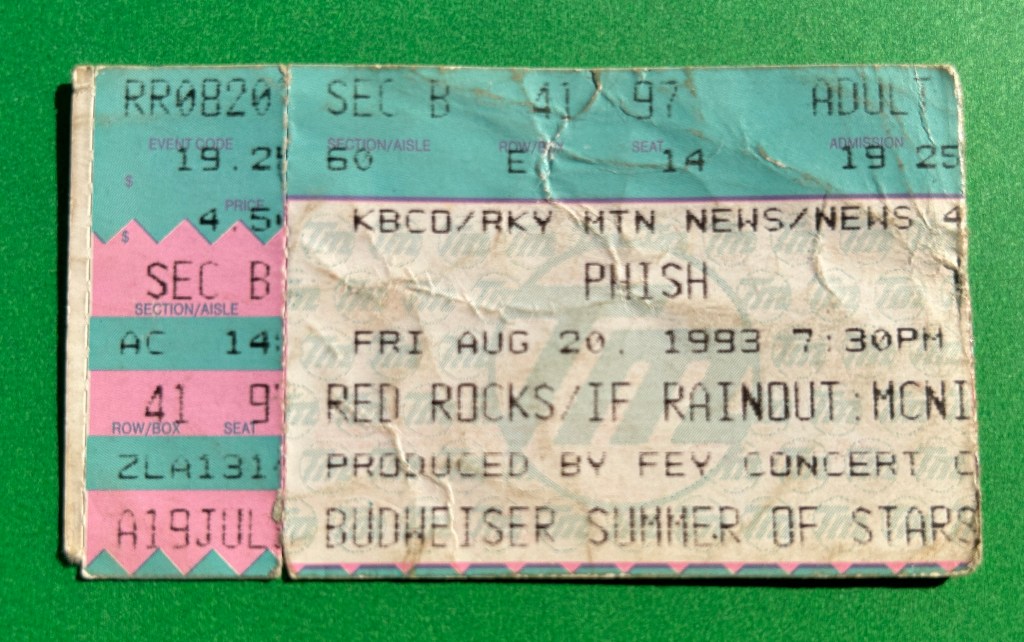
After that first magical night, Phish and their musical movement became a part of my world. Despite an obsession with David Bowie and New Wave music in High School I easily made the shift to devoted Phish fan. I was fortunate to live in Boston throughout the 1990s (which also happened to coincide with my 20s), the same decade the band was rising and growing exponentially in popularity. While Phish launched their brand and collected a gigantic fan base I launched my adulthood, experienced my first broken heart with that first Phish-loving boyfriend, and attempted to discover my place in the world. I never followed the band nationally from venue to venue like a truly dedicated Phishhead, but during those days I saw enough shows in Boston and other Northeast venues to know the words to every song and start a half-inch-thick prized collection of ticket stubs.
Phish ticket stub, 1991
August 3, 1991, Auburn Maine. I had added my name to Phish’s mailing list early on and one day in June 1991 a postcard arrived. It was an invitation to a concert dubbed “Amy’s Farm” because the show was held at the Maine-based farm of Phish’s first fan and friend, Amy. Given that Phish signed with Elektra Records that same year the band was offering thanks in the form of a free show to the fans that had stood by and supported the foursome from their very beginnings in Burlington, Vermont in the early 80s.
This explains how I found myself camping in a dusty field in Northern Maine one hot August day, listening to Phish play under the stars and pines pondering how I got to be so completely free and fortunate. A vague, filmy memory of the band riding out of the thick forest behind the stage, naked, atop horses bounces around my mind, however to this day I’m not certain if this image is a dream, the truth, or a mirage. The sole bummer of the day: we forgot the tent.
Phish ticket stub, 1992
December 31, 1992, Boston, Massachusetts. Another New Year’s show, this one at Northeastern University’s Matthews Arena. Unbelievably, the venue was walkable from the apartment I shared with my best friend in Boston’s South End –no need for tires to make contact with the road. Standouts at the show included the person suspended over the audience in a chicken costume and the mass hysteria signal Trey gave the audience (that I believe was responsible for the “mysterious tremors” mentioned in the Boston Globe the next day). This was also the night I lost track of my group entirely, only to look down from a balcony and immediately spot my friend Nat, his thick bouncing ponytail silhouetted in the immense gyrating crowd like a furry creature signaling his location.
Phish ticket stub, 1993
August 20, 1993, Denver, Colorado. That summer I worked at the Colorado-based camp I’d attended since age six. Phish was playing at Red Rocks and some friends and I managed to get tickets. That evening, I watched the lithe bodies of multiple fans leaping over three benches at a time as the band played “Run Like An Antelope” and the setting sun turned the natural rock walls of the amphitheater a red so brilliant I had to look away.
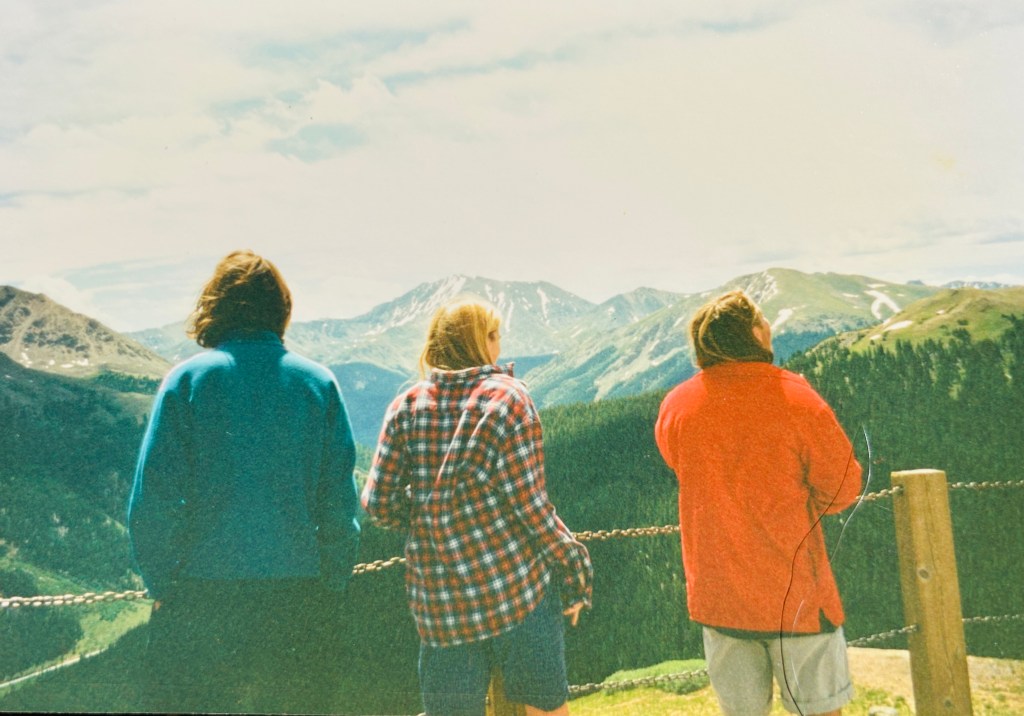
Watching “the smoke around the mountains curl,” Colorado, 1993
Alas, all was not perfect in Phishland. As much as I enjoyed the concerts, the traditions, and the fan culture I sometimes felt excluded by the masculine energy created by the four men on stage. I got tired of the same jams played by the same dudes with the same expressions and longed to see a woman up there, blending her voice with theirs, or theirs with hers. Where are the female jam bands, I wondered?
The amount of wasted, stumbling, blank-eyed fans who don’t know they are that far gone could be off-putting, even if I was sometimes one of them. Undercurrents of negativity surround certain Phish songs, and I didn’t enjoy the screeching, off-key vocals that sometimes took over. My least favorite song is “Wilson,” which invariably turns into a yell-along for the audience. I do realize, however, that music (especially Phish’s) reflects all aspects of the maze that is the human condition and neither band members, nor fans, are immune to life’s peaks, valleys, and temptations.
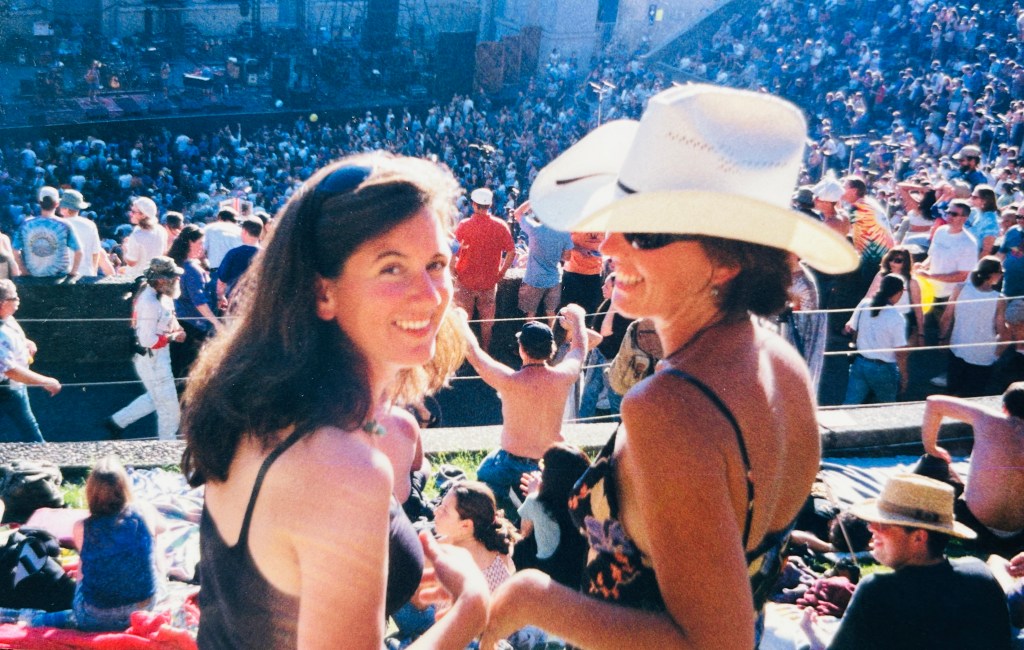
July 10, 2003, Shoreline Amphitheater, Mountain View California. In 1998, after ten years in Boston, I moved back to my native Northern California. Soon after, I met my Midwest-raised future husband when our work cubicles were situated next to each other. One of the first things we connected about? Our mutual love for Phish. During the early years of our relationship, right about the time Farmhouse was on permanent rotation in our car’s CD player, we caught a few Phish shows at Shoreline. The most memorable of these was the final show before the band went on a six-year hiatus. Sitting on the lawn at Shoreline, my shoulders sunburned from a day in the California sun, I gazed around at the massive, dancing crowd while the band launched into an encore of “Rift.” It was hard for me to grasp that this wacky little band I had once stood five feet from was now selling out four nights at a 22K-person capacity amphitheater.
Speaking of valleys, Phish’s founder and lead singer, Trey Anastasio struggled with a variety of addictions and was arrested in December 2006. I followed his story closely, perhaps recognizing some of my creative path, as well as addictive behaviors in his, and acknowledging that our idols can be as fallible as ourselves.
In a January 25, 2019 interview with GQ magazine about his embrace of sobriety Anastasio remarked “You know, I look to my heroes to be reminded that really good, really smart, really talented people can fall into this trap pretty easily, far down the road, if they’re not careful. The important thing is to know that there is a way out. And the life at the other end of that is a beautiful life. Everything bad turns into an incredible gift. If people can find the way out.”
Mistakenly, I thought a sober, creative life would be about as exciting as a bleached sample in a jar, but I assure you, just as Trey has, that it is even more beautiful and exciting than anything that has come before.
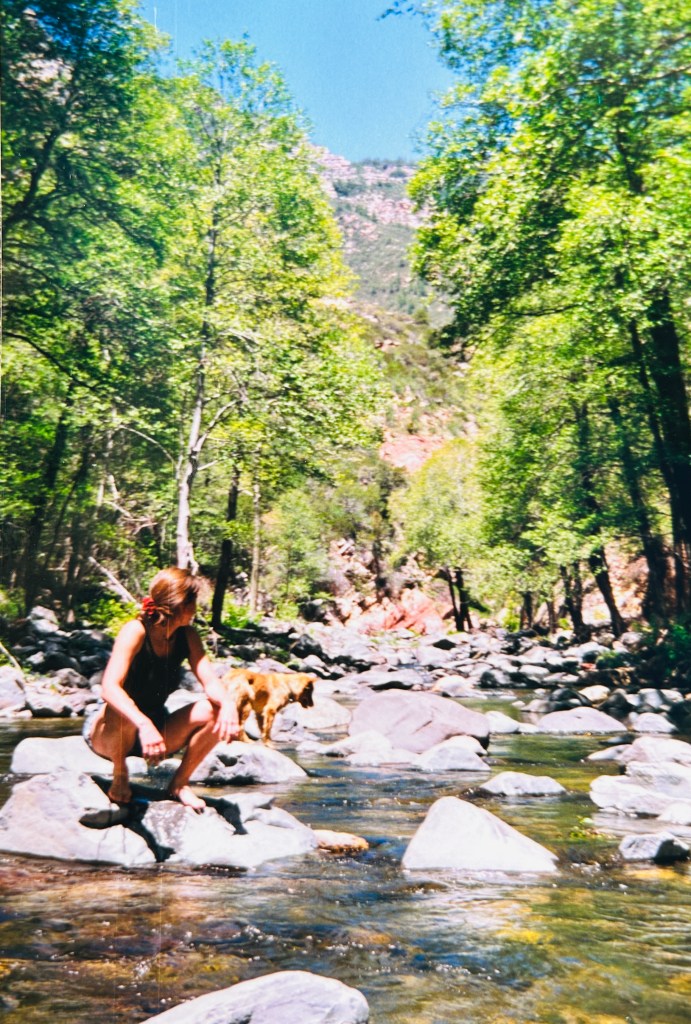
Caught between the past and the future, Arizona, 1995
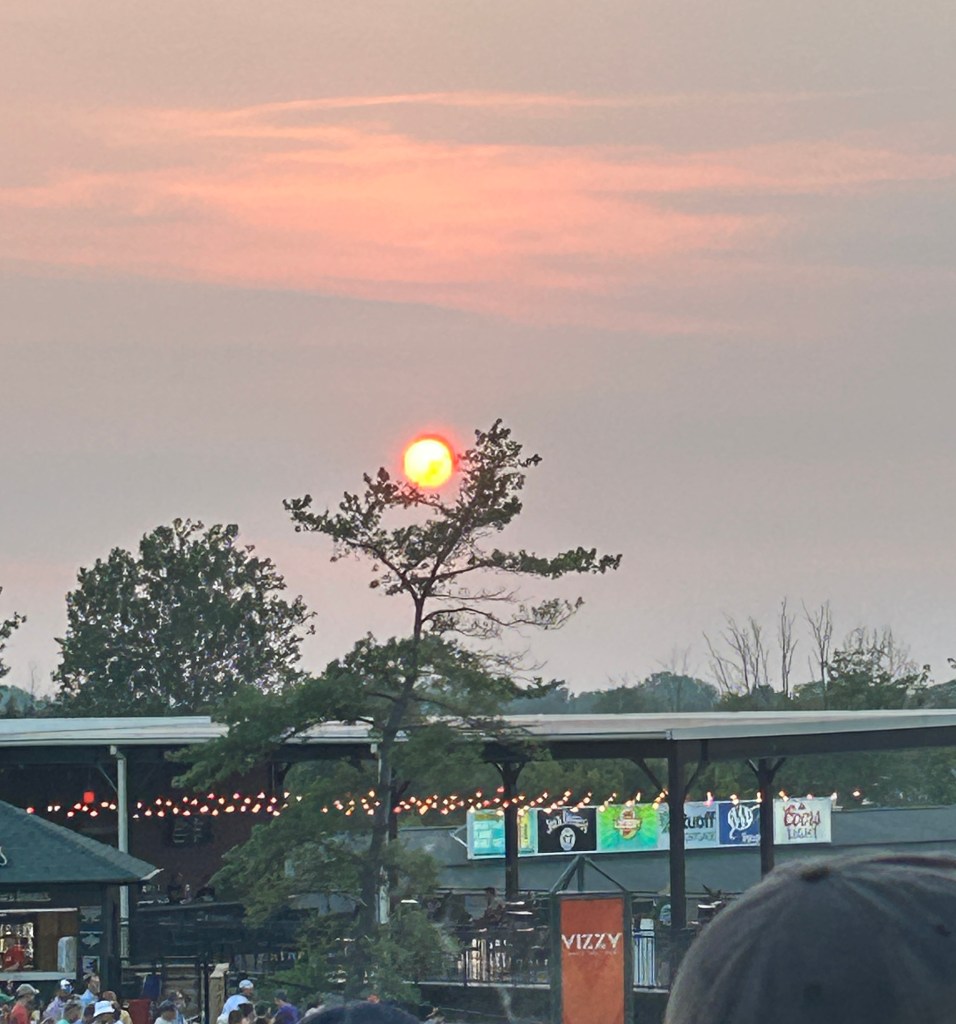
August 3, 2024, Noblesville, Indiana. Back on the lawn at Deer Creek (as Hoosiers will forever insist on calling it), the glowing orb of a setting sun is held by the branches of a lone tree. I am content, the kids are safe at home and my grooving, grinning husband of eighteen years dances alongside. I have been held by Phish’s music for so long that it has become a part of me, the branches of my life growing around the always-evolving but forever-burning core.
Sunset at Deer Creek, August, 2024
And miraculously, thirty-five years after first hearing the tortured sounds emitting from Fishman’s vacuum hose, I am listening to them once more.
Look back but don’t stay too long.
Note: Special thanks to Phish.net which provided many clarifying details to my sometimes (okay, often) hazy show recollections.
You never cared much for birthdays but today is yours. I imagine that you would rock your 85th year like no one’s business, continuing your lifelong practice and talent for helping people heal and get closer to divine Love. Your unabashedly hearty, crinkled-eyed, open mouthed laugh would still fill my ears.
As for me, I lie awake trying to grasp how it is that I haven’t spoken to you, heard your laugh, or felt your touch in TWENTY YEARS.
When you first left, I didn’t think I’d make it through a single day without you. Things got brutal toward the end, didn’t they? That horrid disease crept up and took over your insides and turned your vibrancy into dullness. Your beautiful thick hair turned thin, your healthy body skeletal and swollen.
You hardly spoke a word during the month before your death and I believe it was because you wondered if you had been betrayed by God—I think we all wondered.
I really thought we were going to save you—me, Dad, Pam, and God. That our little team would pray the right prayers, find the best doctor, take the most effective approach to fighting stage four cancer. Afterward, and for a long time, I thought we had failed. All of us.
You must have worried that because of what was happening I’d lose my own faith in Love. To be honest, for a while, I did. I doubted almost everything. Was our God truly a loving God, or had we deceived ourselves? For years after we lost you I limped along, tightly gripping a stale faith that no longer brought me peace and inspiration. Then, I lost my first child, and all bets were off. I spent an entire year without any faith at all.
Somehow, I don’t think all of this is news to you. I believe you were riding alongside me the whole time. You stayed close, you answered when I called, and you sent all manner of angels to nudge and protect me.
Well, Mama, twenty years later the world has changed, people you cherished have left, and people you would adore have arrived. Besides your two grandkids, I think the thing you would be most proud of is how I’ve evolved. I’m still the person you taught me to be but nowadays I’m so much better. I’m a writer who can’t stop writing, a present preschool teacher, and a mom who loves her children the way you loved me. I’m sober, clear, and hopeful.
I understand now that none of us failed. Cancer didn’t win. We succeeded because we knew your love, and you knew ours. The love you were, the love you are, has no end—it remains vital, effective, and alive. It was through your earthly death that I learned the single greatest lesson of my own life: love never dies. It is by its very nature, eternal.
A recent trip to California got me thinking; there is a problem with growing up in the Golden State. For the remainder of your life, no other place will compare. This is partly because no other place is like California, (at least in the US). Where else offers such grandiosity, diversity, a vast range of plants and animals, fresh produce, and glorious redwoods?
Only in California can you enjoy breakfast at the coast, lunch in the desert, and dinner in the mountains. True, legendary traffic might throw a wrench in your between-meals driving time, but the possibility still exists. In California, possibility itself somehow feels endless.
When I was sixteen my parents moved the three of us from our one-acre plot in a lush rural Northern California valley to an apartment in a twenty-two-story high-rise building in downtown Boston, Massachusetts. Brick was substituted for skylights, neatly trimmed hedges for fields of mustard and poppies.
My mom and dad had good intentions and valid reasons—my father had been offered an editor position at a Pulitzer Prize-winning newspaper, and my mother had grown up in the Boston area and welcomed the chance to live close to her aging mother and younger sister who remained there.
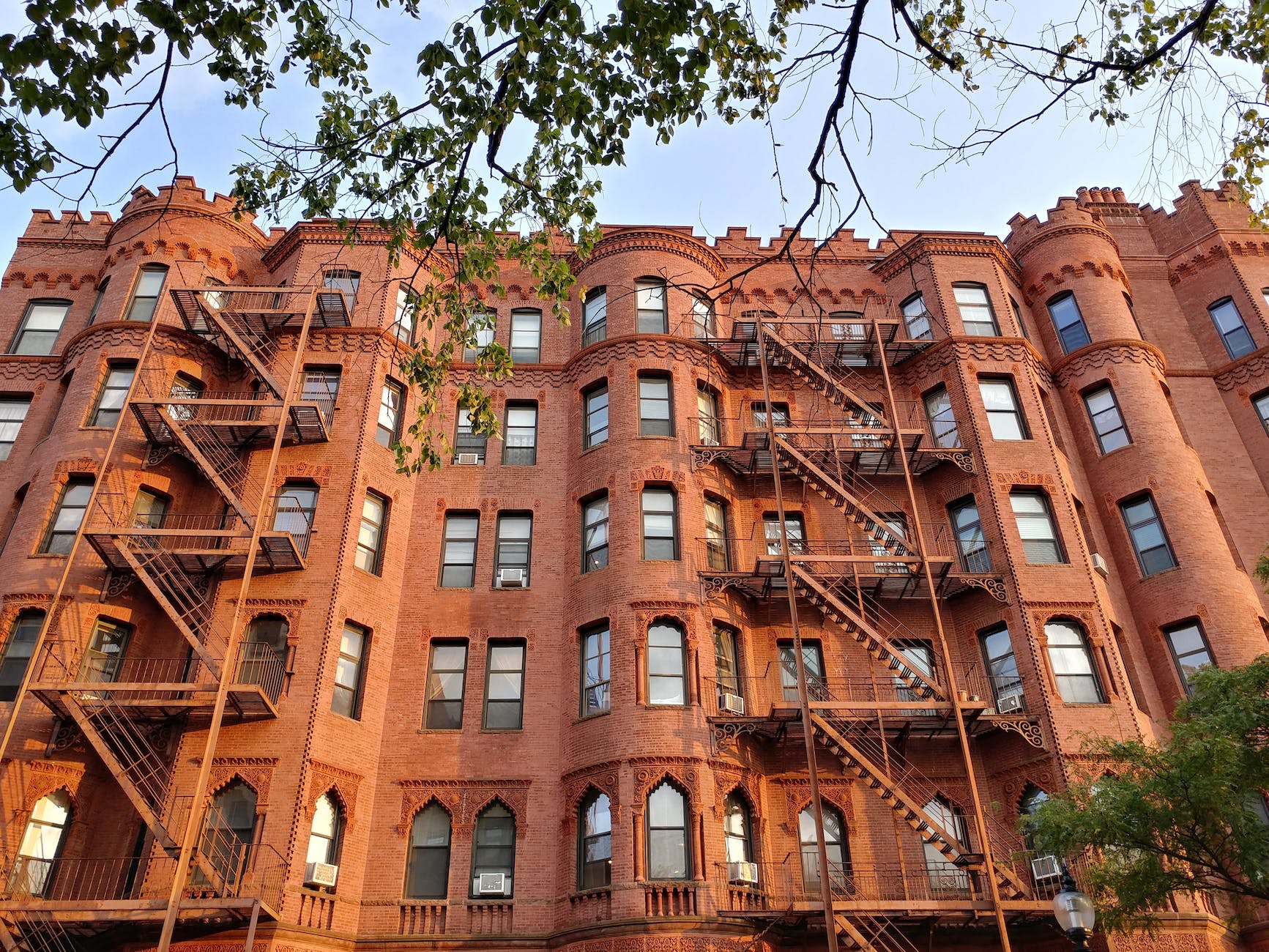
Timeless Boston brownstone Photo credit: bau015faran on Pexels.com
The rationale behind our move was understandable, but the cross-country shift hit me hard. Once there, I often had the sensation that I’d landed in a foreign country—the flat landscape, humidity, unfamiliar food and smells, obsession with sports, prickly attitudes, and sometimes undecipherable accents/slang all combined to made me feel like an outsider who might never crack the code required to live comfortably in my adopted state.
Over time, things improved. I made friends, recognized the freedom the subway offered to non-drivers, got to know my mother’s family, found the bookstores, and took up rollerblading on the paths that lined the Charles River. Briny clam chowder and thin-crust pizza became diet staples. Yet part of me never stopped missing the state that formed me. In fact, for a long while it felt as if I was pining for a lover, one that I’d been forced to leave behind and to whom subsequent lovers paled in comparison. When can I move back? I’d ask myself, sometimes daily. When can I settle back into the arms of my first love?
No bridge looks the same after you’ve crossed this one
You might wonder how I broke the spell, cracked the code, and found happiness again. The answer is simple: I stopped comparing and started appreciating. The Charles River is not the Pacific Ocean, and it doesn’t have to be. The Boston Commons is not Golden Gate Park, nor should it be. I began to grasp that everything has its place and purpose and that I wasn’t fully living the good life I’d been given. Instead, I was keeping a foot in another world, one far away from the present. That way of living, halfway invested and forever dissatisfied, was making me miserable.
Learning to appreciate right now and right here and ceasing to compare has served me well over the years. Nowadays, instead of living on one of the coasts I live in the beautiful middle of the US, and I call often on the conclusions I came to all those years ago.
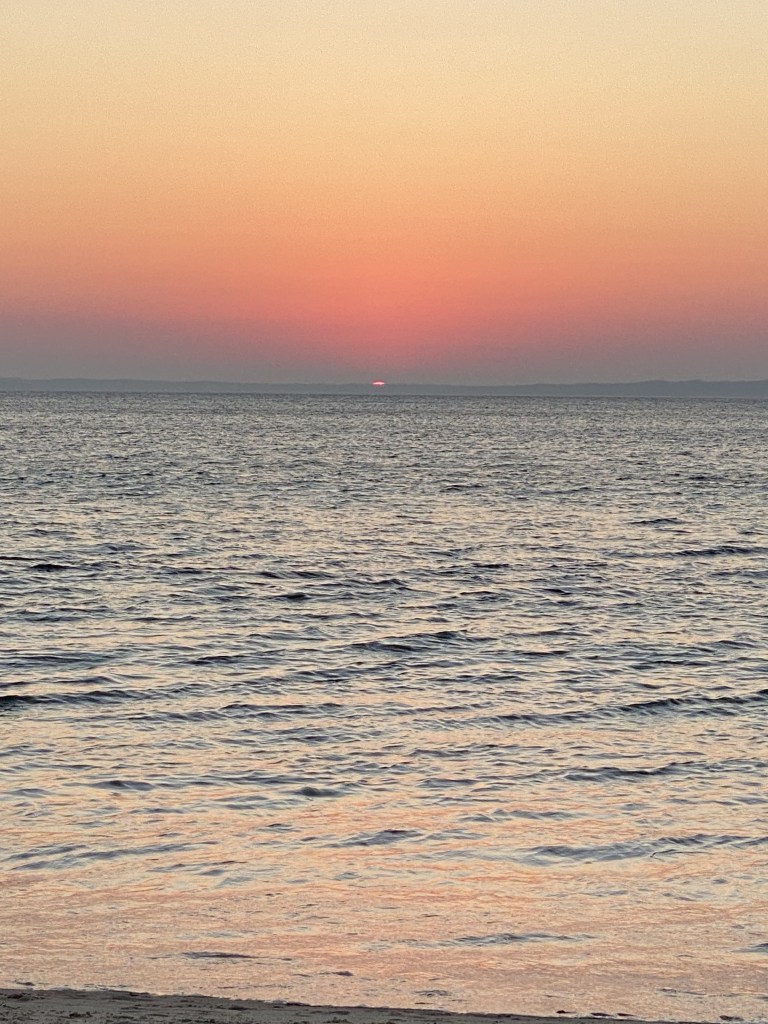
The same sun sets over the Atlantic and the Pacific oceans. Guess which one this is?
California will forever remain my first love, and rightfully so, but I’ve developed a muscle that helps me find beauty and purpose wherever I land.
If I hadn’t traded one coast for the other so many years ago I wouldn’t have that understanding—I gave myself the gift of a lifetime.
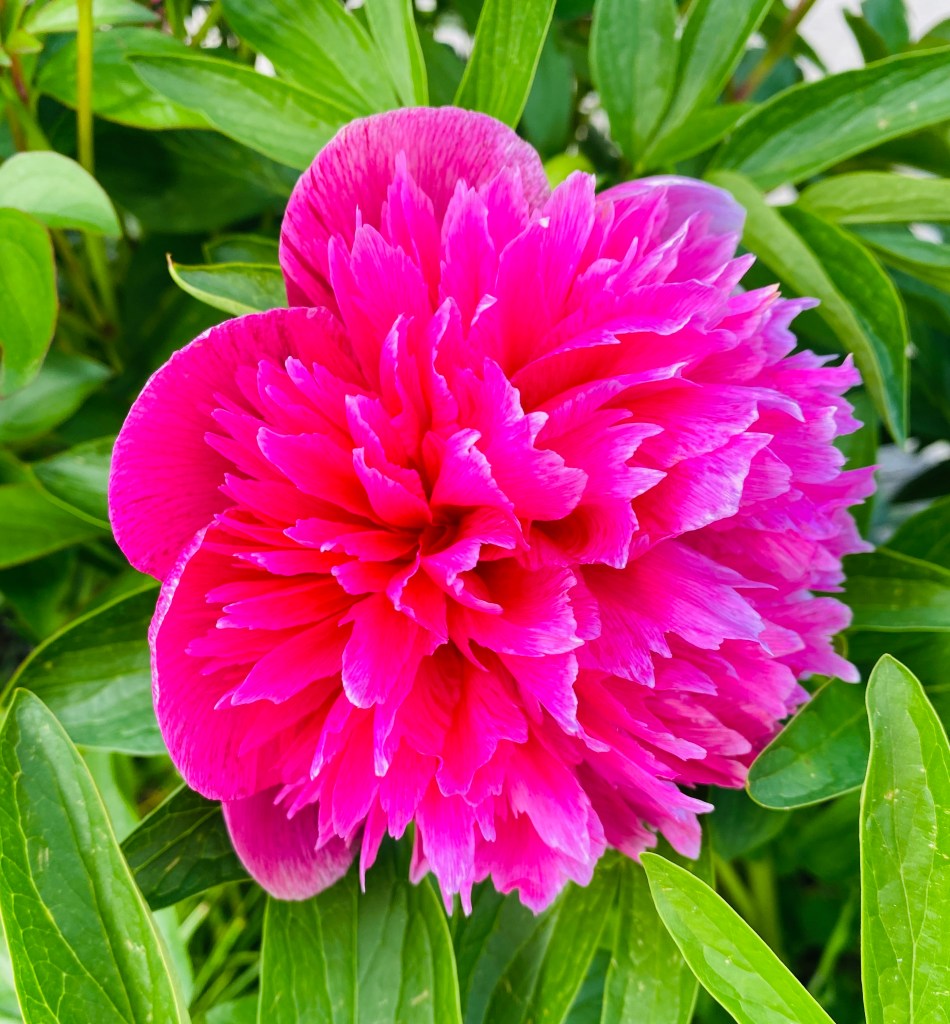
Peonies: the only flower featured in my homemade wedding bouquet.
I experienced my first Midwest spring at the age of sixteen when I, a native Californian, attended boarding school in Missouri. The experience of that season was memorable and lingers even today.
Awed by scarlet redbud trees, bursting pink peonies, and carpets of purple violets, I remember feeling an odd restlessness, an overwhelmingly expectant sense that I now recognize as spring fever.
Redbuds are often the first blooms to arrive.
We teenagers sat in overheated classrooms that spring, shedding unnecessary clothing layers, and gazed longingly out the window at landscapes painted with more colors of green than I knew possible. Everything felt laden with yearning and newness.
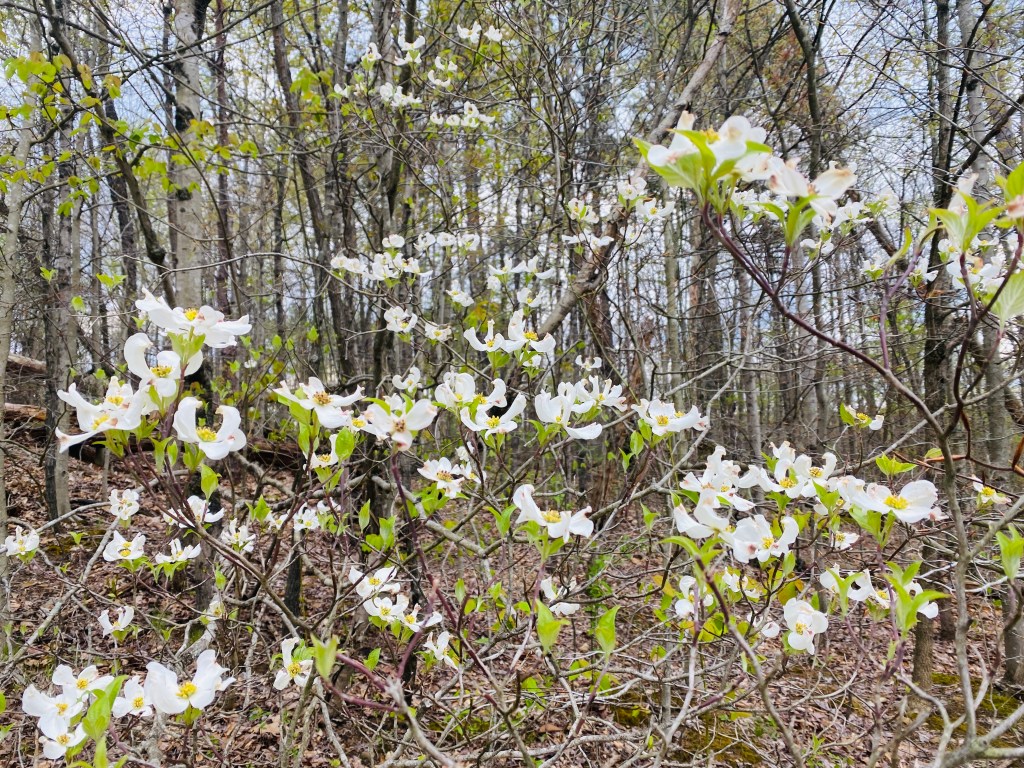
White dogwood blossoms make their forest entrance.
It’s not that spring in Northern California was unwelcome or lacking color, it’s that the overall effect wasn’t quite the same, nor was the sweet season as hard-won. A few months of winter rain and chill simply can’t compete with the impact of snowfall, sleet, hail, and thunderstorms.
In California, while certain plants bloom in spring and the hillsides often reach Irish heights of green, the resident birds, for the most part, remain in the same territory (and sing) all year long, and much of the foliage stays the same.
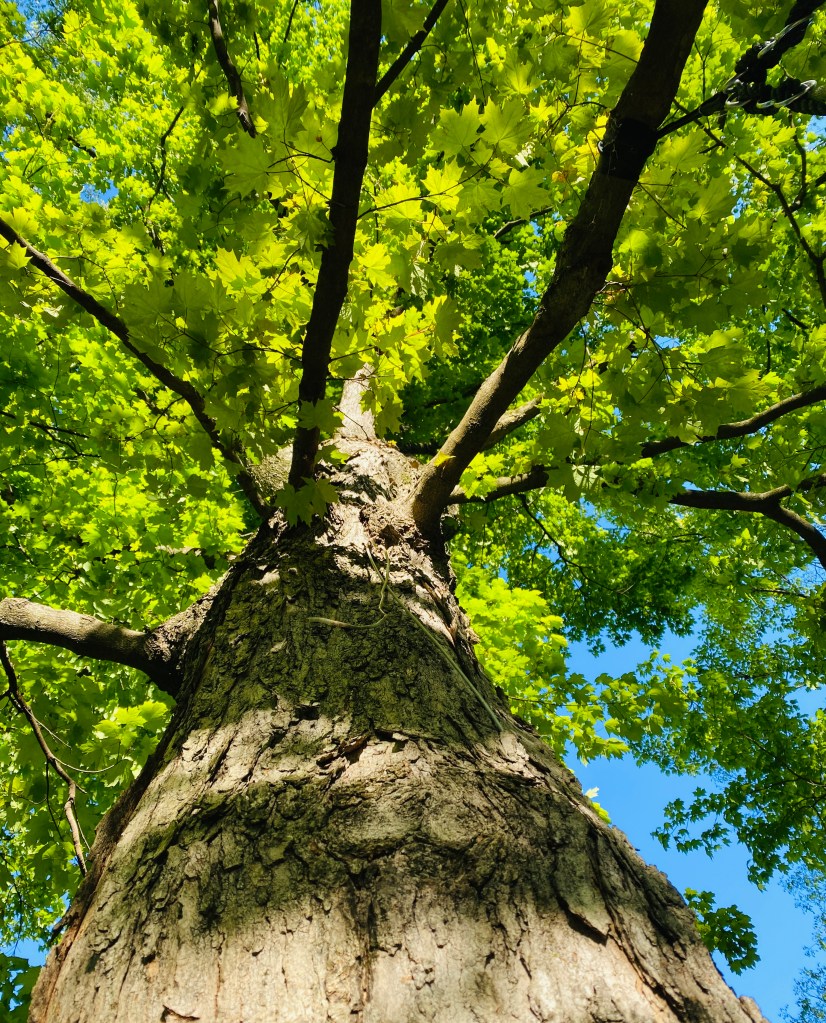
In the Midwest you know Spring is close when the birds begin singing you awake. Each stage of Midwest spring holds beauty—beginning with bursts of welcome color against stark grey tree trunks, continuing with the elegant white and pink dogwoods that recall Japanese woodcuts, and for the finale…the trees and bushes are adorned with the kind of green that vibrates in the sun and calms the soul.
A favorite maple puts on her greenery.
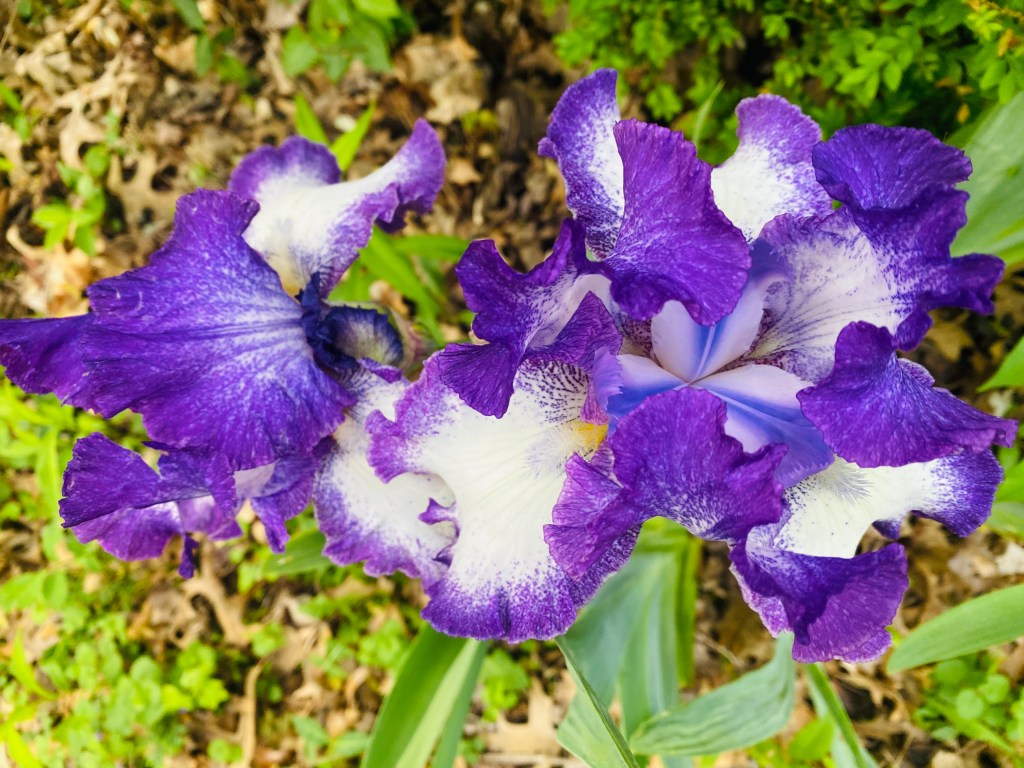
Back in high school I never imagined I would one day have my own Midwest landscape to tend but now I do–and here is where the two geographies connect: long ago my mother dug up some Bearded iris bulbs out of her California garden and gifted them to her dear friend Nancy who planted them in her own California garden where they bloom and thrive, even to this day.
Nancy has a gift for arranging the irises artistically in tall handmade pottery vases around her house and seeing those displays always gave me the sense that my mother was close, even though she is no longer here physically with us.
After living in California for a decade in my thirties I transplanted yet again to the Midwest and Nancy surprised me by digging up and sending me tulip bulbs from the same plants my mother had given to her all those years ago.
Bearded iris blooms.
Now, springtime not only returns the green, but it also returns the gift of my mother’s presence and touch, in full bloom yet again no matter the locale.
It makes me uncomfortable to say (and write) it but here goes: I value my father’s writing more now that he is gone.
I must have read my dad’s walnut essay (as I call it) when it was first published in 1984, but when I unearthed it two years ago it felt like I was reading it for the first time.
In my opinion, the essay perfectly captures his talent for noticing that which often goes unnoticed, and then translating the hidden meaning into inspiration for the rest of us.
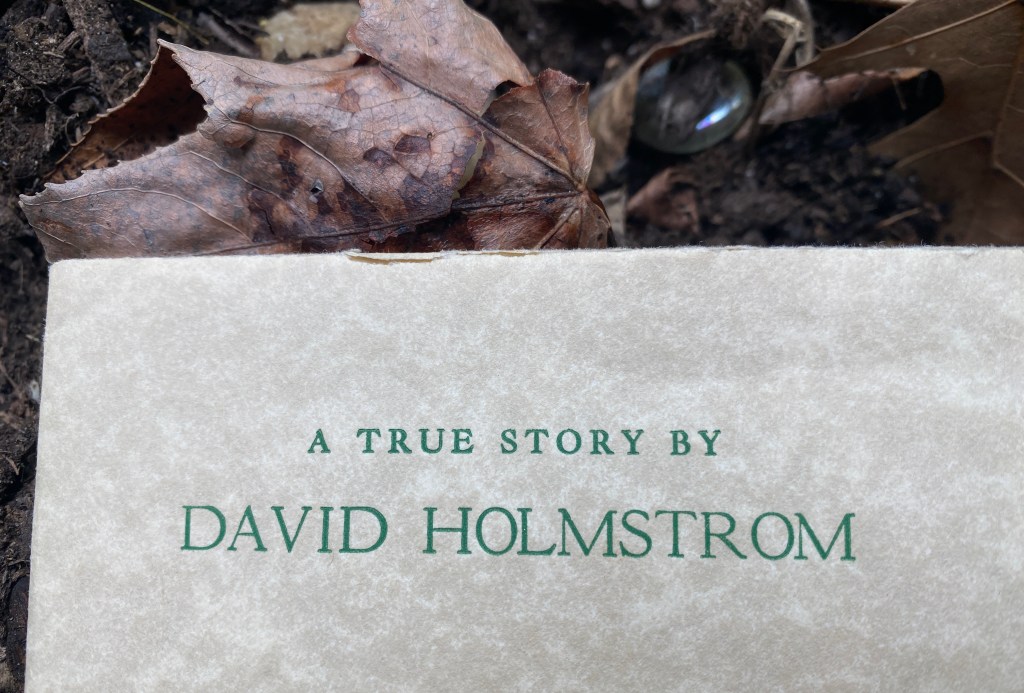
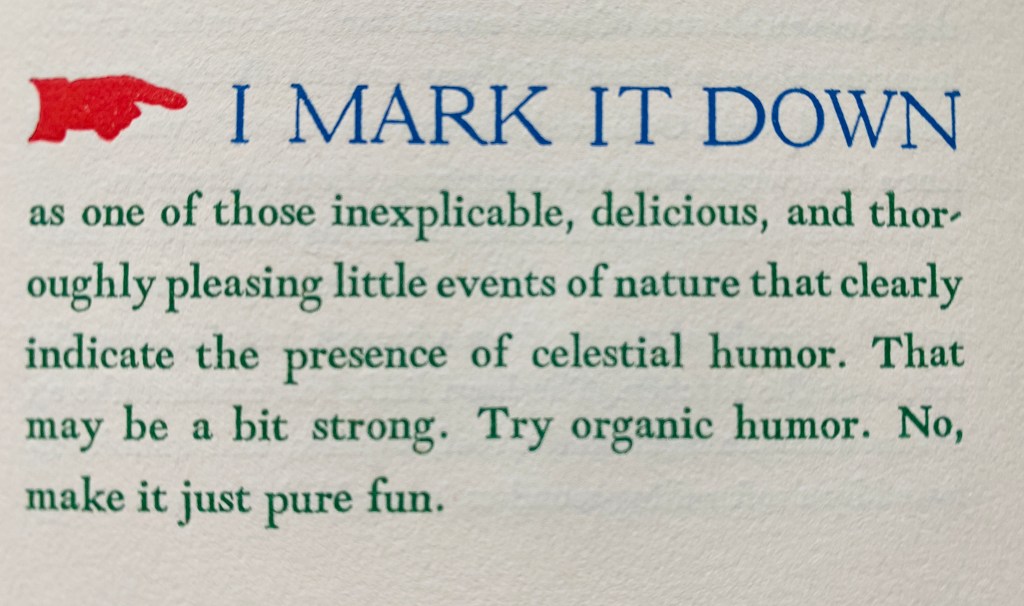
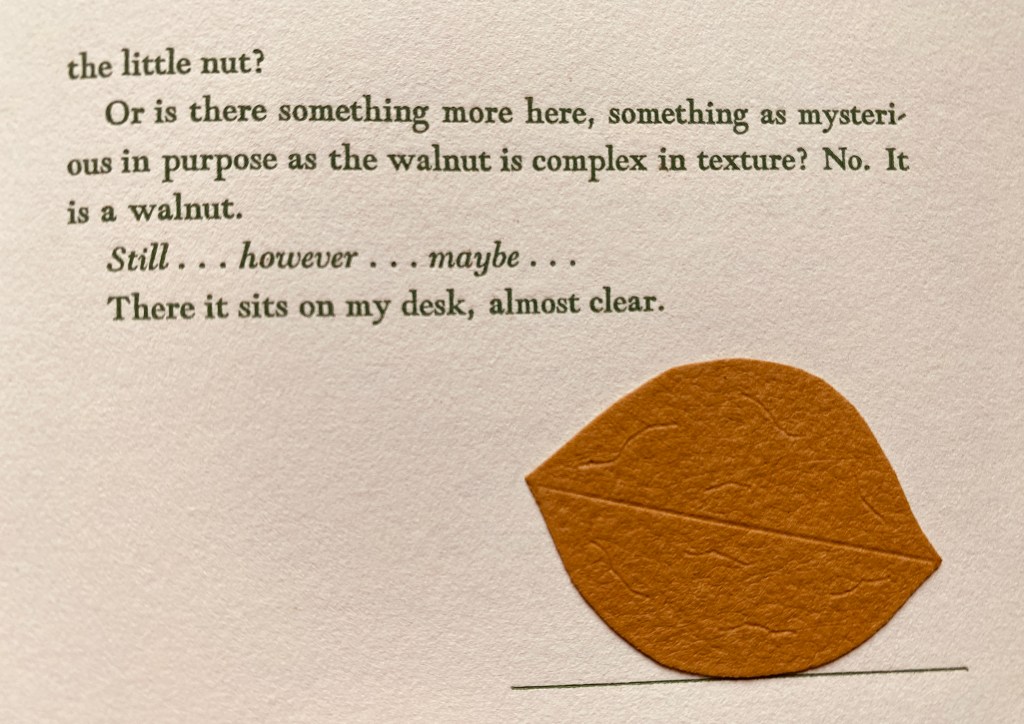
A reader who read my dad’s original walnut essay in The Christian Science Monitor recognized his wisdom as well. She ran a small print shop in Iowa and asked permission to turn the essay into book form. The printed images included are from the small book(s) she created.
Still … however … maybe …
By David Holmstrom
I mark it down as one of those inexplicable, delicious, and thoroughly pleasing little events of nature that clearly indicate the presence of celestial humor. That may be a bit strong. Try organic humor. No, make it just pure fun.
It was a brittle, still day. (Stillness is very important here, almost an aspect of readiness). No wind stirred and there was an absence of rural sounds such as cars and trucks humming along a distant highway or the collective sounds of resourceful birds. Overhead, the sun was sweetly warm and lent a lazy wryness to the conspiracy about to happen.
I was standing in the kitchen buttering bread for a maverick sandwich when the chain of events began. The walnut fell, directly above me from a branch hanging over the roof over the kitchen. The hard little ball crashed like an abrupt announcement on the roof, a quick, dull splunk followed by a soft rolling sound as it tumbled down the sloping angle of the gravel and tar roof. I looked up, butter knife poised.
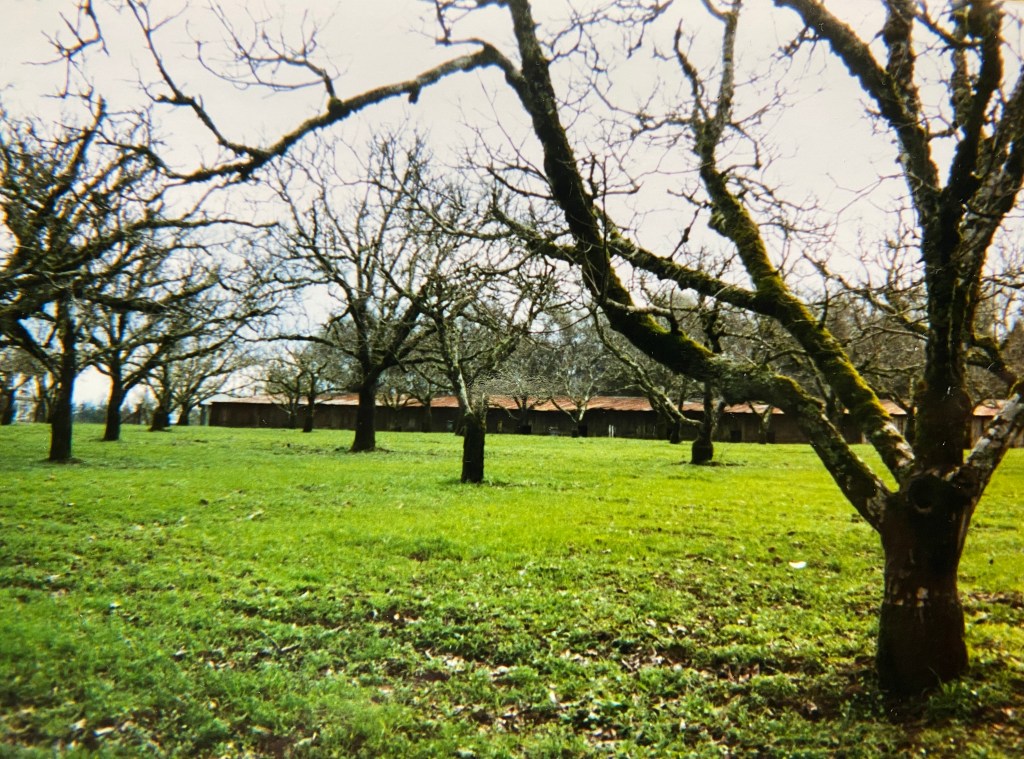
Northern California walnut grove in springtime.
The walnut then entered the uncovered hole of the drainpipe (attached to the outside of the kitchen wall) and plunged about eight feet down, ricocheting and rattling in the dark chamber for perhaps a second or more. Then it bashed against the curve of the drainpipe spout and shot out in a westerly fashion like a tiny bowling ball across a Lilliputian alley.
I looked out the window above the kitchen sink just in time to see the walnut skidding across the brick patio. For reasons that only a good time-and-motion man could probably explain, the walnut rolled quickly for four feet, glanced off the edge of a slightly raised brick, and pirouetted wildly on end like a top. When it finished it stopped, slumped on its side, and was motionless. Had it not been for me it would have slipped into walnut obscurity.
I felt delight. Was this not a funny little marvel? I felt serendipity. I also felt a somewhat low-key but irritating struggle within me to be a mature adult and not wax childish over the walnut’s curious journey. A falling walnut did not amount to a hill of beans, did it? It fell on the roof, went down a drainpipe, shot out the spout, and pirouetted crazily. So what? Still … however … maybe …
I laid down my butter knife and went out to the patio and picked up this … this, this acrobatic walnut.
To cast a spell, I should entertain fantasy here by conjuring up a walnut genie or fashion some kind of walnut clue to solving an international mystery. But the walnut in my hand – alas, poor walnut – was without guile or any need of the complexity of fiction. Break it open and find what? A guidance system? A tiny engine? A worm on a fun ride? Or a simple walnut. Still … however … maybe …
I will not lie. I actually went up on the roof the following day under the pretext of removing leaves from the roof. With a dozen walnuts I tried to duplicate the flight of the previous day’s walnut. I could not do it. The first walnut I rolled missed the hole. The second, too. The third rolled over the hole and over the edge of the roof. The fourth, fifth, and sixth would not roll near the hole. The ninth went down the hole into the drainpipe but never came out the spout. The rest were completely erratic.
What I have done is to put the previous day’s walnut in a special place on the clutter of my desk. Twice, out of nothing more than impulse, I brought the walnut to my ear in the way we’ve all done a hundred times with a big seashell to hear the hum of the sea. No sound comes from a walnut. But because of what it has done shouldn’t I somehow honor the little nut?
Or is there something more here, something as mysterious in purpose as the walnut is complex in texture? No. It is a walnut.
The odds of it happening aren’t good. If I told you the story you might not believe me, because it sounds like the basis of a movie script.
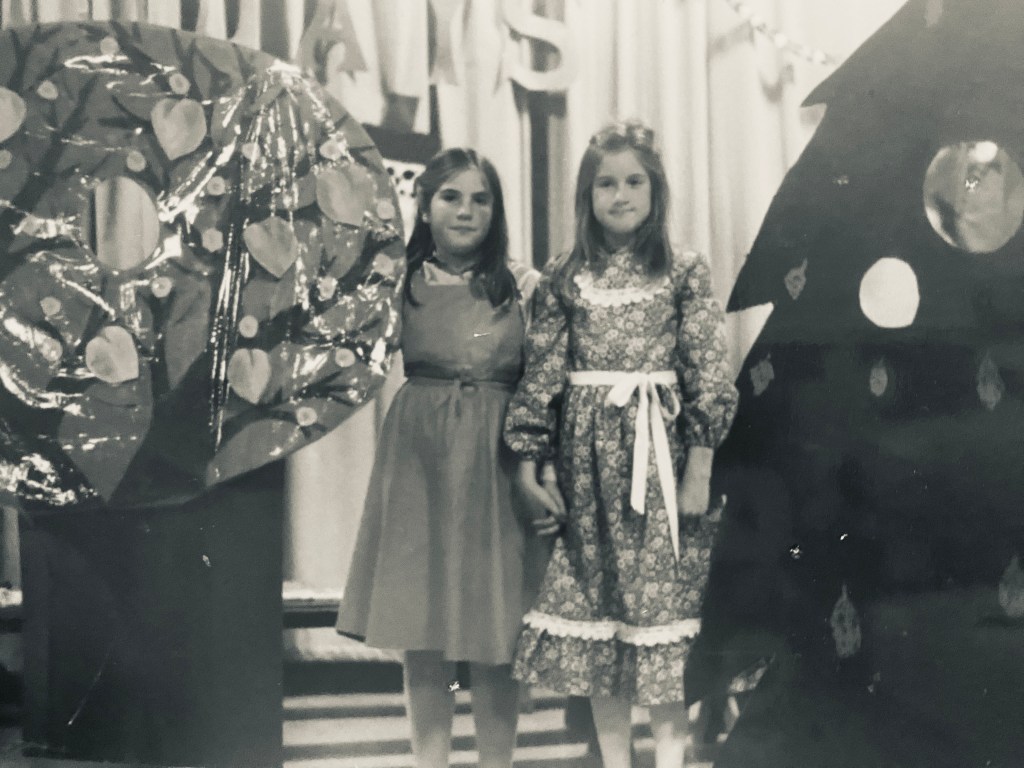
Two girls, both only children and the best of friends, grew up together in a small Northern California town called Kenwood. Leslie and Dilly met on the first day of first grade when Dilly took Leslie’s hand in hers to give her a tour of their elementary school. The brown-haired, brown-eyed girls shared a rare closeness, forged by their common gentle natures and sibling-free status. Whether exploring the beautiful creeks and lush valleys of their hometown or enjoying frequent sleepovers on thick foam mats in front of Dilly’s parents’ crackling fireplace Leslie and Dilly discussed their unknowable futures. What careers would they choose? Would they have children? Where would they travel? Who will they love? The girls went to school together, took dance classes, played soccer, and read voraciously.
In fourth grade, they won the roles of the Peach Tree (Dilly) and the Pine Tree (Leslie) in the holiday play. The girl’s four parents– all uniquely talented and creative—assisted in the building of the tree costumes/props; Dilly’s stately peach tree featured round and luscious-looking paper fruit while Leslie’s dark-green pine with dangling ornamental cones towered over her onstage.
Eventually, the teen years settled on the girls’ tender shoulders and the two began to drift in separate directions. They fell in with different crowds, Leslie’s more social and mainstream, Dilly’s cerebral and alternative. While remaining friendly, they spread their wings separately, each young woman setting off down her own complex and glorious life path.
When she turned fifteen Leslie’s family moved to the East Coast. For a long time after the move, there was a Dilly-sized hole in Leslie’s heart. Before, she never missed having a sibling because she had Dilly, but now Dilly was gone and Leslie couldn’t imagine anyone taking her place. Leslie realized that it was likely no friend would ever know her as well, or accept her as lovingly as Dilly had, and she mourned the friendship as she might a death.
Decades passed and after traveling the world and going to school on the East Coast, Leslie landed in San Francisco. Dilly goes to college, moves to Chicago, attends graduate school in Texas, and eventually settles in Los Angeles. Occasionally the two exchange brief, somewhat formal greeting cards.
One day, when Leslie and Dilly are in their early thirties, their mothers take a hike together. The mothers are friends and have remained in touch despite living on opposite coasts. The conversation turns to their daughters and Leslie’s mother mentions that Leslie is dating a young man from Bloomington, Indiana.
Dilly’s mother is incredulous. “Dilly is dating a guy from Bloomington, Indiana too!”
For a moment, the two mothers wonder if their daughters could be dating the same guy but soon learn that the men have different names. Crisis averted.
A few days later Leslie’s mother shares this oddity with Leslie’s boyfriend Malcolm and mentions Dilly’s boyfriend’s name. Malcolm is incredulous. “Daniel!? We grew up together, our parents were good friends and taught at the University together. We played all the time when we were kids. I think I called my grandmother Grammy because Daniel called his grandmother that.”
Everyone involved is amazed. A meet-up is arranged in Los Angeles and the two young couples, made up of four old friends, get along famously. New, grown-up friendships are forged. A few years later, when Leslie and Malcolm attend Dilly and Daniel’s elegant wedding in Dilly’s parents’ Kenwood backyard Malcolm knows many of the Midwest guests and Leslie the California contingent.
But there’s more. Leslie and Malcolm leave California and settle in Malcolm’s Indiana hometown. They grow a family and create a Midwest-based life together. Daniel’s mother has remained in Bloomington and Dilly and Daniel often visit from their home in Los Angeles, where they now own a successful business and raise their son.
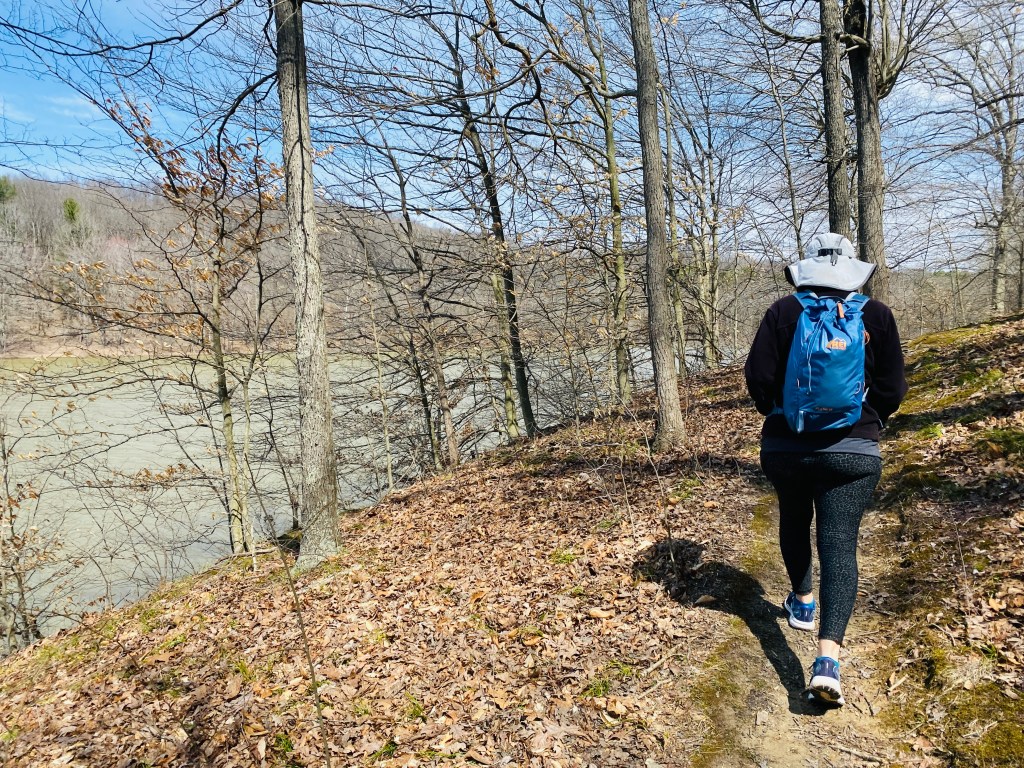
Dilly takes to the trail.
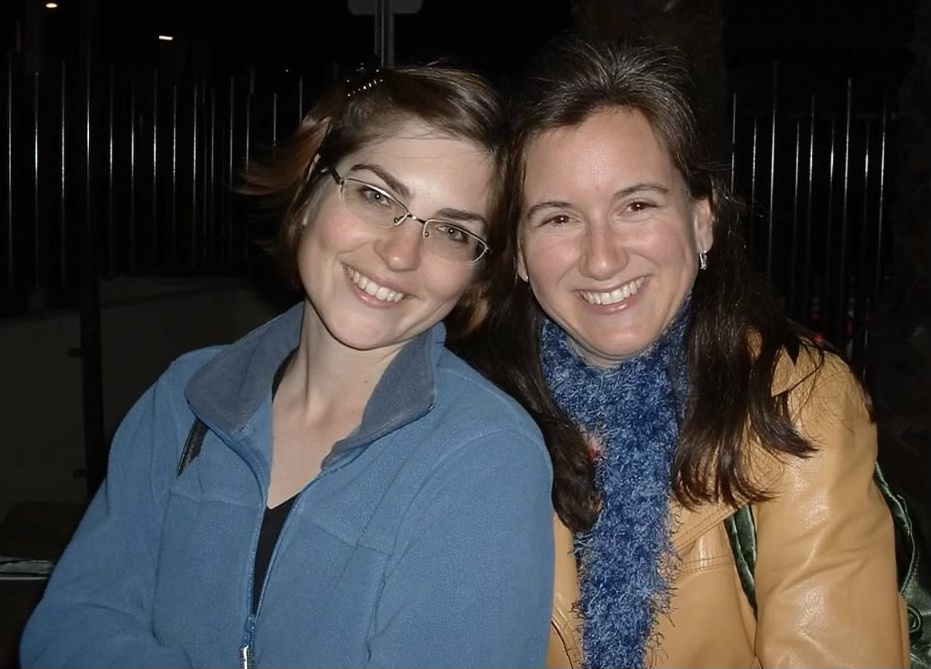
This means that Leslie and Dilly get to spend time together and re-stitch the fabric of their sisterhood. In fact, just the other day they took a five-mile hike through the Indiana woods. As their footsteps echoed through the springtime forest the two reviewed their rich lives—their chosen careers (writer and artist among other trades), their loves and losses, the three children shared between them and their world travels.
When Dilly reached for Leslie’s hand back on the first day of first grade she could never have imagined that forty-six years later she would be crunching down a leaf-covered trail in Indiana with that same Leslie.
While the future forever remains unknowable, the past is complete, and the present is really all we have. Now is the time to love each other, to cherish friendship. The unlikely yet sublime story these two friends share suggests that sometimes, despite ourselves, there are greater forces at work over a lifetime than we can fully comprehend.




 Still...however...maybe...
You must be logged in to post a comment.