“Spring has come at last. All the cold winter days are passed.”
— Quote engraved on a bench in Sugarloaf State Park
Recently, I hiked a cherished trail and held the hands of my past, present, and future selves.
A decision I made six years ago has made all the difference.
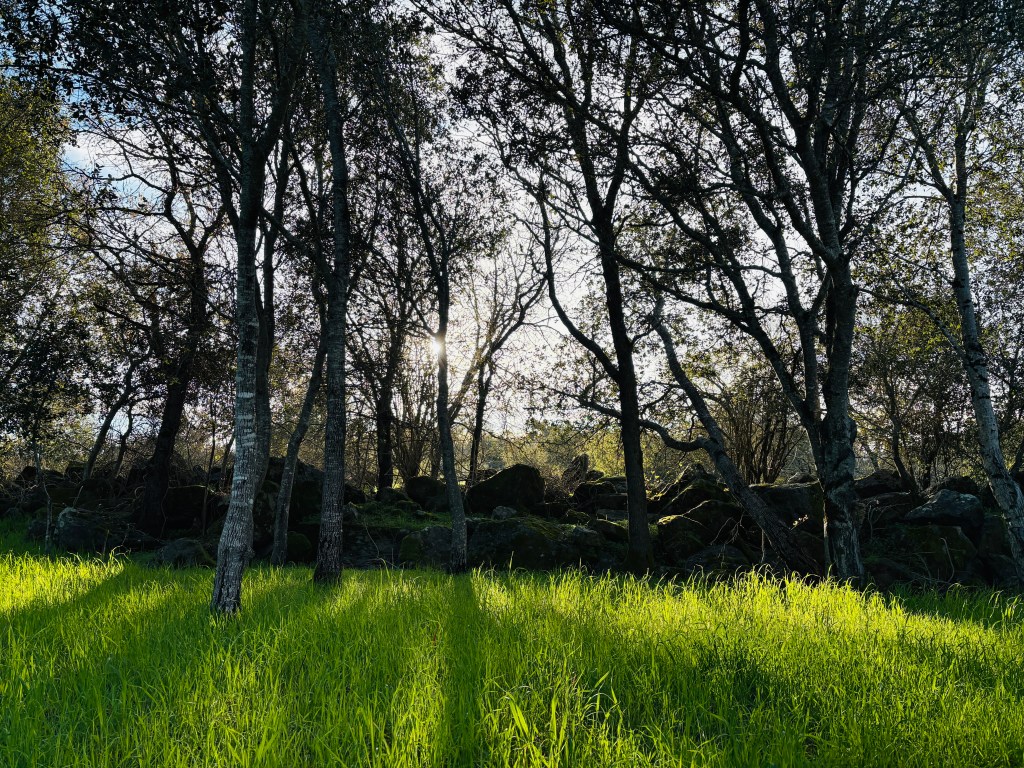
Sugarloaf State Park stretches across part of the Mayacamas Mountain range in Sonoma County, California. Like a vast emerald saddle, the park cradles wildflowers, waterfalls, redwoods and firs. An array of wildlife, including bears and mountain lions make the park their home.
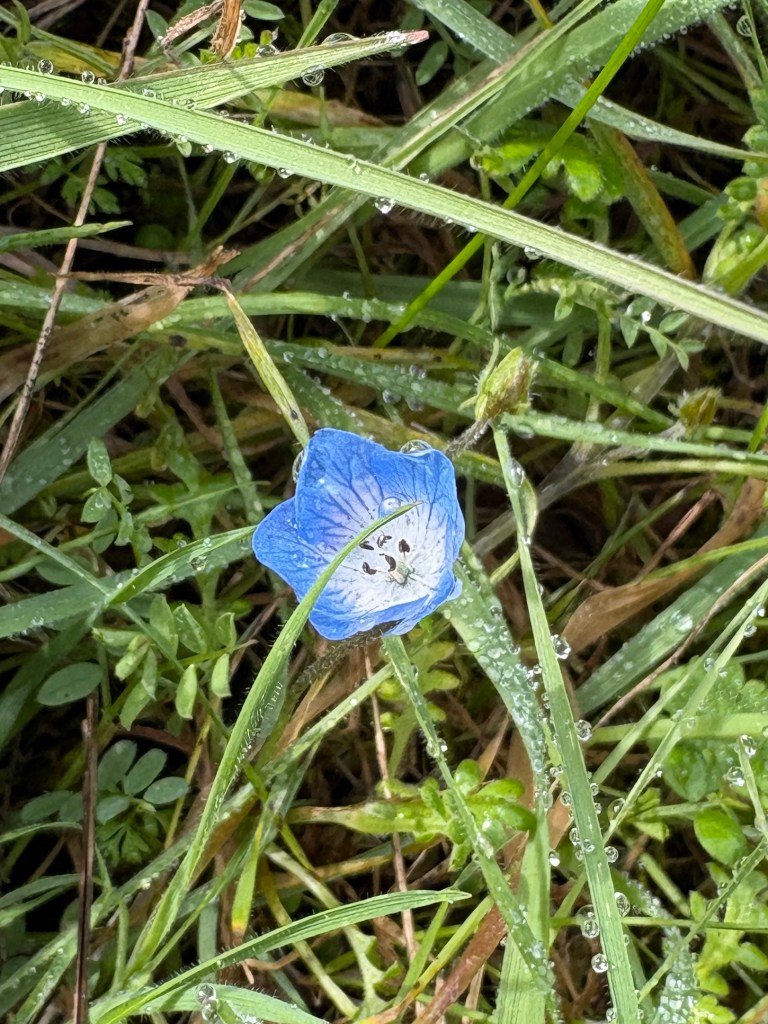
A tiny Baby blue eyes (Nemophila menziesii) blooms in a meadow.
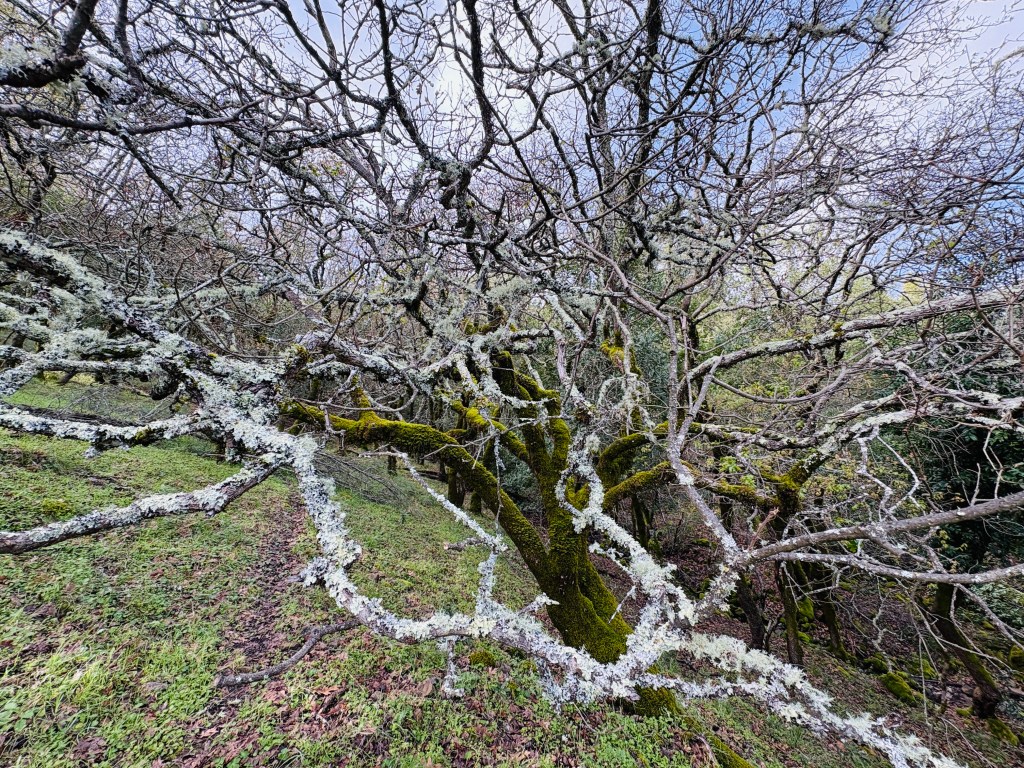
It is a chilly, misty early spring morning when I set off down the trail. I am happy to be walking by myself. Other than my footsteps on the hard-packed dirt and the the twirling of a Red-winged Blackbird in the distance, it is quiet. To my right, a meadow carpeted with dewy grass slopes northward, ending in a towering craggy rock face far above. A gnarled oak, dripping with lichen and lacy Spanish moss, beckons at the top of the slope. Turning off, I heed the oak’s call and head up a faint deer passage.
The beckoning, mossy oak.
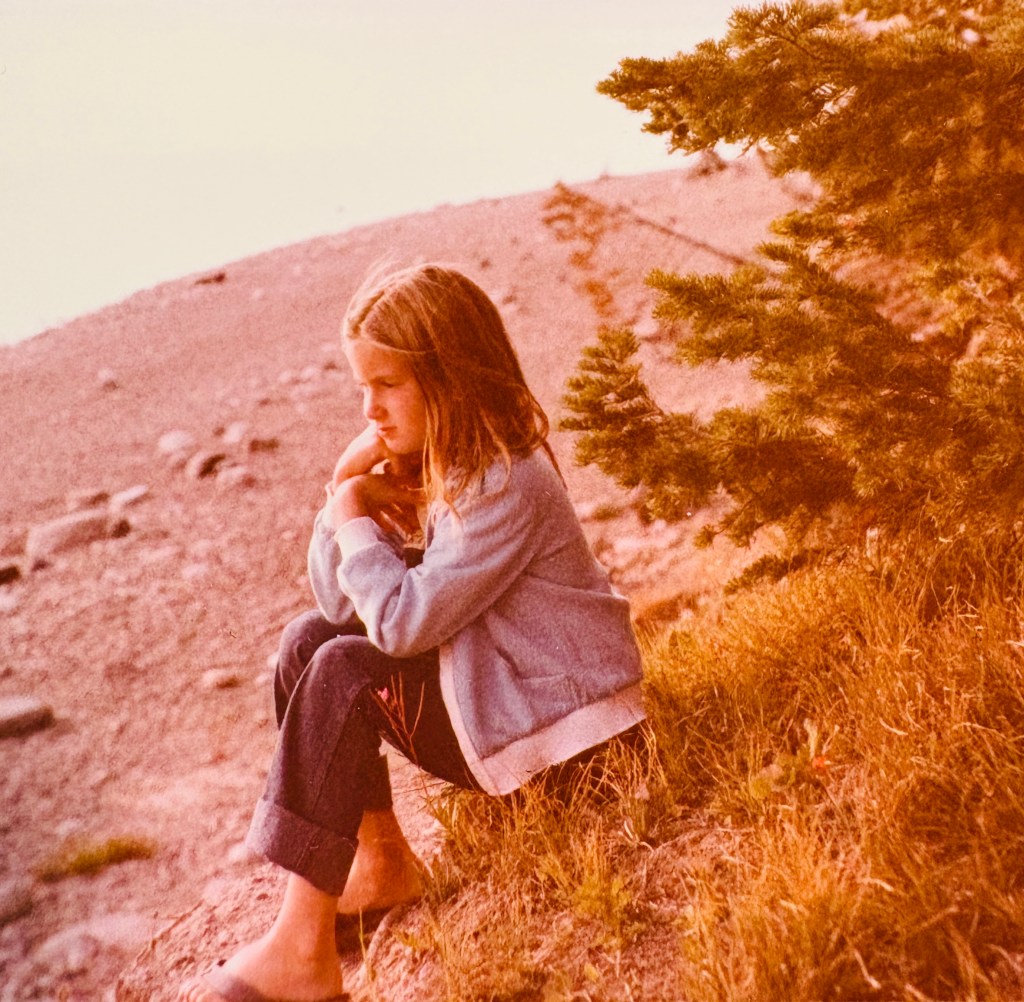
While I climb, I wonder how many times I have visited the park, and walked these trails. My first visit would have been at age six, when my family moved into a house nestled amongst the vineyards in the valley below. Throughout my formative years there were camping trips with my Brownie troop, hikes with my parents, and stargazing at the Robert Ferguson Observatory. It was in these friendly mountains that my love for nature was cemented.
Appreciating nature, age six. Portrait by my father.
Later, after moving away, I visited the park with city friends, my now husband, and eventually my children. Further up the trail grow the same blackberry bushes that produced the fruit that smeared across my lips and pricked my fingertips as a child.
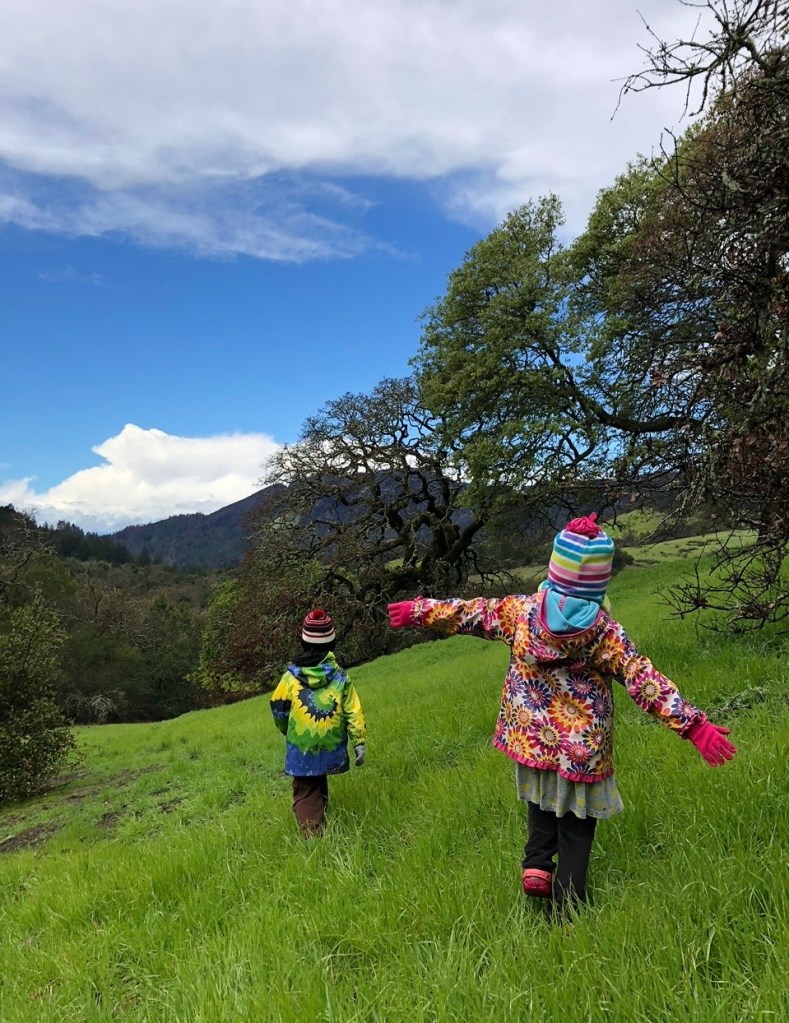
My children found the park equally as enchanting (2018).
Once, in my early 30s, while living in San Francisco, I camped solo at one of the park’s sites and slept through an overnight rainstorm. I woke to a partially soggy sleeping bag and a swollen creek a few feet from my head. That visit was also memorable for another reason—I had experienced a gripping panic attack (my first) while driving to the park in hectic Bay Area traffic. Pulling off to the side of the 101 Freeway at rush hour on a Friday is not something I would recommend, but I was desperate for peace. It would be easy to say that the stresses of my professional and personal life at the time contributed to that experience, but that would be a lie. In truth, before getting into the car, I’d gotten way too high.
At the top of the sloping hill, I look out across the ridge and remember the times I visited this park as an adult under the influence. My road to sobriety has been paved with a need for clarity, for telling myself the truth. Without relying on substances I’m happier, more free, less caught up in my many faults. More aware of my many, many blessings. Loathe to mistreat myself.
Recently, I wrote the following about striving for sobriety in a letter to a friend; “If you’ve been working hard to cultivate your deeper awareness of the world around you, to tend to the unspoken by being more honest with yourself, to respond to the direction of your heart/gut, then your actions and decisions can naturally flow from this sacred intention. Letting go of the internal struggle is a relief and frees up mental space. The internal push/pull, the self-incrimination can dissolve like the mist on the Pacific.”
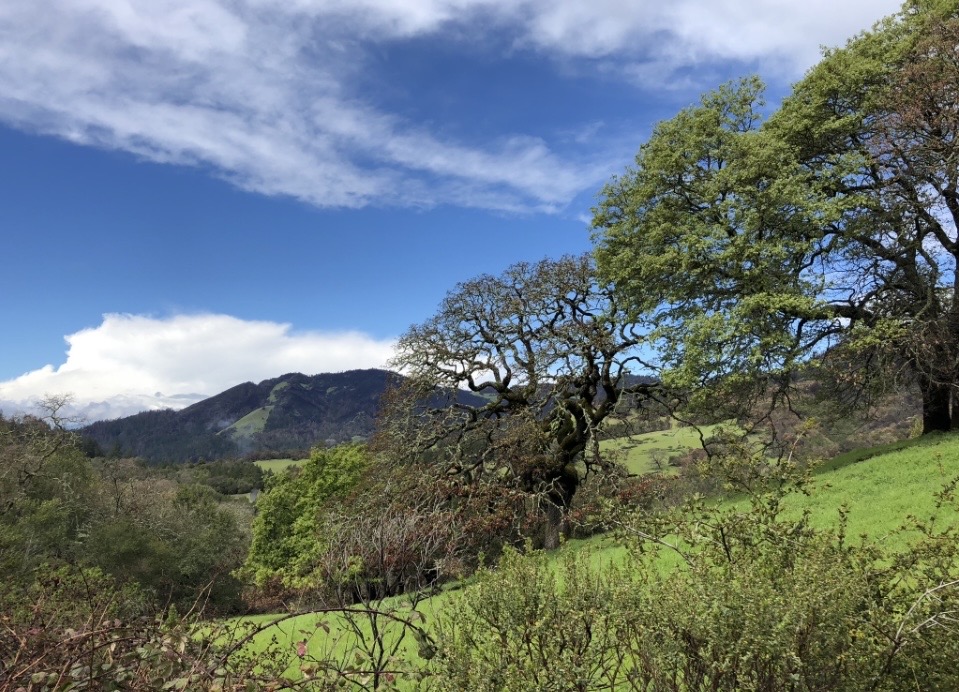
In front of me, green hills resonate against the azure blue of the sky. Gratitude for the calm clarity I feel washes over me. I have deep reverence for this land; the trees, birds, grasses, butterflies, flowers, clear-running creeks, moss, lichen, and even the mud. Today I am seeing the place through new eyes, unencumbered by any influence other than the peace of the morning.
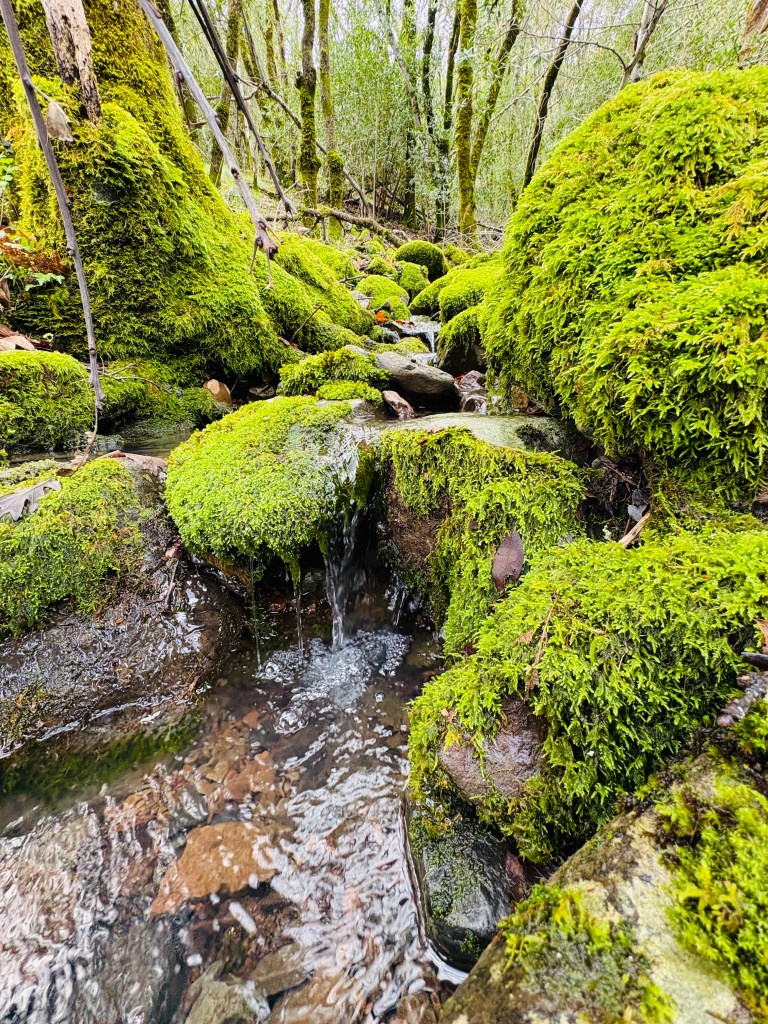
Veering off the deer trail, I find a creek I’ve never seen before. Perching on a rock, enchanted, I listen to the musical sound of the water moving across mossy rocks. It strikes me how much has happened since I plucked those childhood blackberries, both in the park and in my own life.
The enchanted creek.
In 2020, the Glass Fire devastated 75% of the vegetation in Sugarloaf. Today, evidence of the fire still lingers in pockets darkened by ashes. After closing for a stretch, the park survived, and life sprouted anew. Trees have shed limbs and grown new ones, grass has sprouted, wildflowers have bloomed, animals have died. New ones have been born.
2020 was a big year for me, too. Almost 50, newly sober, I navigated (truthfully, mostly bumbled ) through the pandemic. For me, this included anxiety attacks, homeschooling, unemployment, a concussion, and the death of my beloved father. Like the park, I came out the other side, a little singed, but still here, and stronger for it all.
Since then parts of me have healed and sprouted anew (my writing practice, for instance). Other parts have dropped away (I released more than one addiction). There is renewed appreciation for my resources, talents, and privilege. Landing at midlife, solidly on my feet, feels like a gift. My past is acknowledged and appreciated. My future stretches out like an unexplored mountain range, full of fresh adventure and promise.
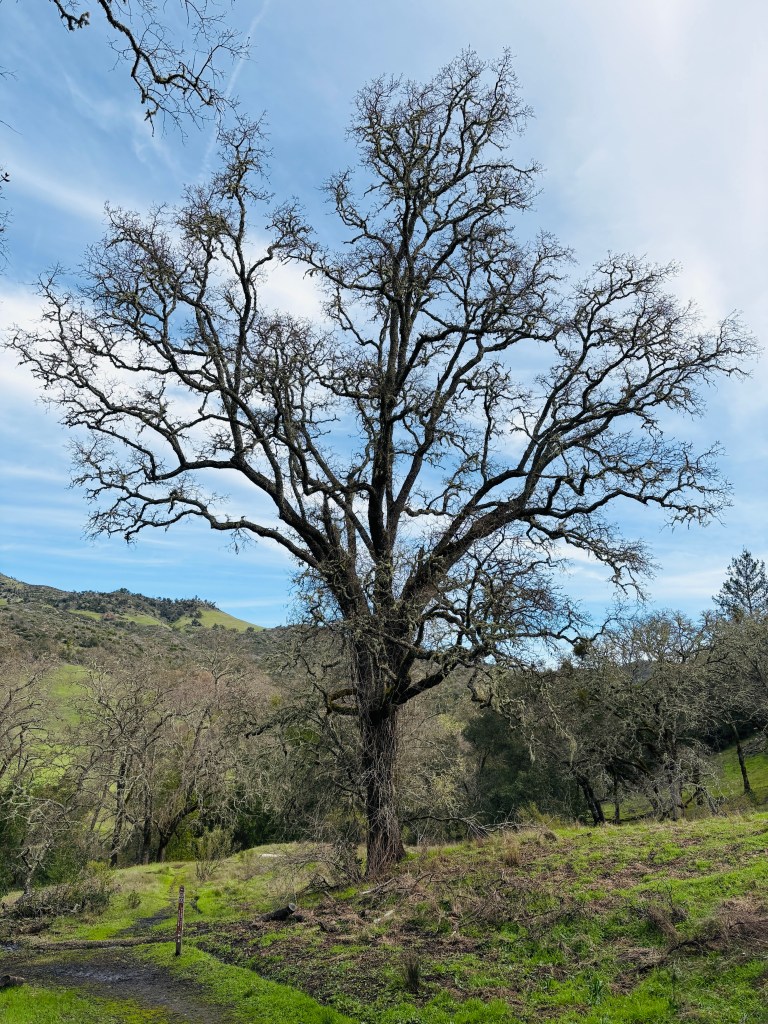
A stately oak, licked by the fire but growing strong.
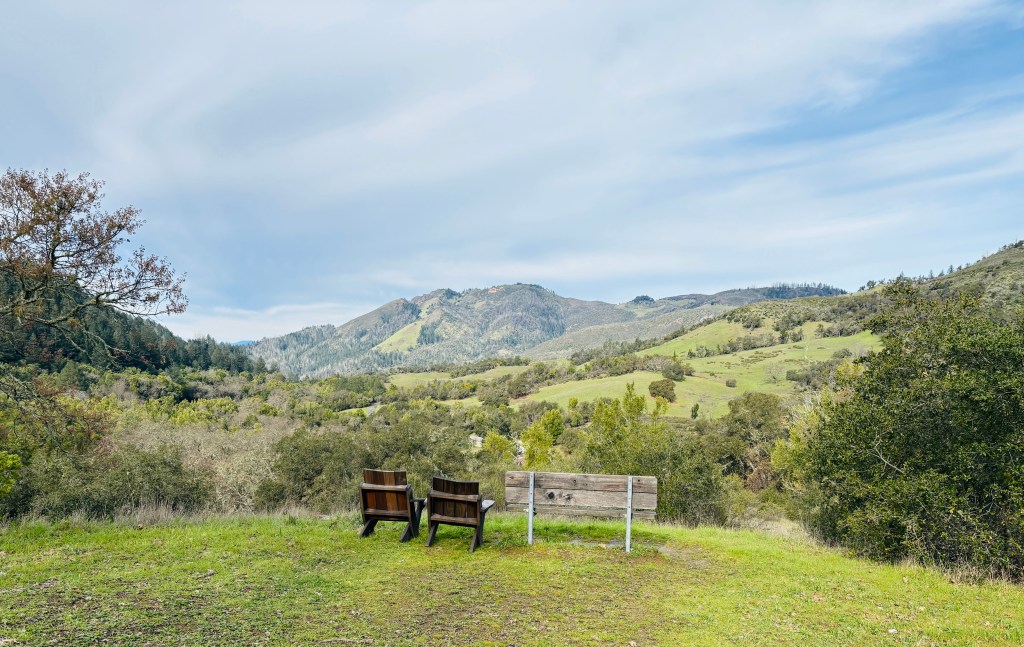
Heading back down the slope, I reconnect with the main trail, eventually arriving at my favorite scenic overlook. Slightly out of breath, I stand at the bench and give thanks to the thoughtful soul who put it there. The view is what I imagine the afterlife will look like.
A slice of heaven in California.
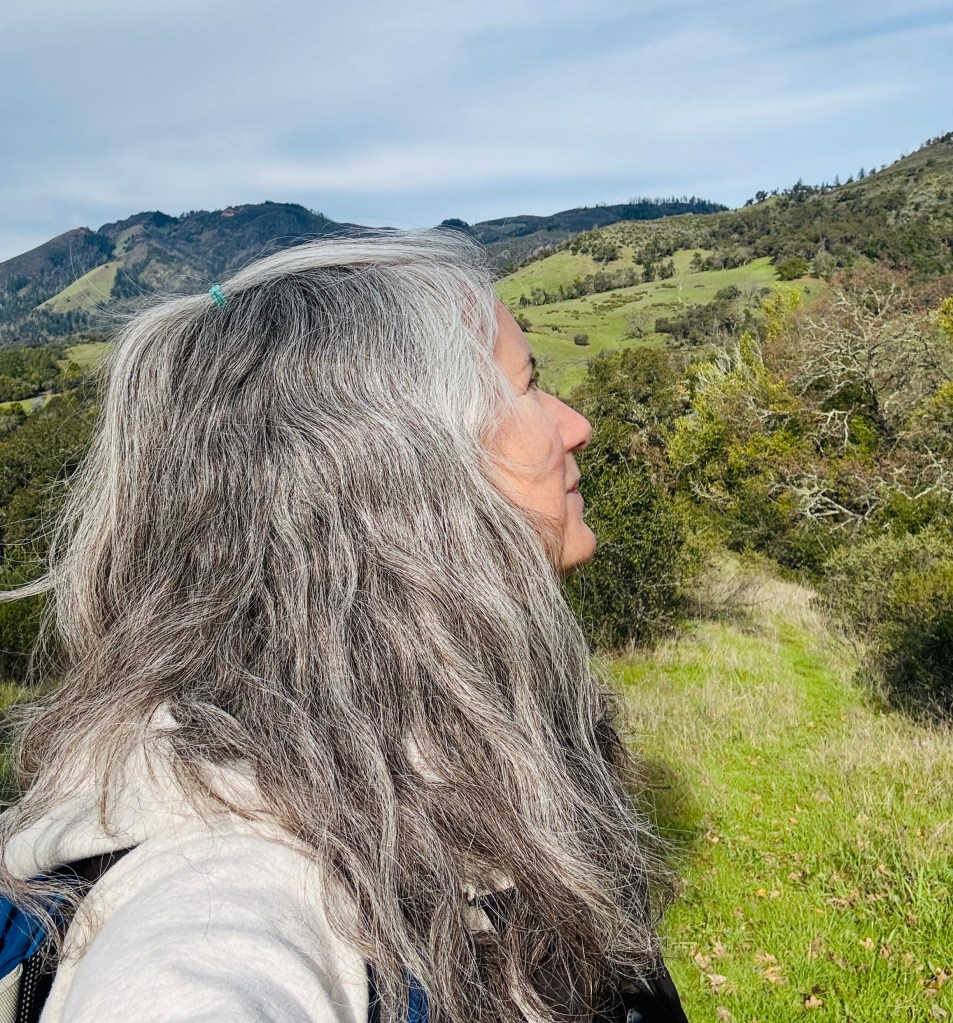
The past and future will take care of themselves, as they always do. I’ve learned that the most important thing is this very moment—the present one. The warmth of the sun on my upturned face, the gentle wind in my hair, the embrace of this place.
We’re still here, alive and renewed. The park, and me.
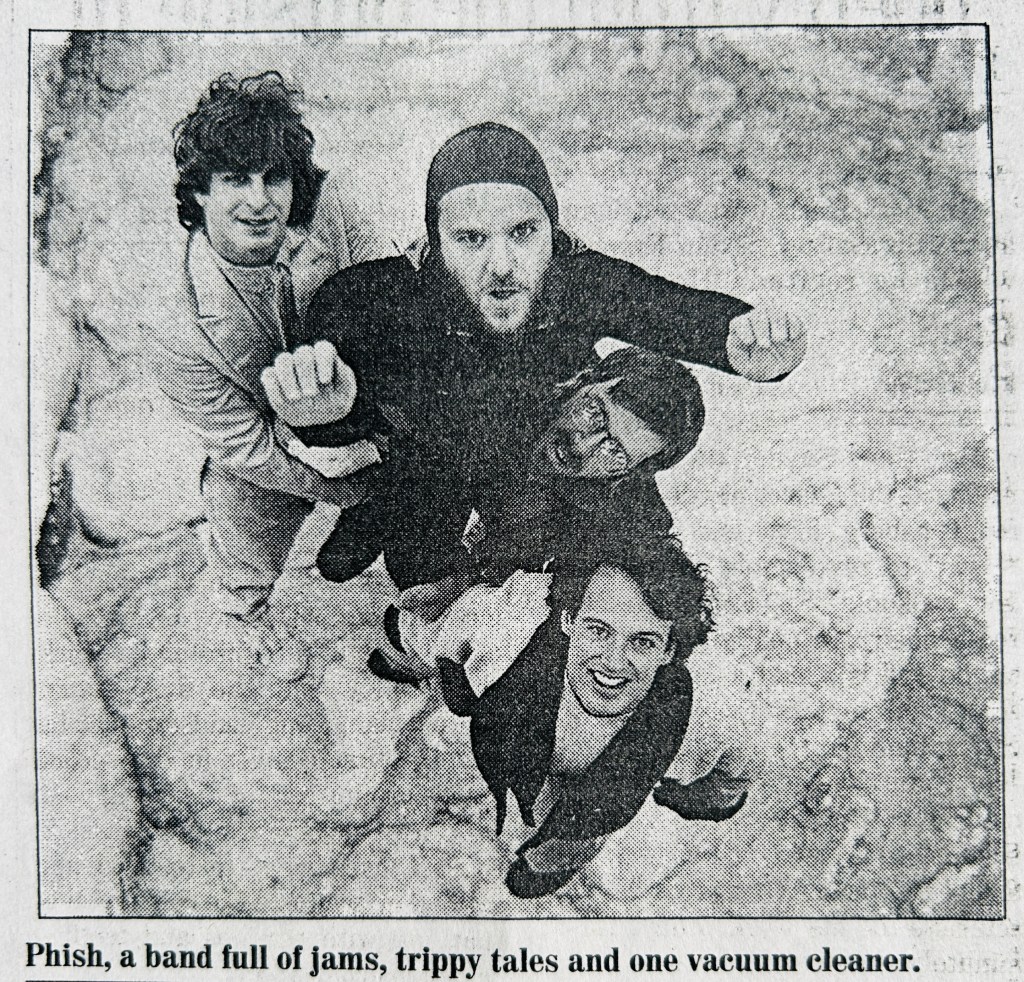
Phish, pictured in The Boston Globe, January 2, 1993
“When I jumped off, I had a bucket full of thoughts
When I first jumped off, I held that bucket in my hand
Ideas that would take me all around the world”
-Phish, Back on the Train, Farmhouse
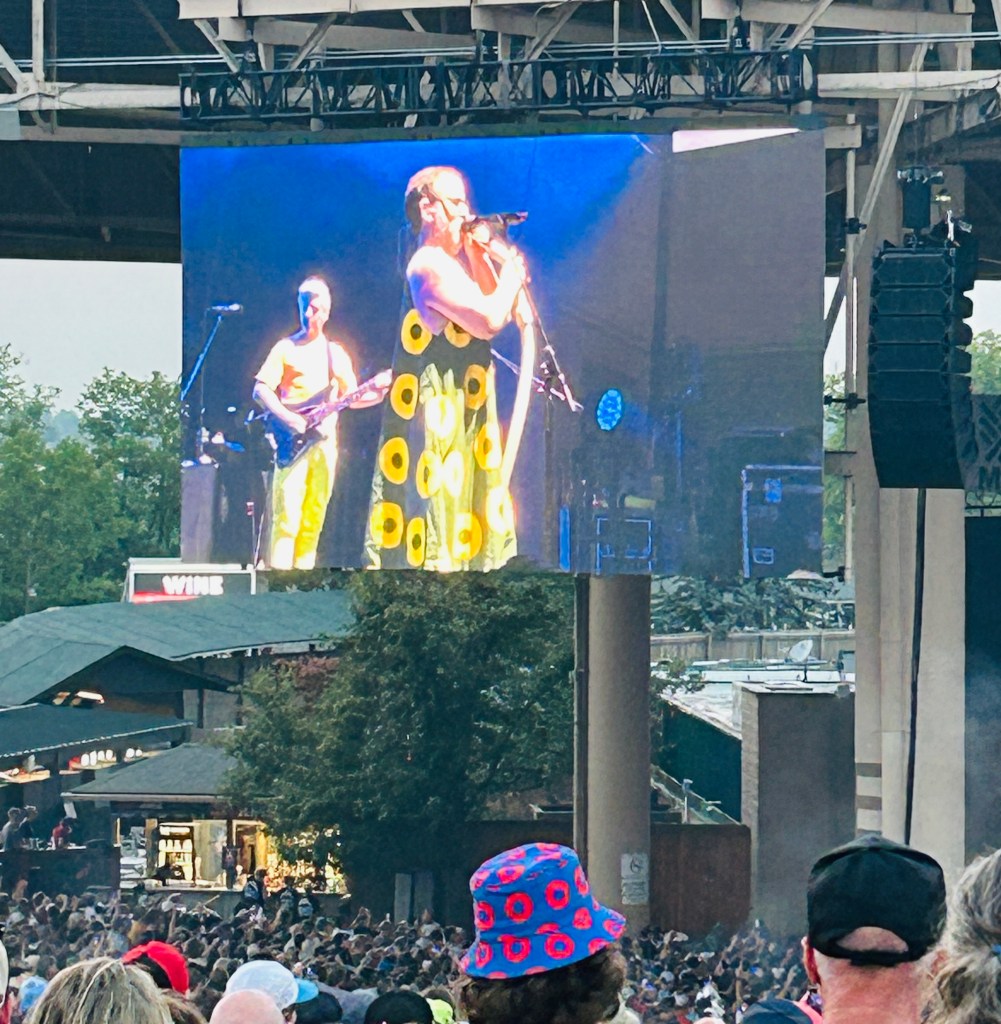
August 3, 2024, Noblesville, Indiana. A quizzical anticipation washes over the restless amphitheater crowd as the short, bespeckled man strides across the stage, dragging a vintage vacuum behind him. The man’s light cotton dress ruffles as the familiar red (or yellow this time?) circles dotting the fabric glow in the oppressively humid evening air.
My eyes remain glued to the giant hanging screen to my left as I watch the band’s namesake, Fishman, carefully place his lips to the end of the vacuum’s hose and … blow.
Jon Fishman makes the Hoover sing.
Imagine a cross between a flatulent Kermit the Frog and a beached seal’s whistling lamentation and you might come close to the sounds that emit from the microphone. As the crowd roars in appreciation, I stand on a narrowly folded picnic blanket, stagnant air trapping me, my husband, and our two friends in a sea of drifting marijuana smoke and patchouli-scented, undulating, frequently tie-dye adorned Phish fans.
Suddenly, the darkening sky above me appears to divide between the present and the past. I’m traveling back in time. Waaay back. Thirty-five years in fact.
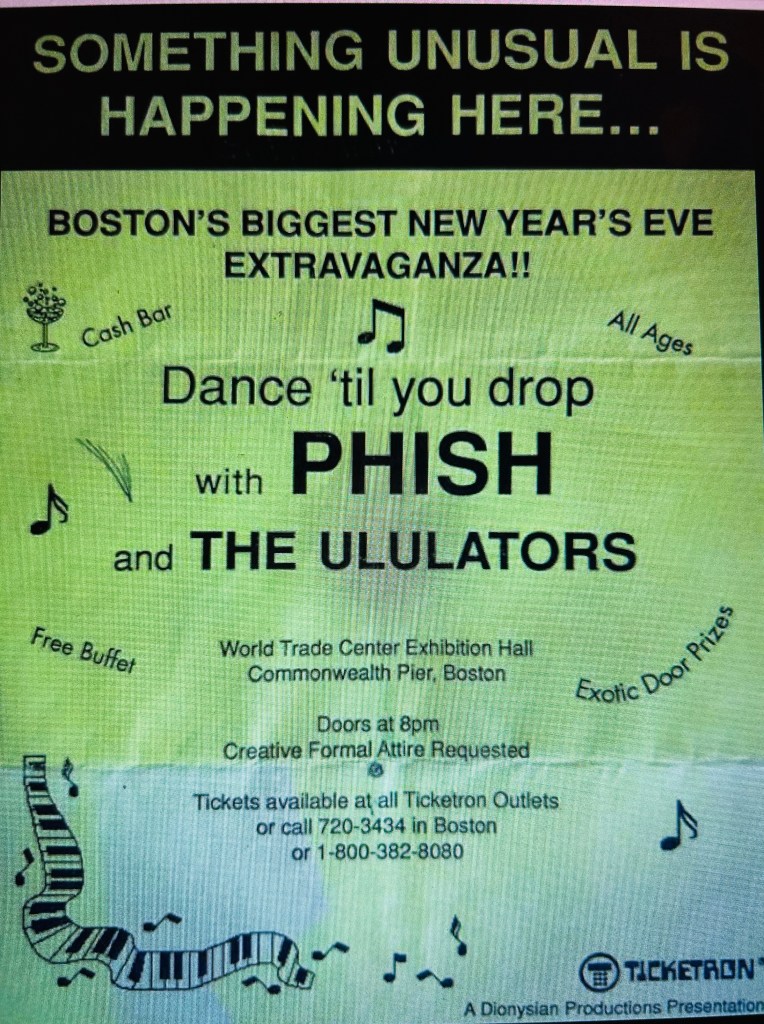
January 31, 1989, Boston, Massachusetts. I am nineteen years old, a recent college dropout sitting on the arm of a floral couch talking to my cousin on the phone, the receiver heavy in my hand. “We’re seeing Phish tonight,” she announces excitedly, “with a P, not an F … they’re hard to describe but I think you’d love them … this is their first New Year’s Eve show ever.” Impulsively (how else does a nineteen-year-old make a decision other than impulsively?) my high-school boyfriend and I decide to see the mysterious, aquatically-monikered band play in Boston that evening.
At that point, the future stadium-fillers only had a handful of fans. Jenny, my older by six months cousin, was first exposed to Phish’s music while attending a very alternative boarding school in Vermont (so alternative that her “roommates” at the institution consisted of her boyfriend and their pet rat—or was it a ferret—and their “dorm” a dilapidated cabin on a wooded Vermont hillside).
That final, frigid night of the 1980s found a group of us stomping along city streets, cold air winding its way under my velvet scarf and straight through my silvery tights as we searched for Boston’s World Trade Center Exhibition Hall, tucked away at the end of a pier. Once inside the wide, dark space we gripped our drinks and watched as the opening band, the popular Ululators, warmed up the festive, eclectic crowd.
Soon it was time for the main attraction to take the stage. A group of four grinning young guys walked out, not much older than us. The two guitar players wore tuxedos and top hats, and the drummer sported nothing but a G-string with tuxedo tails streaming out behind his bare rear.
As soon as the four launched into “I Didn’t Know,” I knew.
While it was clear that these guys were gifted musicians, but something else was also going on, fresh and wholly different. Lyrics were whimsical, clever, and funny. Guitar riffs melodic and transporting, with piano and drums providing both a classic and fresh accompaniment, rousing and soothing the crowd. This was rock music, but it was also a kind of entertainment, a university of the musically absurd.
I’d never seen a band enjoying themselves as much as the crowd facing them. Audience participation was encouraged, as important to the life show’s life as the performers on stage. As the four burned their way through instant classics like “Bathtub Gin,” “Split Open and Melt,” and “Fee” the energy created was reciprocal, as evidenced by the ecstatic grin splashed across the face of the man I later learned was Trey, the enthusiastic, head-bobbing red-haired guy who appeared to be leading the charge.
The notes built and crested and shattered as they rolled around in my head, sometimes all at once. But the highlight, the episode we talked about for days after, was when the red-circle-on-grey-fabric-dress-wearing Fishman (who in my opinion should receive more national credit for normalizing men wearing dresses) rolled a cylindrical vintage vacuum out on stage.
“Maybe he’s going to do a little cleaning,” I thought, “Hoover up the confetti?” Instead, he raised the hose to his willing lips and began to enjoy himself playing the vacuum like an instrument. Our mouths opened in wonderment, the crowd laughingly danced around the room and shook our heads in disbelief. That was it – I’d wager that everyone at that show became a Phish fan for life.
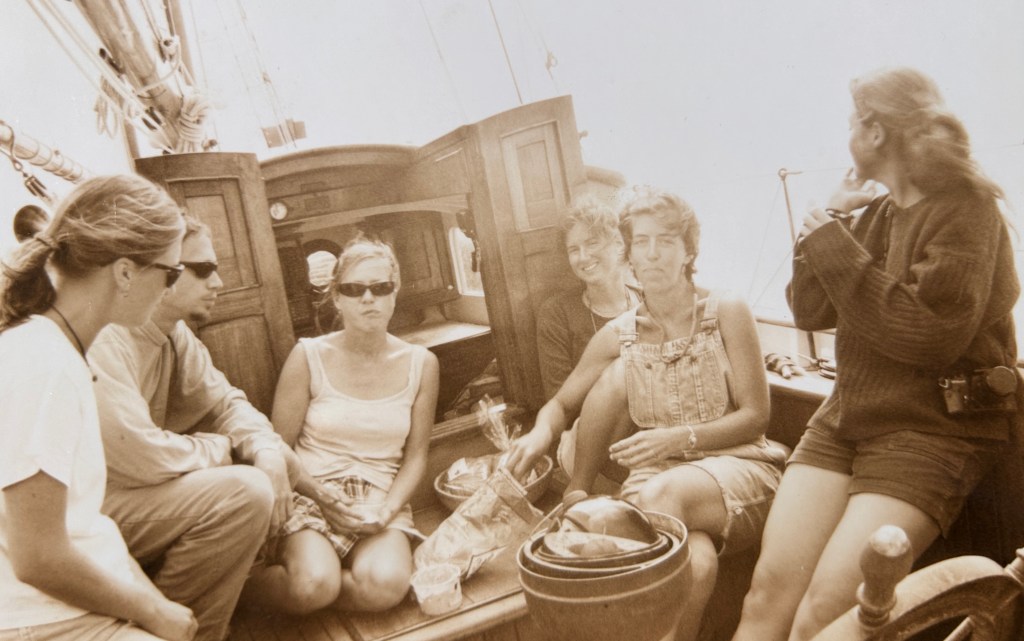
Some of the motley crew that attended the first New Year’s show in 1989
After that first magical night, Phish and their musical movement became a part of my world. Despite an obsession with David Bowie and New Wave music in High School I easily made the shift to devoted Phish fan. I was fortunate to live in Boston throughout the 1990s (which also happened to coincide with my 20s), the same decade the band was rising and growing exponentially in popularity. While Phish launched their brand and collected a gigantic fan base I launched my adulthood, experienced my first broken heart with that first Phish-loving boyfriend, and attempted to discover my place in the world. I never followed the band nationally from venue to venue like a truly dedicated Phishhead, but during those days I saw enough shows in Boston and other Northeast venues to know the words to every song and start a half-inch-thick prized collection of ticket stubs.
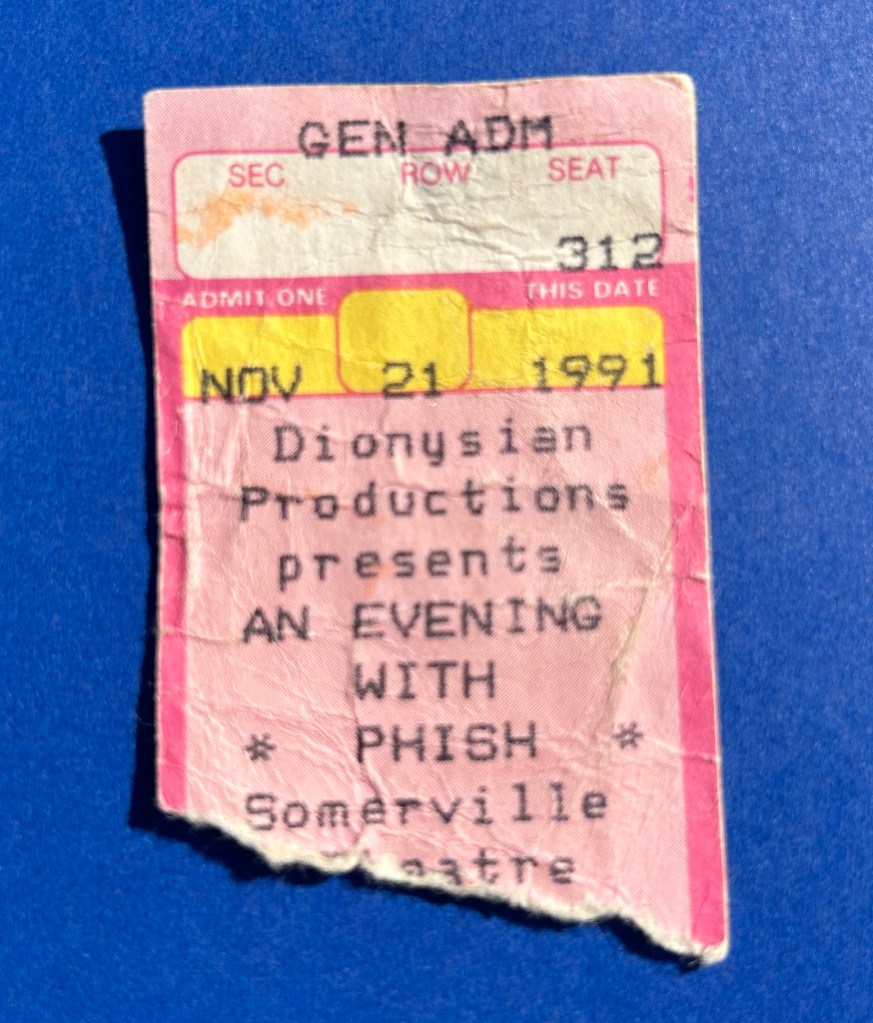
Phish ticket stub, 1991
August 3, 1991, Auburn Maine. I had added my name to Phish’s mailing list early on and one day in June 1991 a postcard arrived. It was an invitation to a concert dubbed “Amy’s Farm” because the show was held at the Maine-based farm of Phish’s first fan and friend, Amy. Given that Phish signed with Elektra Records that same year the band was offering thanks in the form of a free show to the fans that had stood by and supported the foursome from their very beginnings in Burlington, Vermont in the early 80s.
This explains how I found myself camping in a dusty field in Northern Maine one hot August day, listening to Phish play under the stars and pines pondering how I got to be so completely free and fortunate. A vague, filmy memory of the band riding out of the thick forest behind the stage, naked, atop horses bounces around my mind, however to this day I’m not certain if this image is a dream, the truth, or a mirage. The sole bummer of the day: we forgot the tent.
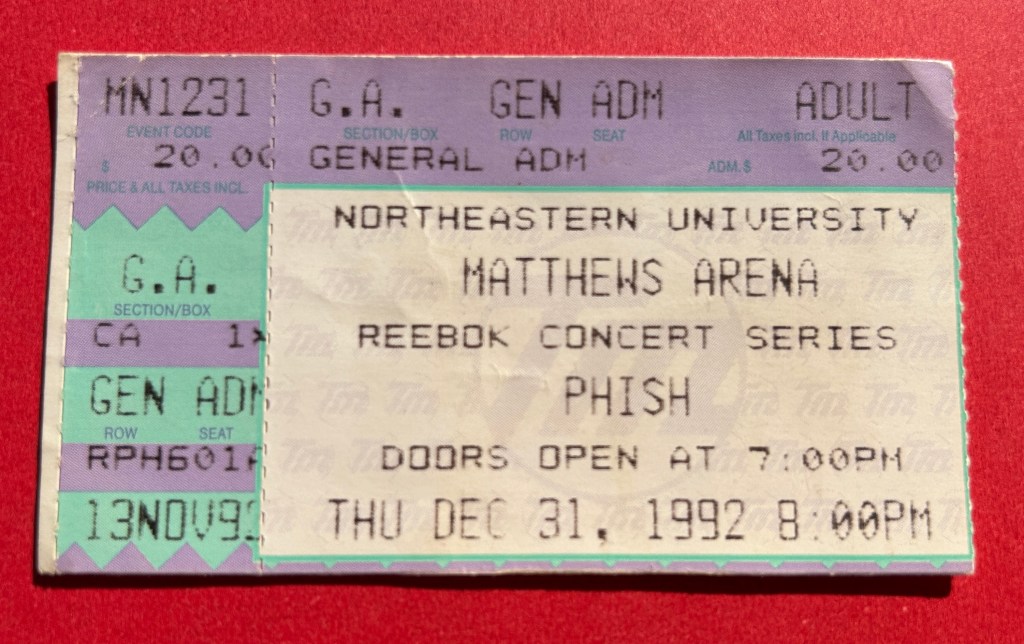
Phish ticket stub, 1992
December 31, 1992, Boston, Massachusetts. Another New Year’s show, this one at Northeastern University’s Matthews Arena. Unbelievably, the venue was walkable from the apartment I shared with my best friend in Boston’s South End –no need for tires to make contact with the road. Standouts at the show included the person suspended over the audience in a chicken costume and the mass hysteria signal Trey gave the audience (that I believe was responsible for the “mysterious tremors” mentioned in the Boston Globe the next day). This was also the night I lost track of my group entirely, only to look down from a balcony and immediately spot my friend Nat, his thick bouncing ponytail silhouetted in the immense gyrating crowd like a furry creature signaling his location.
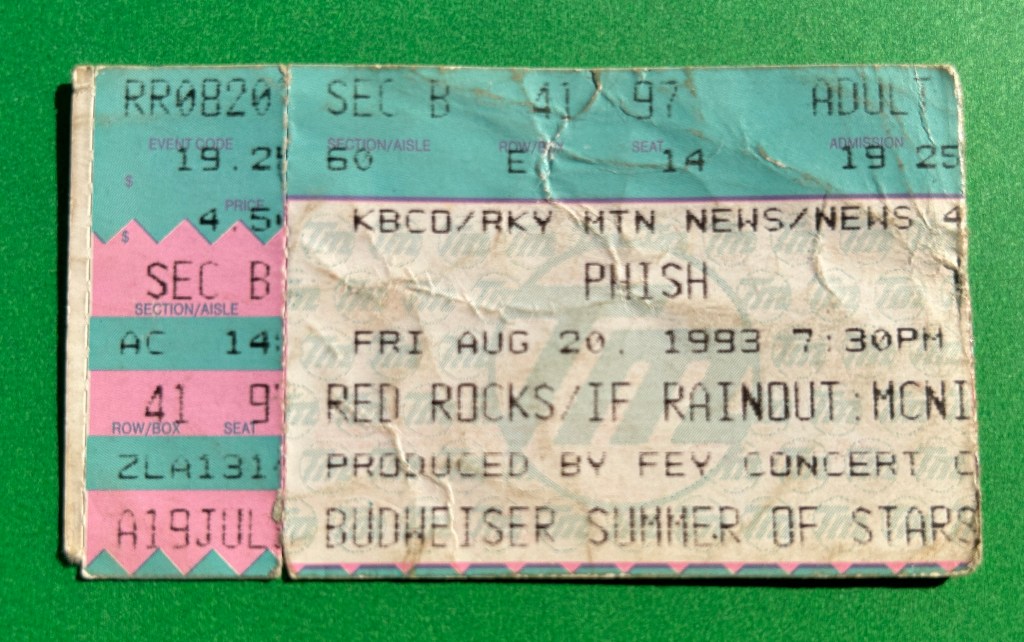
Phish ticket stub, 1993
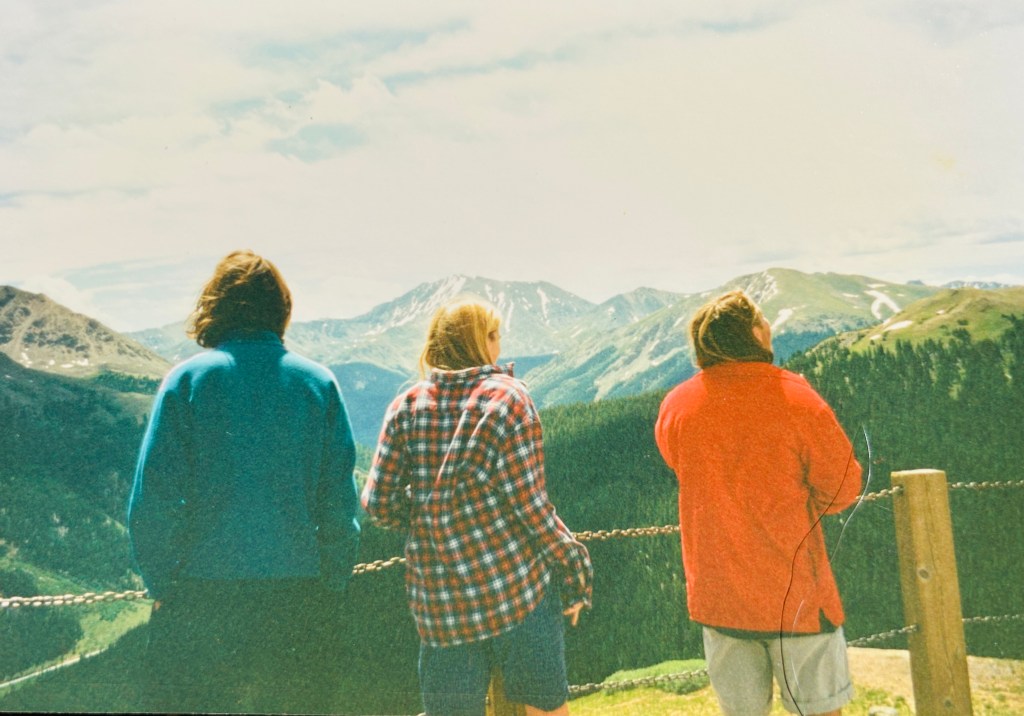
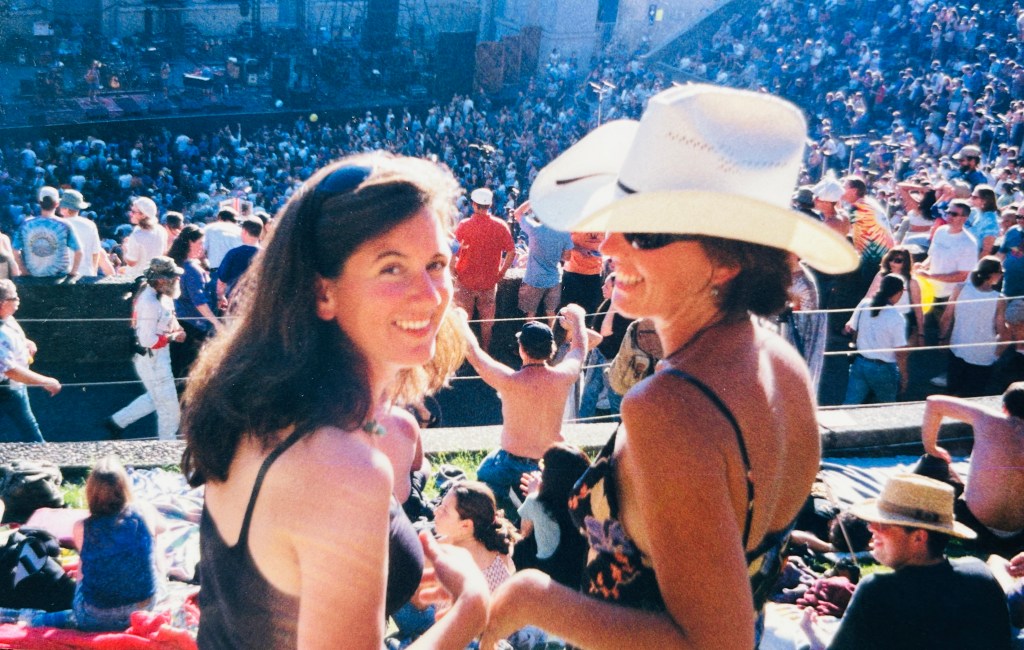
August 20, 1993, Denver, Colorado. That summer I worked at the Colorado-based camp I’d attended since age six. Phish was playing at Red Rocks and some friends and I managed to get tickets. That evening, I watched the lithe bodies of multiple fans leaping over three benches at a time as the band played “Run Like An Antelope” and the setting sun turned the natural rock walls of the amphitheater a red so brilliant I had to look away.
Watching “the smoke around the mountains curl,” Colorado, 1993
Alas, all was not perfect in Phishland. As much as I enjoyed the concerts, the traditions, and the fan culture I sometimes felt excluded by the masculine energy created by the four men on stage. I got tired of the same jams played by the same dudes with the same expressions and longed to see a woman up there, blending her voice with theirs, or theirs with hers. Where are the female jam bands, I wondered?
The amount of wasted, stumbling, blank-eyed fans who don’t know they are that far gone could be off-putting, even if I was sometimes one of them. Undercurrents of negativity surround certain Phish songs, and I didn’t enjoy the screeching, off-key vocals that sometimes took over. My least favorite song is “Wilson,” which invariably turns into a yell-along for the audience. I do realize, however, that music (especially Phish’s) reflects all aspects of the maze that is the human condition and neither band members, nor fans, are immune to life’s peaks, valleys, and temptations.
July 10, 2003, Shoreline Amphitheater, Mountain View California. In 1998, after ten years in Boston, I moved back to my native Northern California. Soon after, I met my Midwest-raised future husband when our work cubicles were situated next to each other. One of the first things we connected about? Our mutual love for Phish. During the early years of our relationship, right about the time Farmhouse was on permanent rotation in our car’s CD player, we caught a few Phish shows at Shoreline. The most memorable of these was the final show before the band went on a six-year hiatus. Sitting on the lawn at Shoreline, my shoulders sunburned from a day in the California sun, I gazed around at the massive, dancing crowd while the band launched into an encore of “Rift.” It was hard for me to grasp that this wacky little band I had once stood five feet from was now selling out four nights at a 22K-person capacity amphitheater.
Speaking of valleys, Phish’s founder and lead singer, Trey Anastasio struggled with a variety of addictions and was arrested in December 2006. I followed his story closely, perhaps recognizing some of my creative path, as well as addictive behaviors in his, and acknowledging that our idols can be as fallible as ourselves.
In a January 25, 2019 interview with GQ magazine about his embrace of sobriety Anastasio remarked “You know, I look to my heroes to be reminded that really good, really smart, really talented people can fall into this trap pretty easily, far down the road, if they’re not careful. The important thing is to know that there is a way out. And the life at the other end of that is a beautiful life. Everything bad turns into an incredible gift. If people can find the way out.”
Mistakenly, I thought a sober, creative life would be about as exciting as a bleached sample in a jar, but I assure you, just as Trey has, that it is even more beautiful and exciting than anything that has come before.
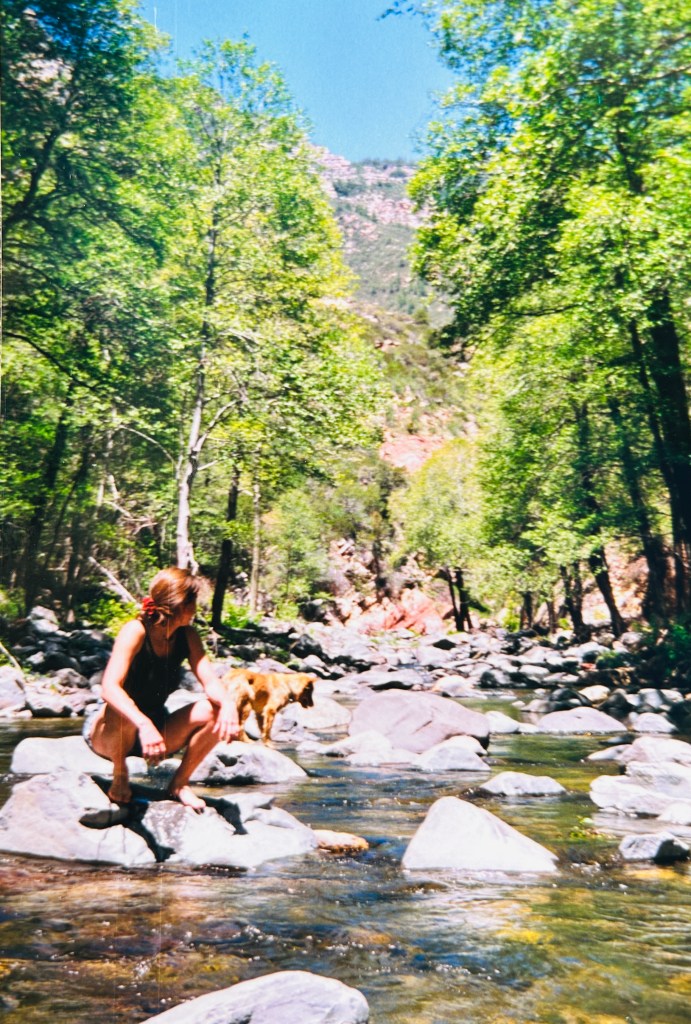
Caught between the past and the future, Arizona, 1995
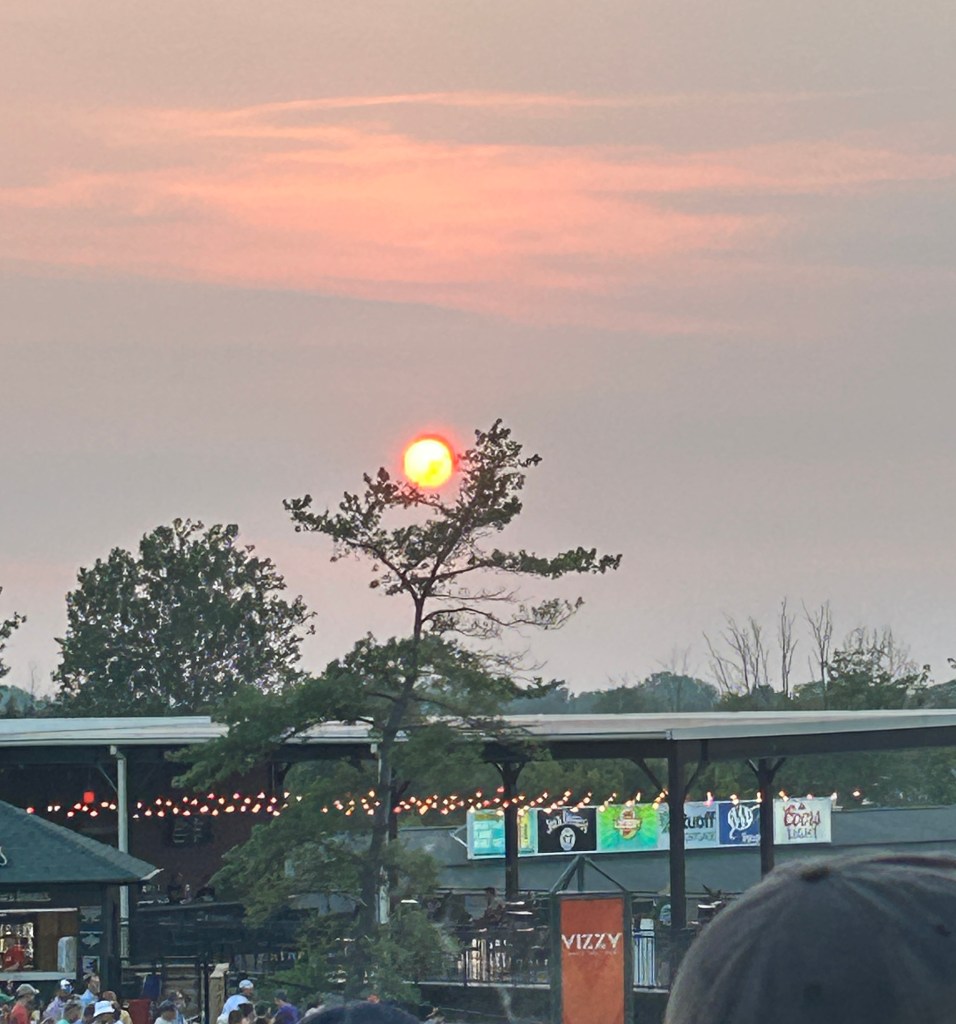
August 3, 2024, Noblesville, Indiana. Back on the lawn at Deer Creek (as Hoosiers will forever insist on calling it), the glowing orb of a setting sun is held by the branches of a lone tree. I am content, the kids are safe at home and my grooving, grinning husband of eighteen years dances alongside. I have been held by Phish’s music for so long that it has become a part of me, the branches of my life growing around the always-evolving but forever-burning core.
Sunset at Deer Creek, August, 2024
And miraculously, thirty-five years after first hearing the tortured sounds emitting from Fishman’s vacuum hose, I am listening to them once more.
Look back but don’t stay too long.
Note: Special thanks to Phish.net which provided many clarifying details to my sometimes (okay, often) hazy show recollections.
I’ve had some unusually deep conversations lately, ones that touched on topics we humans are pretty adept at keeping to ourselves. Abuse, pain, addiction, failure. So often we bundle and wrap our sorrows, issues, and dreams like hoarded and expensive presents, presented infrequently and with trepidation.
A friend once described to me what her Chinese grandfather would do when she banged or bumped herself to avoid bruising: he would press his fingers into the afflicted area and knead it with great force. She loathed this and learned to run in the other direction and hide in a closet when she hurt herself around him.
My friend’s childhood solution reminds me of the impulse so many of us have – don’t delve too deeply into the pain because you might expose yourself, and it’s going to hurt. Don’t reach out or share what happened with anyone. Instead, run away quickly and shut the door quietly.
Why do we avoid talking about difficult things, when sharing, supporting, and loving each other is perhaps the most meaningful thing we can do as humans? I see it as a two-fold issue: the first is trust and the second is time.
Establishing trust with another person is fraught with minefields. From our very beginnings, the muscle of trust is exercised. We require food and shelter, love, and learning. Sometimes, those who are tasked with our well-being fall short and we can live our lives carrying that knowledge like the heavy baggage it is. If I couldn’t trust then, why should I trust now? The tender, fragile petals that make up our seemingly impenetrable armor are easily trampled on. And even if you are fortunate enough to avoid childhood trauma, at some point in our collective lives, betrayal is a given, whether the source is family, friends, romantic partners, employers, society, or otherwise.
Heck, I’m currently writing an entire book on how I worked through feeling betrayed by God.
And then there’s the issue of time. Carving out the opportunity and space to share deeply can feel like the least important thing on one’s list. The conversations I referred to earlier happened in the following places: a coffee shop, a friend’s living room, and an art supply closet. Two planned, one not. All three offered me deep solace, information, and inspiration I didn’t consciously know I needed.
Our lives, packed with work, survival, and to-do lists, do not often allow room for the unfolding of leisurely, unstructured, open conversation. But when the stars align, when people reach across the table and hold a friend’s hand, or share their deepest thoughts, fears, and hopes a rare, healing alchemy bubbles up. We feel connection, relief, understanding. The tattered fabric of our hearts stitches back together. Walking forward with a lighter load, even a few solutions, is possible because we have been heard and understood, and we know someone else has laid down some baggage too.
Back to my friend’s grandfather’s folk remedy: if the whole point of massaging the hurt area was to avoid bruising, that must be what we do for each other when we connect, when we listen without judgement. We help each other heal the deep bruising.
That is, as long as we make time for it and don’t hide.
I’ve been thinking about our conversation and decided to write you a letter to share ideas about how I successfully stopped drinking and why I’ve stayed sober for four years.
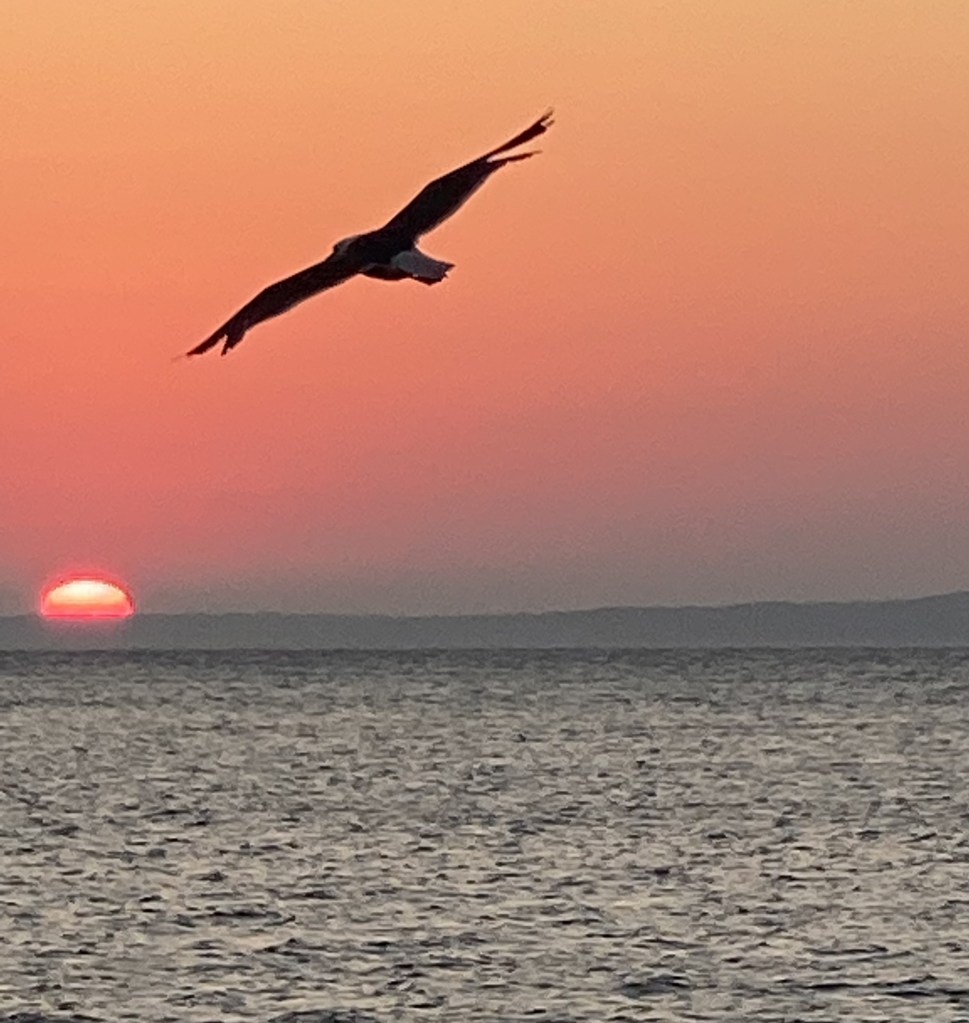
I imagine you find it hard to believe that on the other side of hangovers, bitterness, and self-loathing you can be free as a bird at sunset, soaring over the shimmering ocean that is your beautiful life.
Not everybody who drinks alcohol has a problem but in my opinion if you think you have a problem with alcohol, you do. I sense that you sincerely want to be free of the depressing cycle and there is no doubt in my mind that focusing with honestyon your deep desire to be sober is the best place to begin.
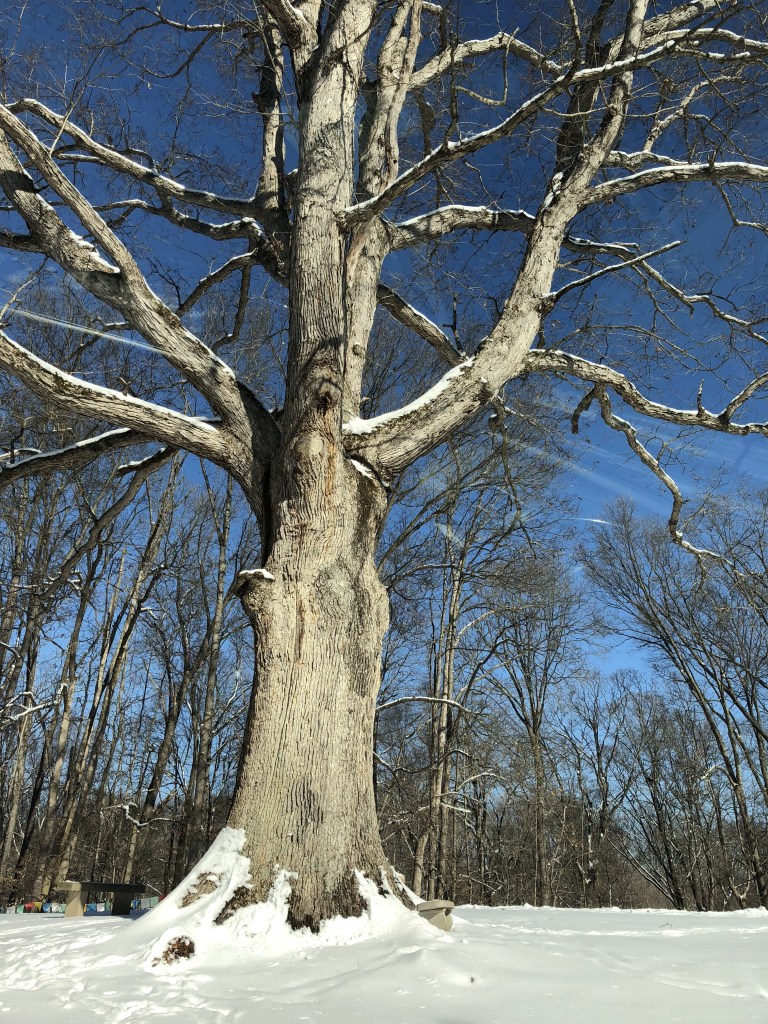
Cultivate the strength of a tree..upright, whole and free despite influence, annoyances and harsh weather.
I’m thinking back to my days of early sobriety four years ago when I quit cold turkey after one particularly bad night. I started drinking in the afternoon and then later that evening, after leaving a neighborhood party, I walked home in frigid temps, tripped, and fell down an embankment, badly hurting my shoulder.
When I woke up that next morning, unsure about what happened the previous evening, deeply embarrassed, injured, hungover, and sour in body and spirit, I thought “I am treating myself terribly, I am abusing myself. What would I say to someone who was being treated this way by another? I think I would tell them to leave.”
So, consider this letter an encouragement to follow a new path and allow to yourself leave an abusive relationship.
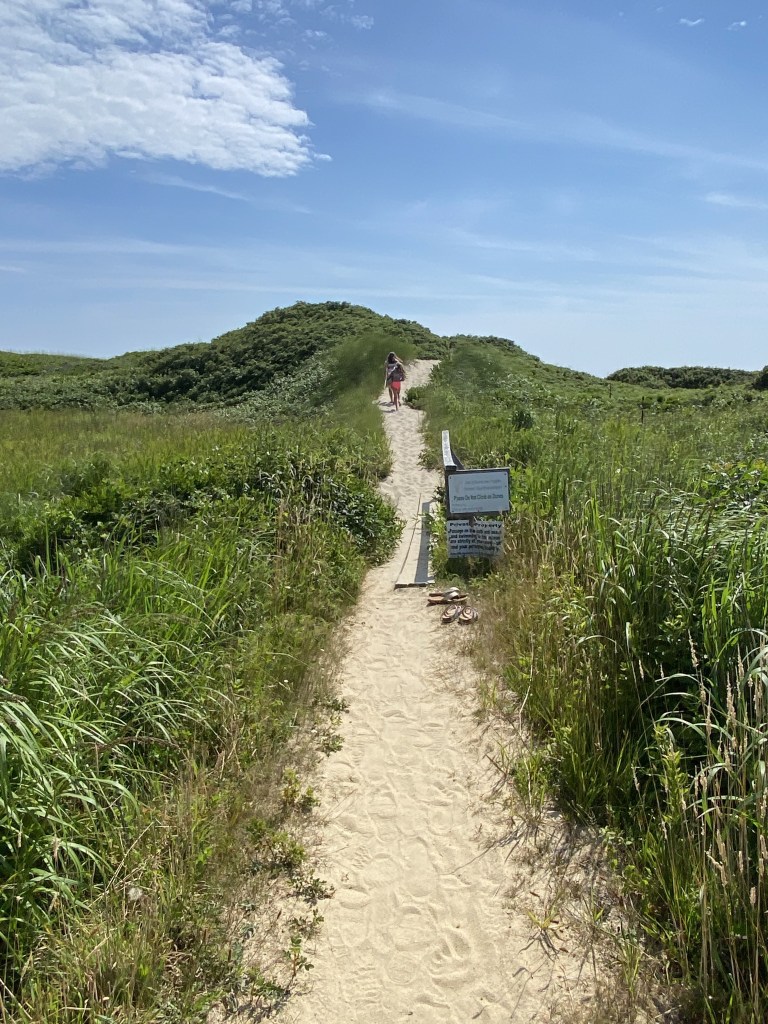
The soft sandy sober path leads to freedom and blue skies.
That cringe-inducing night turned out to be one of the most important in my life so far. My drinking career had started at age 13 and there I was at age 48, with the intervening 35 muddy middle years of (mostly, minus pregnancies and the occasional dry stretches) imbibing whenever and wherever I wished to. Even though I grasped long ago that there was a problem I continued to drink, often daily. I failed at modifying my intake, I failed at drinking only one type of alcohol, I failed at anything that had to do with ending my tendency to use something that was poisoning me from within and without.
I also did the dishes, parented, wifed, worked, and lived a life that may have appeared to many as a full, happy, connected one. But I was an expert at living a compartmentalized life, a less than truthful one–this was uncomfortably familiar ground.
I needed that final low, that rusty nail in the coffin of my lengthy drinking career, to look my glaring imperfections in the eye and to see my actions for what they were, self-defeating, injurious, and below me.
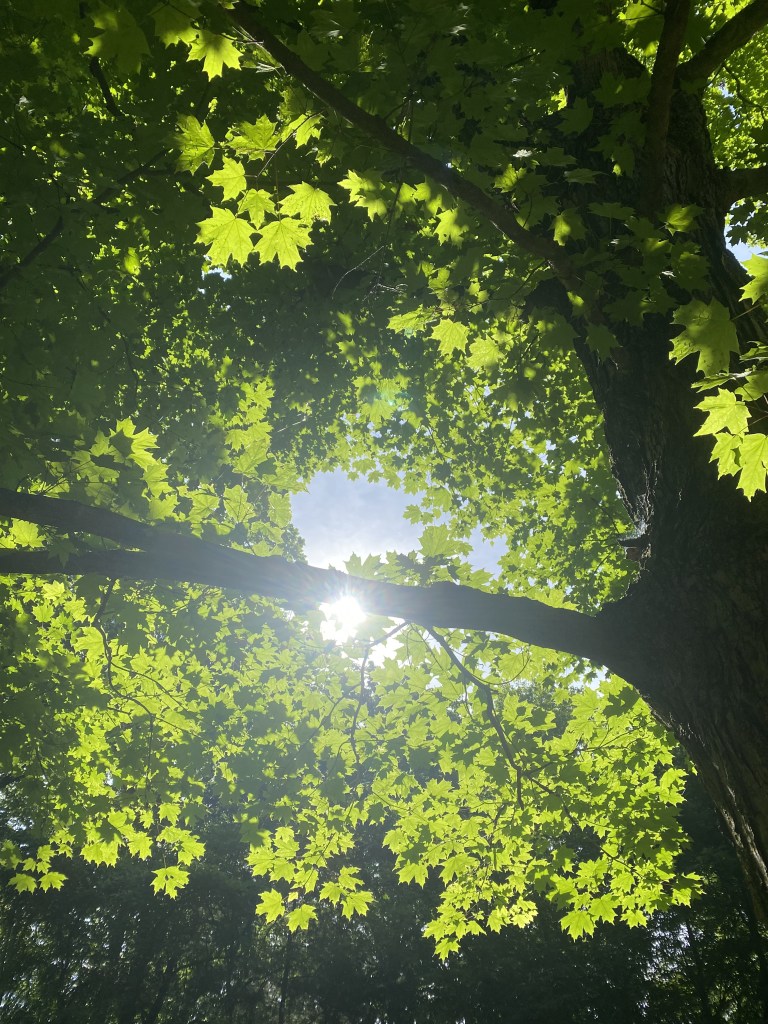
The light shines on those who lean toward it.
Here is the part I wish I’d figured out years earlier: In my fresh sobriety I could treat myself as I would a cherished friend. Setting relentless judgment and failures aside, I clutched onto the glimmers of my goodness. At first, those glimmers seemed minor…I considered the way I am (generally) loving to others, the way I take care of animals, the way I make tea for myself in the morning, and the way I feel when I am hiking in the woods. I brush my teeth twice a day! I wear a bike helmet! I thought about how there were people in my life that seemed to like me…if they saw good in me there must be something loveable there.
I created a loop of these fresh and positive ideas in my thought process, I wrote good things about myself in my journal instead of paragraphs of self-doubt. For a brain accustomed to a whole lot of self-criticism and judgment, this was an unfamiliar approach but the more I flexed it the easier (and stronger) the “treat yourself as a cherished friend” muscle became.
Try creating an arsenal of good thoughts for yourself. Ask people close to you what they love about you and put their comments together in a place you can access when you need a lift. The Notes section of your phone or a piece of paper taped to the fridge or the bathroom mirror or used as a bookmark. Try a meditation where you view yourself through the eyes of someone who deeply loves you. What do you imagine they love about you? Consider those qualities in your meditation. There is never going to be another you. What will you do with the gift of you? Strengthen the muscle of your loving self-acceptance.
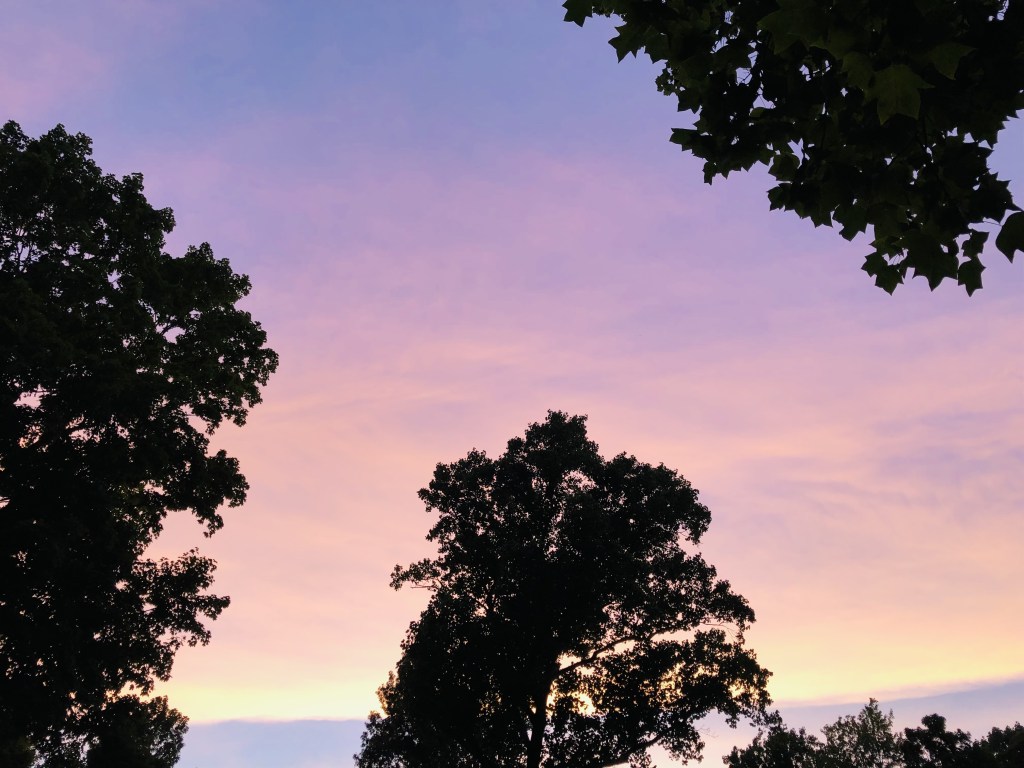
Take the path to self-acceptance. Your imperfections can be your superpowers.
Stay tuned, part two of my letter covers strengthening the will to be sober, ideas for what to do with all the money you’ll save not buying alcohol, asking and answering the hard questions for yourself, savoring present moments, thriving instead of wilting through stressful situations, and evolving/improving/letting go of relationships through sobriety.
Understand that there is a massive industry built on the back of your addiction. Don’t allow your well-deserved peace and happiness to be stolen by a poisonous substance used to power jets.
Cherish yourself and be your own champion–no one else can do it for you. I urge you to take this path because on the other side of sobriety you will find self-acceptance, joy, and clarity, the beauty of which you can only imagine.
Originally, I had a different post in mind. I will share more about my collection of materials soon, but there is something else I want to write about this week.
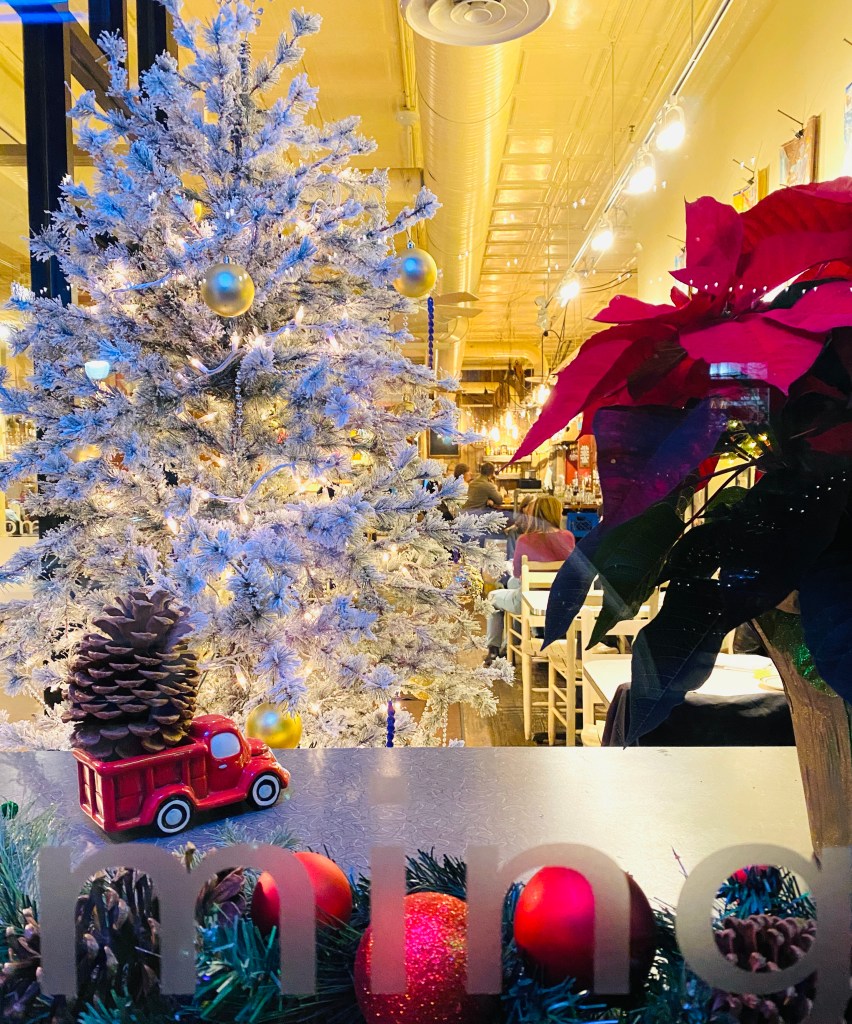
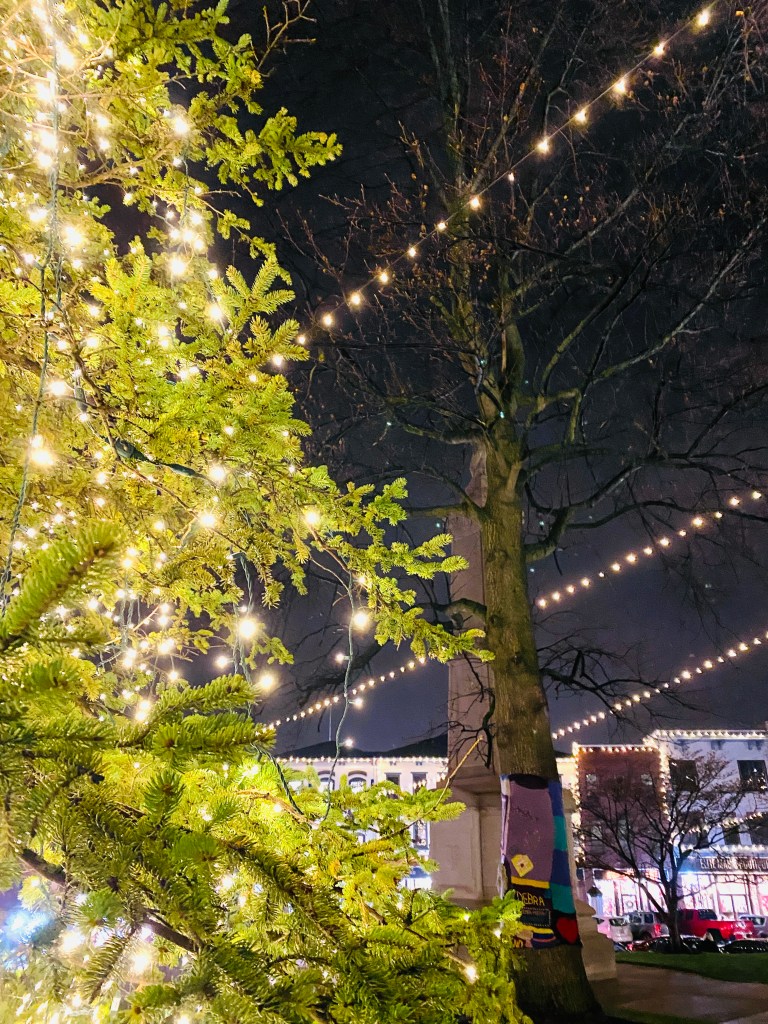
I recently found myself at a table with three girlfriends enjoying a celebratory dinner. Shadows were getting long on that chilly December day as we gathered at an upscale eatery in the charming Indianapolis, Indiana suburb of Carmel. Blocks crowded with quaint shops stretched out around us; boughs of fragrant greenery decorated our cozy booth and holiday lights twinkled on the ceiling above.
The four of us were there to celebrate an anniversary. Not a birthday, a career milestone, or a relationship. Instead, we were celebrating a sobriety anniversary. One friend had invited us to gather with her to mark and acknowledge two years of living successfully alcohol-free. The remaining three of us were sober as well, two of us closing in on three years and our fourth friend with an impressive thirteen years under her belt.
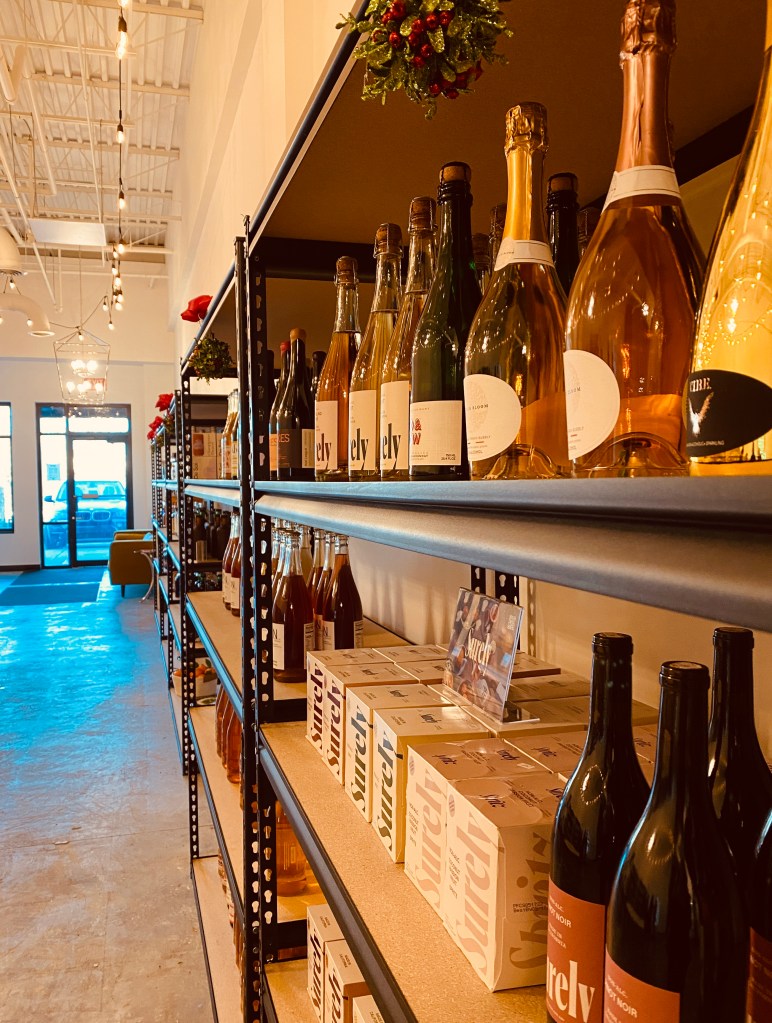
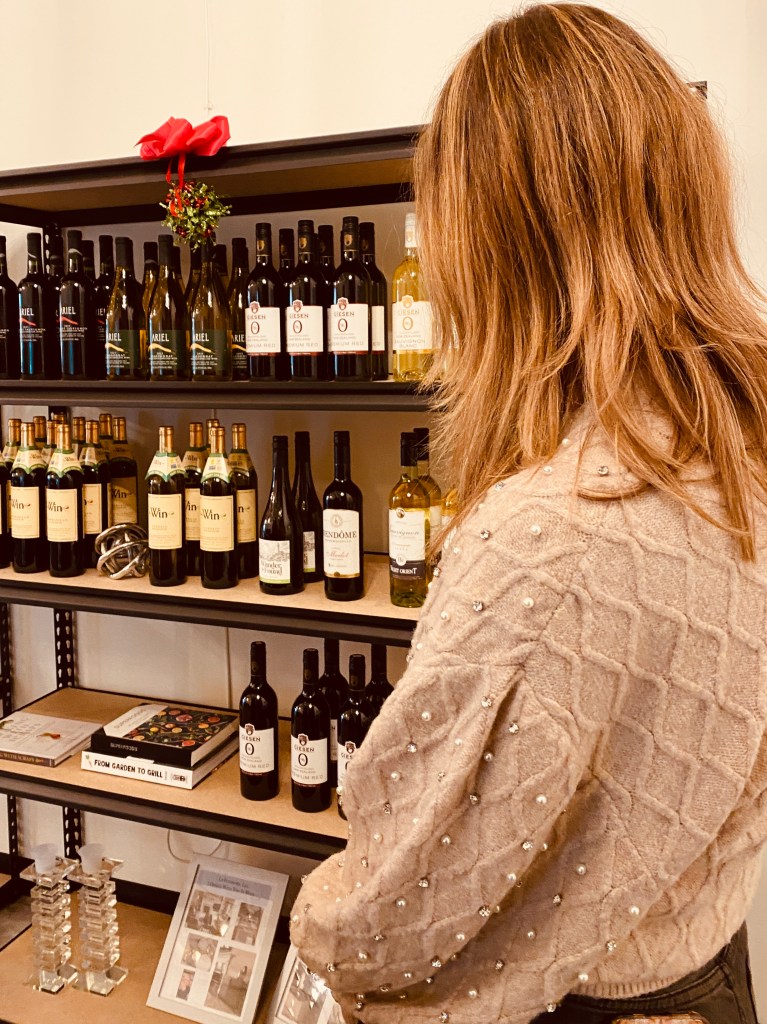
Attractive displays at Loren’s AF Beverages in Carmel, Indiana
Alcohol-free Tequila?! Is the world ending?
Before the restaurant, we visited a sleek alcohol-free beverage store (I know, what a concept) where we sampled a distilled botanical “gin alternative” and did warming shots of spirit-less cinnamon “schnapps” out of tiny plastic cups. It was heartening to learn that the shop is thriving and that non-alcoholic beer sales grew by 23 percent in the U.S. in 2019. There is a sense of camaraderie and enjoyment that comes from cradling a refreshment in your hand as well as browsing in a shop with friends and we welcomed the chance to do both.
When I was drinking, I saw the world differently. I imagined that all of us imbibers belonged at one long festive table, laughing, telling stories, and planning trips. We were the interesting ones, the adventurous ones, and the entertaining ones. In my view, the non-drinkers belonged at a separate slab entirely, far off in the corner keeping themselves company with their boring conversations, their vanilla clothing/hairstyles, and their staid and mostly uneventful lives (apparently alcohol fueled my judgmental side as well).
I did form many lasting friendships and connections over my decades as a drinker, and I acknowledge without judgement that there are many adults in the world for whom alcohol is not a problem. However, I’ve also come to understand that much of what I thought was deep and meaningful while drinking was in reality often fleeting and circumstantial. One of the greatest gifts of being free of alcohol is that I settle entirely into each moment of my life, I am truly present in a way I haven’t been since I was a child. I want nothing more than where I am, nothing more than who I am with–especially when I am around people I enjoy and love. There is a sense of savoring that infuses my days and…bonus!…I remember every single detail. No more mental fast-forwarding, gritting my teeth until I can relax later with a drink in my hand in a space momentarily free of life’s bothersome minutiae.
Absorbing the unexpected beauty of a cold winter evening.
The four of us covered a lot of subjects in our booth that afternoon. The evolution of our personal histories, friendships, relationships. The joy and pain and freedom we have in our sober lives. The pride we feel in ourselves and each other, and the shame we are still working to shed and/or embrace. Adventures we have embarked on since we got sober, ambitious plans we have for the future (sober social pop-up events, anyone?). I felt the tears well up as I described the poignant sweetness and waves of gratitude I experience daily with my family, my health, my writing, my clarity.
I shared a recently-discovered quote with my friends;
“Not drinking has lifted a veil on every part of my life including the bonkers me, the energetic me, the creative me, the poetic me, the loving me, the joyful me, the angry me, the what-the-f*ck me, the connector me, the boundaries-me, the open me, the closed me — essentially all the me’s of me.”
~Susan Christina, Hola Sober
Across the restaurant I spotted a group of friends in their twenties, drinks crowding the tabletop, laughing, and looking at their phones. If they glanced over at us, I wondered what they would see. A table of four middle-aged-ish women sharing a meal, engaged in serious conversation, sipping tea and sparkling water (side note: why are so many restaurants missing out on the potentially lucrative “mocktail” market? No, we do not want tonic water with lime thankyouverymuch, we want something designed to stand alone and taste great sans alcohol).
Do we appear boring and colorless over here in the corner booth, living out our uneventful, dull lives?
Now I know nothing could be further from the truth.




You must be logged in to post a comment.