• Home

Still…however…maybe…

  • Material Abundance: Part Two

    December 16th, 2022

    The Project That Started It All

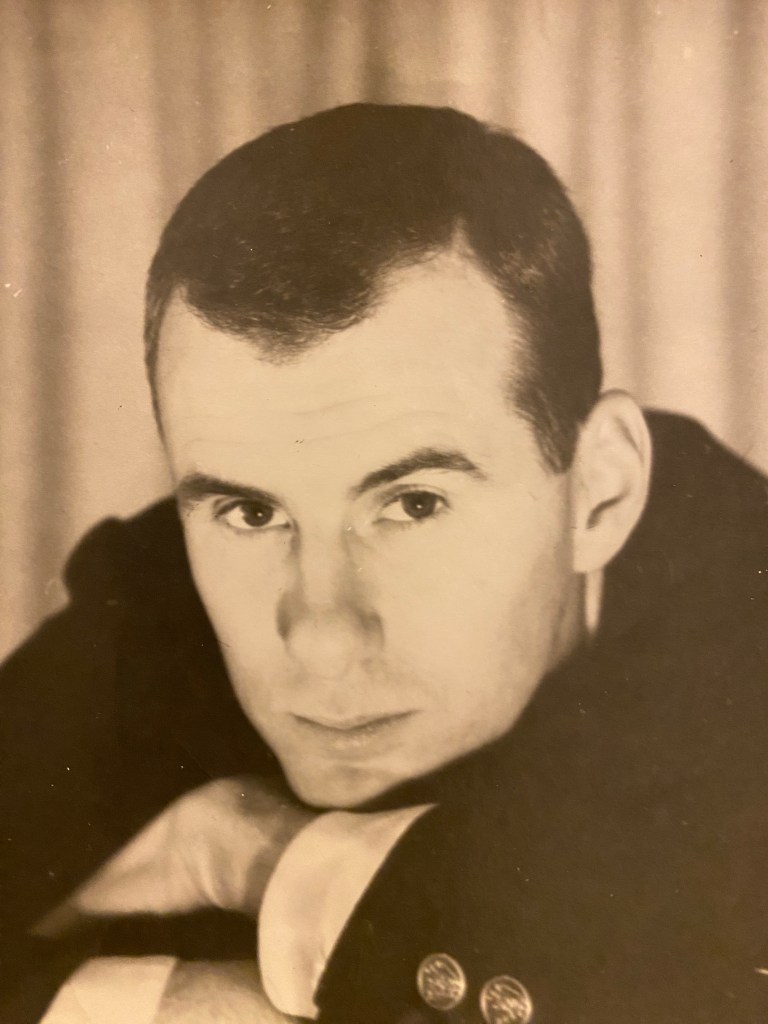
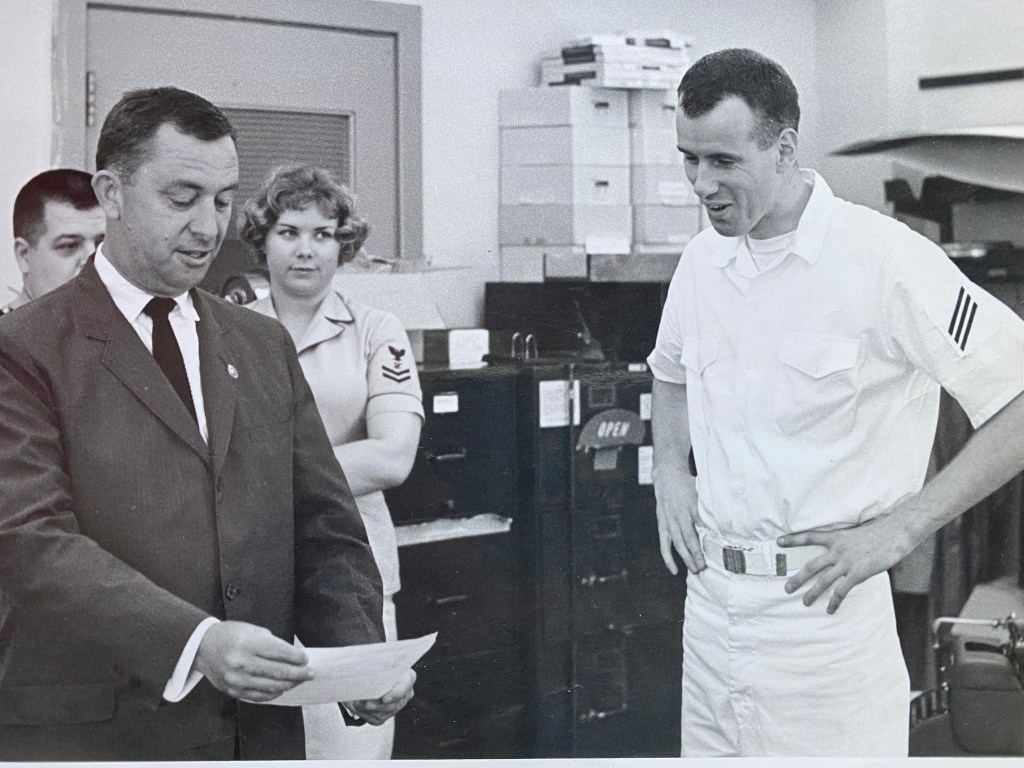
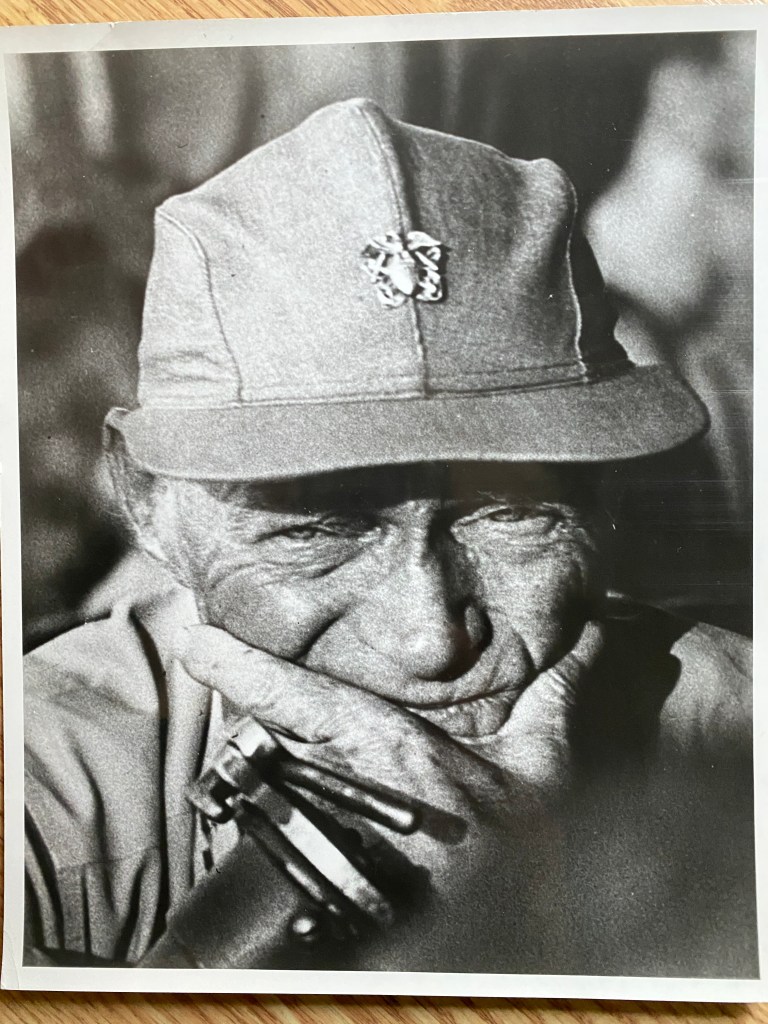
    My father David Holmstrom in 1965

    Projects and ideas tracked my dad like rainbows following the ideal combination of light and showers. Sometimes he was introduced through his work as a journalist, other times he welcomed friendships that led to serendipitous adventures, or to his visions of art installations, manuscripts, photo series, or performances. He gathered information and objects into his life and unwittingly grew collections…there was no end to the number of interesting items that attracted his attention. 

    My father also cultivated adventure and possibility. It was not unusual to hear him say something like the following at my childhood dinner table: 

    “Would you like to stay overnight at a lighthouse in San Francisco Bay this weekend? I’m going to write about some people who are lighthouse keepers and they invited me to sleep on their island.”
    Now that I’ve had some time to consider the trajectory of his life, I have a feeling I know where my dad’s original drive toward putting big ideas into motion as well as his collecting tendencies might have sprouted from. 

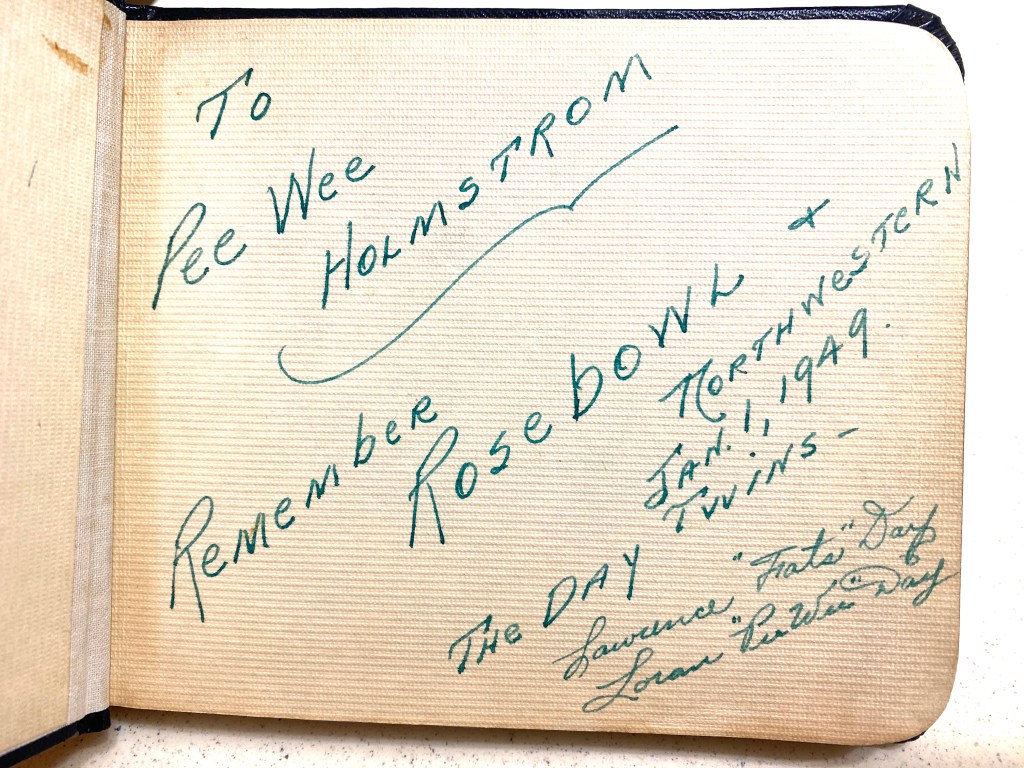
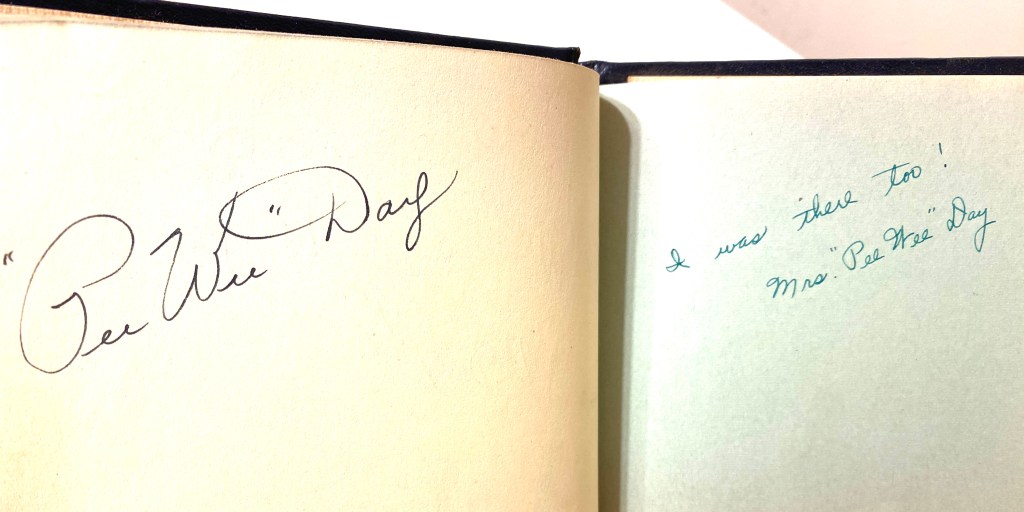
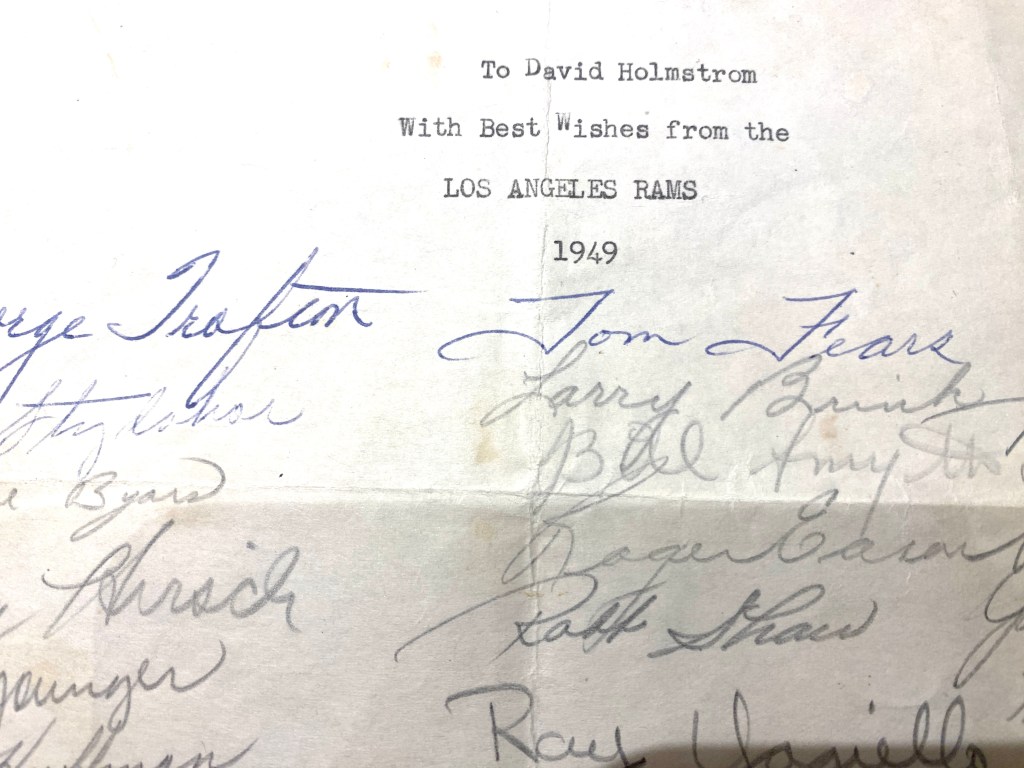
    Winning the Autograph Lottery: As a sports-loving boy growing up in Los Angeles, California David’s nickname was Pee Wee. One bright day in 1949 found David writing two letters: one to an idol who shared the same nickname, Loren “Pee Wee” Day, the star halfback on the Northwestern University football team, and the other to the head coach of the (then) Los Angeles Rams. Both letters were a twelve-year-old’s best attempt at thoughtful and persuasive requests for autographs. 

    Weeks passed and he felt hope slowly ebbing away. Then, to quote David: 

    “A small package arrived from Pee Wee Day. I tore it open. To my utter, wordless, gossamer astonishment I unwrapped a blue, leatherbound autograph book filled with signatures from the entire Northwestern football team, plus all the coaches. Even Pee Wee’s mother and father had signed it. Then, a week or so later a letter arrived from the Los Angeles Rams. On a single sheet of paper addressed to me with their best wishes, all the players and coaches of the Rams had signed their names. I was absolutely delirious.” 

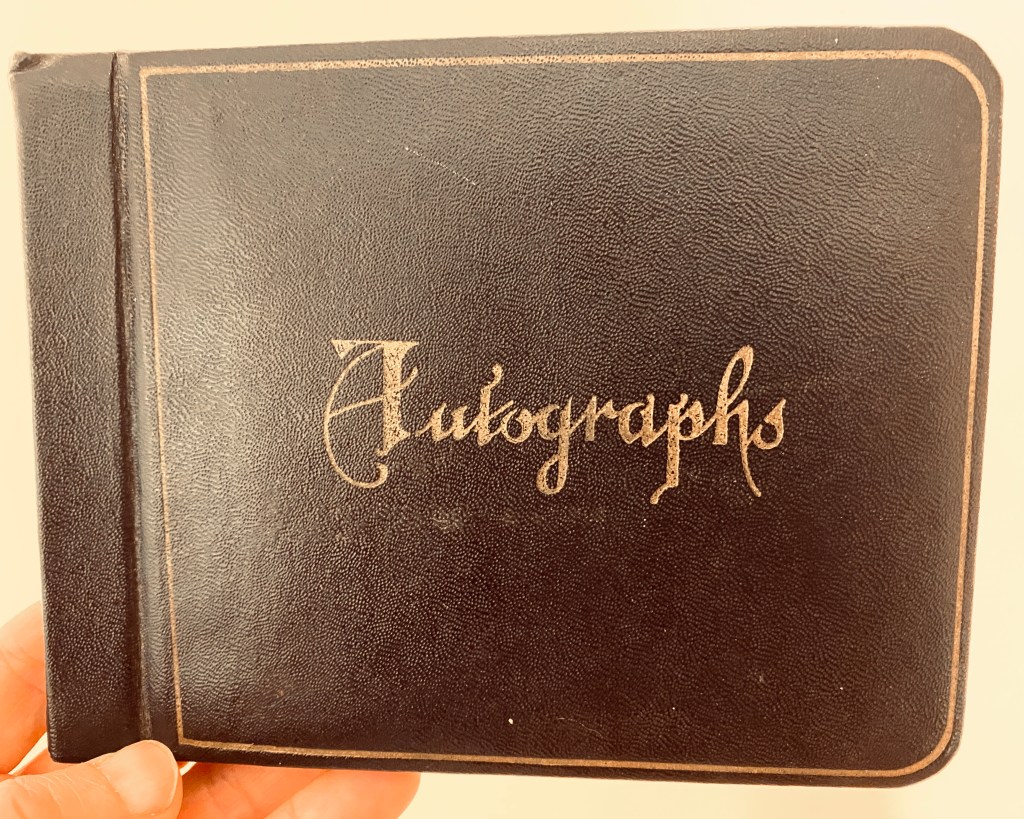
    Front page of David’s treasured Autograph book

    “I was there too!” wrote Pee Wee’s mother.
    The entire Los Angeles Rams team signed their autographs
    on a singe page, just for David.

    I couldn’t possibly begin to describe every project or collection of my dad’s as that would take up all the real estate on this blog. For now, I will share a few of my favorites.  

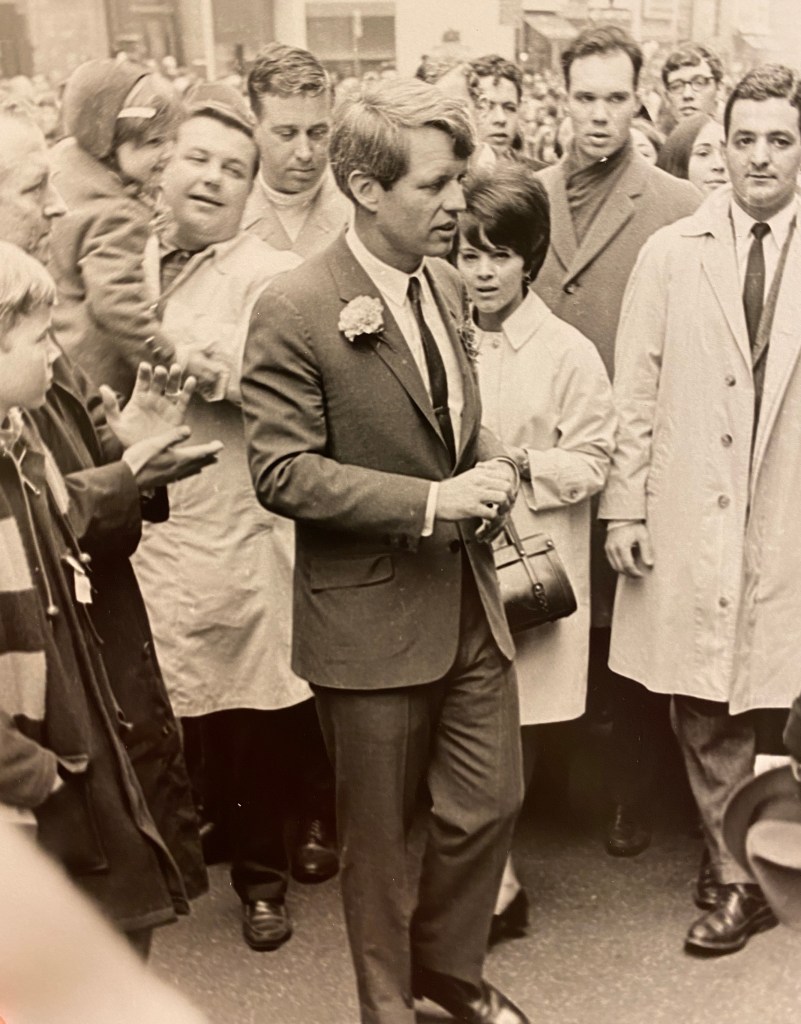
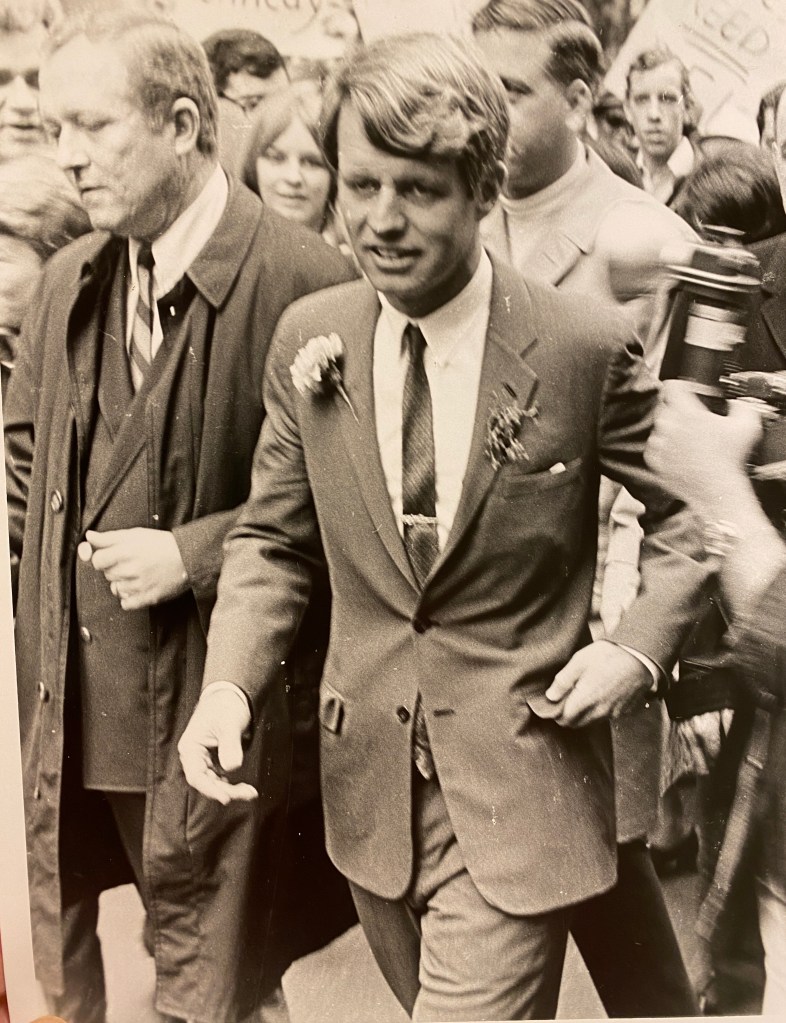
    Capturing Bobby: One day in March 1968 my father, who was a reporter at the time, took candid photographs of Bobby Kennedy campaigning on the streets of New York City. Bobby was killed in Los Angeles three months later. I was astounded when I found these images in my father’s boxes. 

    Bobby Kennedy, New York City, March 16, 1968
    What would be different today if this man had become President?

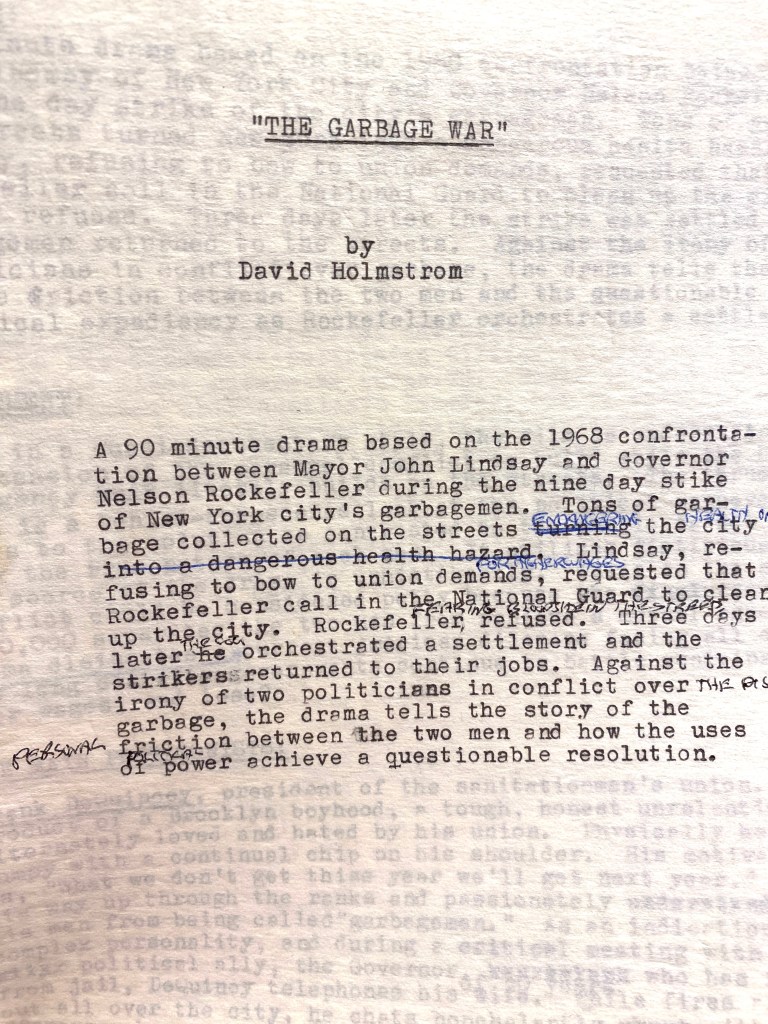
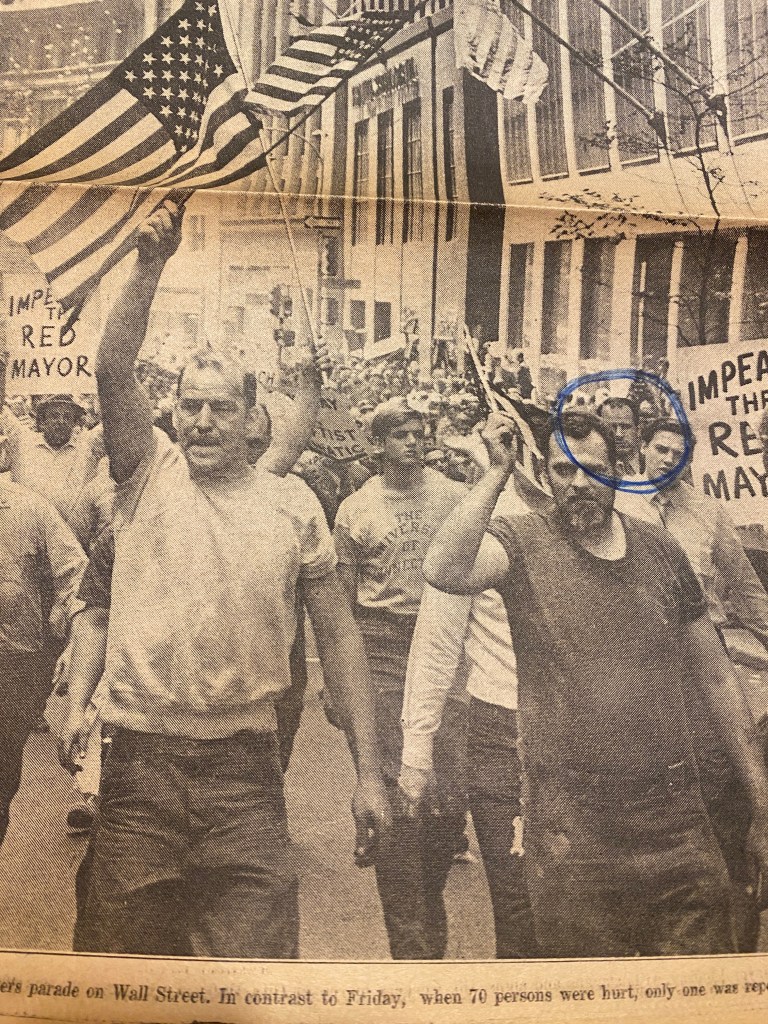
    The Garbage War: It is a little-known fact that in May of 1970 there was a nine-day-long strike held by the garbagemen of New York City, (ignited by a conflict between the Mayor at that time, John Lindsay, and the Governor of New York, Nelson Rockefeller). Refuse began to accumulate in great piles on the streets. My dad had the idea to turn this fetid event into a play…” imagine the action and dialog happening on stage while piles of garbage slowly surround the actors and grow in size” he would say. 

    Front page of David’s “The Garbage War” script.
    Garbage War coverage from the New York Daily News, May 12, 1970. Look closely and you may recognize the person circled.

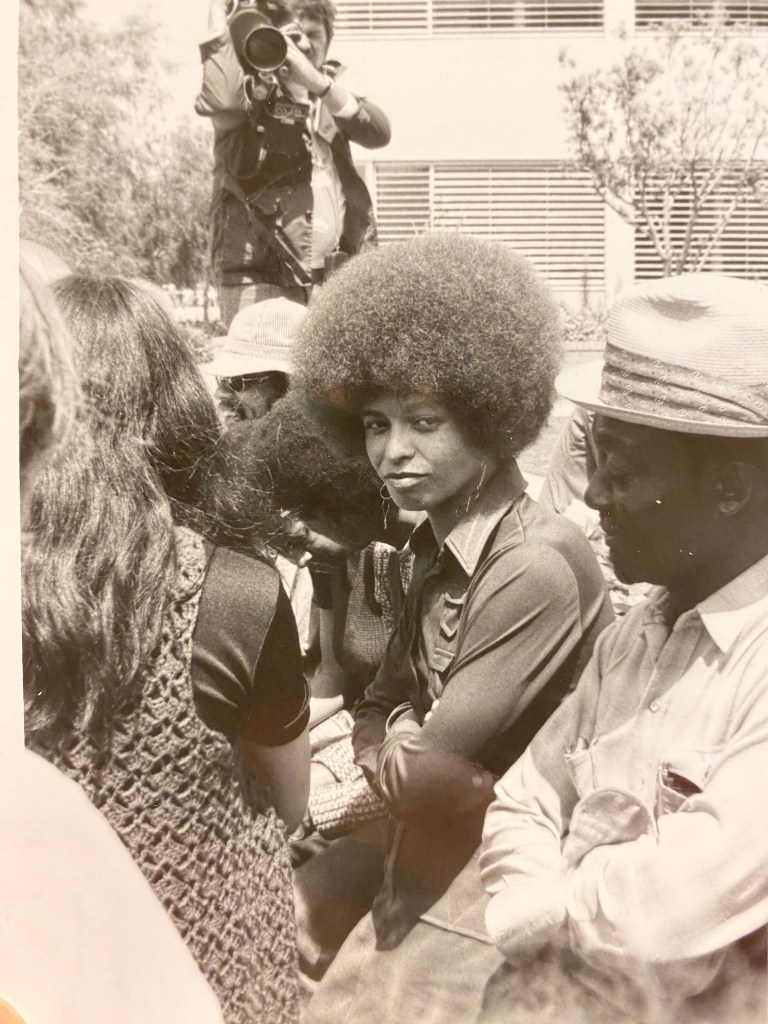
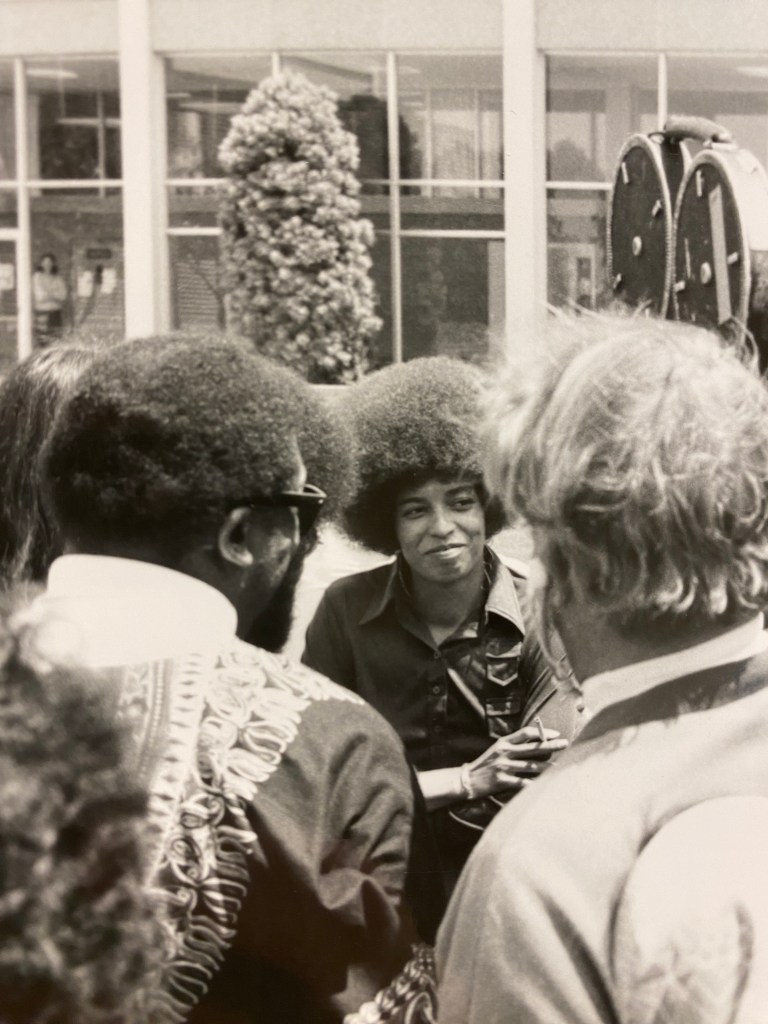
    Angela Davis Outside: In 1972 African American author, civil rights activist, and scholar Angela Davis was accused of supplying weapons that were used in a San Rafael, California courtroom shoot-out that resulted in the death of three people including a Superior Court Judge. Davis’s accusal, as well as the entire case in general, was dripping with racism and misogyny. In June 1972 Davis was acquitted of all charges and my dad was there as she exited the courtroom and spoke to people outside. In my opinion, there is much to admire about Angela Davis, including her hair. 

    Many would say Davis deserved that cigarette.

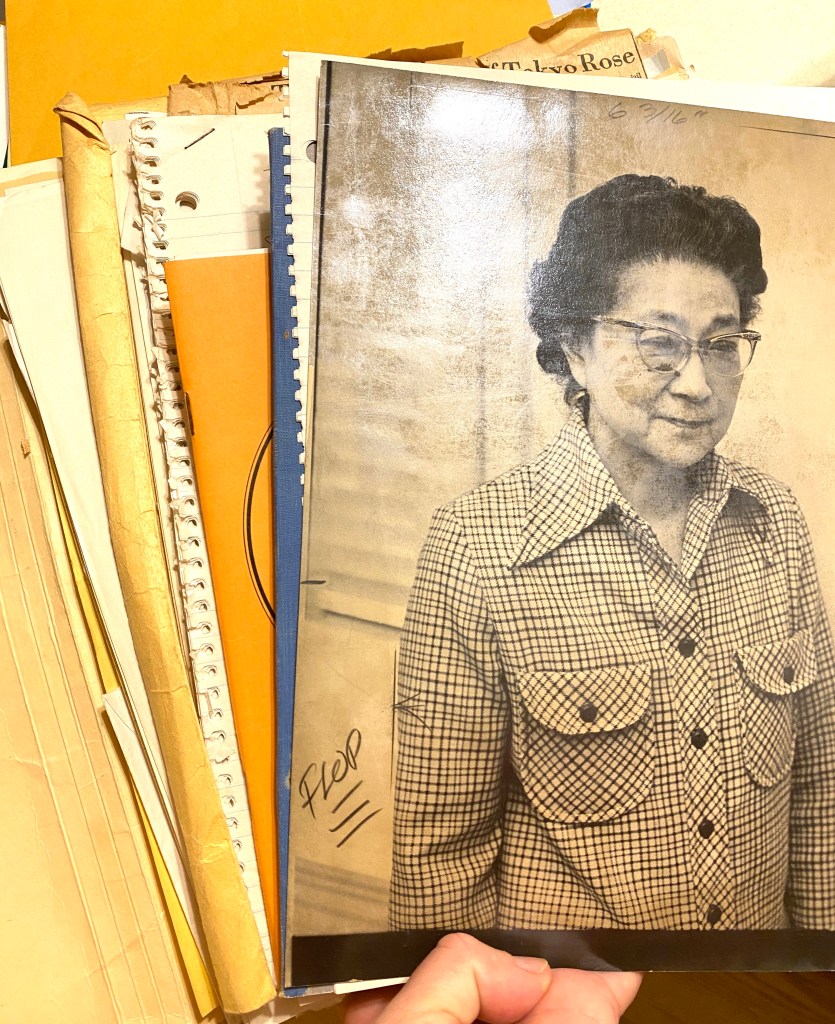
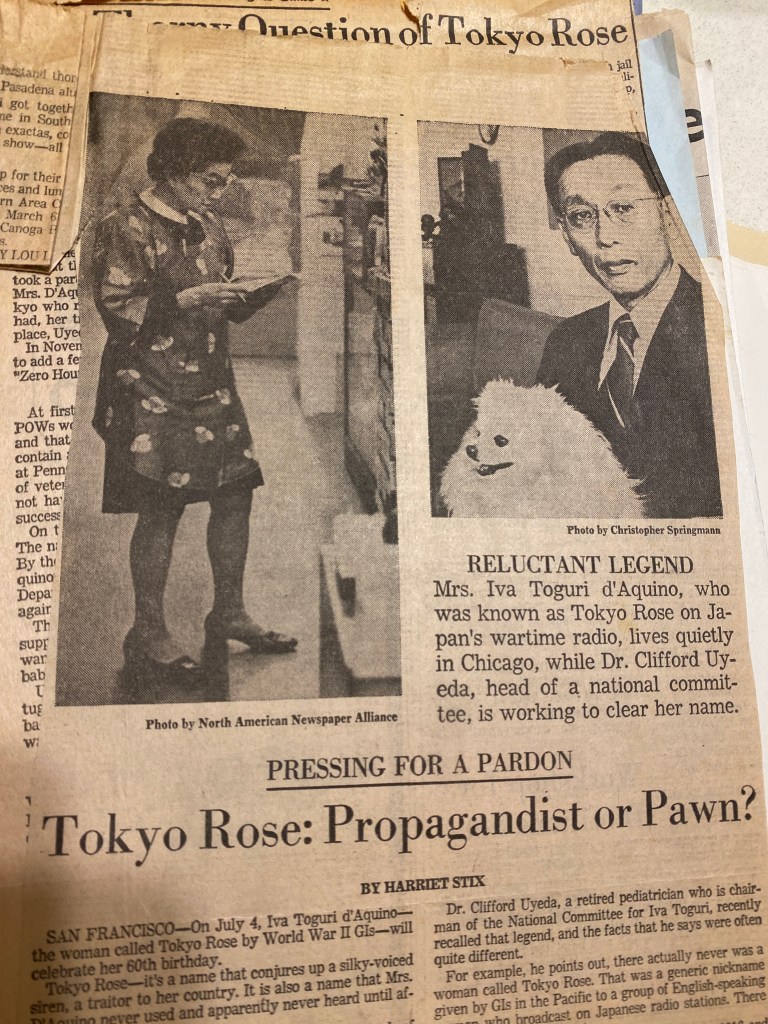
    The Saga of Tokyo Rose: As a journalist, my father covered quite a few trials but there was one in particular that he followed for decades. Iva Toguri (aka Tokyo Rose) was a U.S. citizen (born in Los Angeles in 1914) who was stranded in Japan during the attack on Pearl Harbor. Iva was forced to renounce her U.S. citizenship and found herself stuck in Japan. She got a job as a radio announcer, broadcasting to U.S. troops stationed in Japan. She was returned to the U.S. after the war and was convicted of treason and spent six years in jail. You, like me, might be thinking WTAF? So did my father which is exactly why he wanted to write a film script about Iva’s story. President Gerald Ford finally pardoned her in 1976. 

    Iva Toguri.
    Two folders full of clippings, court transcripts, letters
    and information about Tokyo Rose.

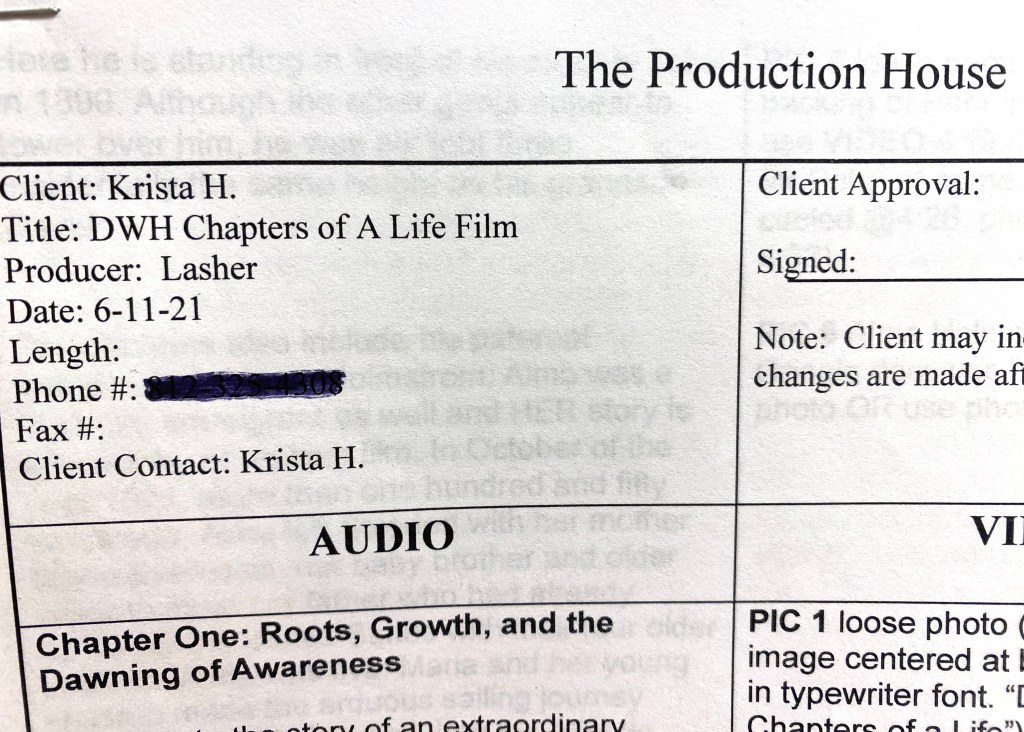
    Perhaps you are getting a sense of why I am making a film about my dad. What was initially a slideshow for his memorial service has evolved into a five-chapter film about his life. One of the chapters focuses on…you guessed it…his projects (including his art, collections, and photography). 

    Script from the film I am working on about my dad and his life.

    I will share more about the film as it comes together. Bringing my dad’s story to life on a screen feels like the best way to do justice to what was an endlessly fascinating career and life.

    All of this documentation is indeed compelling, but at the end of the day, two truths remain:

    His creativity knew no bounds and he was simply the best father a girl could have. 

  • Celebration and Sobriety

    December 9th, 2022

    Originally, I had a different post in mind. I will share more about my collection of materials soon, but there is something else I want to write about this week.

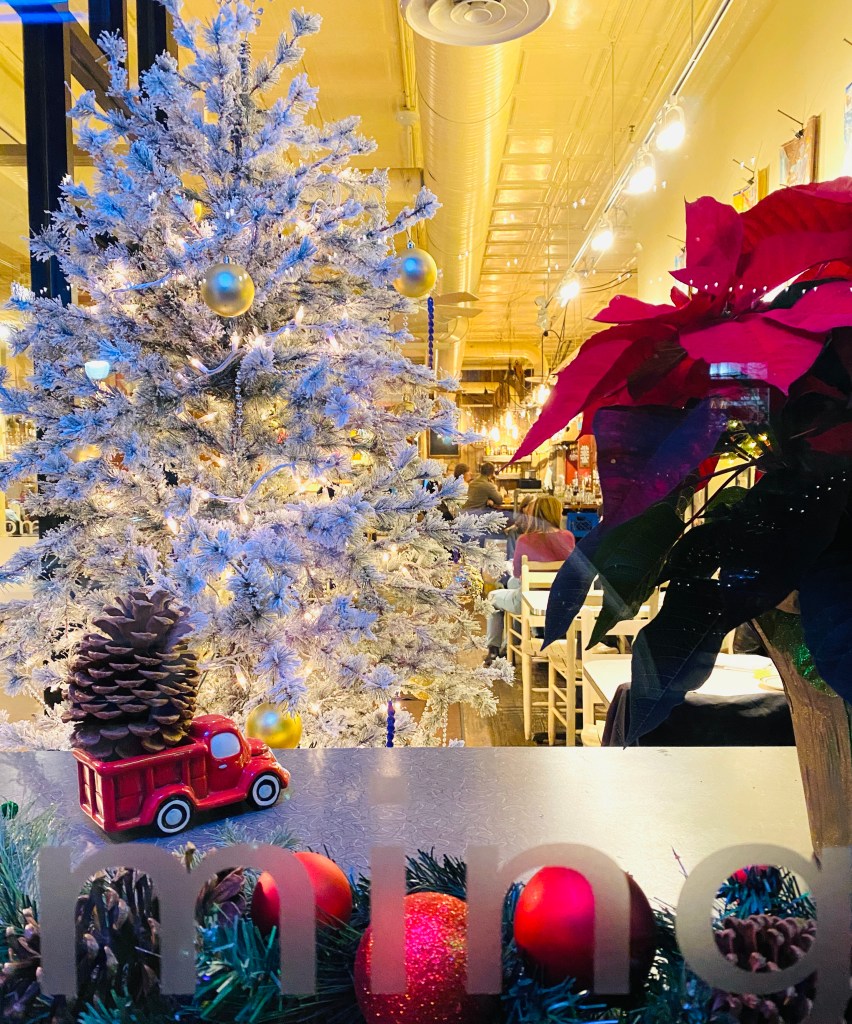
    I recently found myself at a table with three girlfriends enjoying a celebratory dinner. Shadows were getting long on that chilly December day as we gathered at an upscale eatery in the charming Indianapolis, Indiana suburb of Carmel. Blocks crowded with quaint shops stretched out around us; boughs of fragrant greenery decorated our cozy booth and holiday lights twinkled on the ceiling above.

    The four of us were there to celebrate an anniversary. Not a birthday, a career milestone, or a relationship. Instead, we were celebrating a sobriety anniversary. One friend had invited us to gather with her to mark and acknowledge two years of living successfully alcohol-free. The remaining three of us were sober as well, two of us closing in on three years and our fourth friend with an impressive thirteen years under her belt.

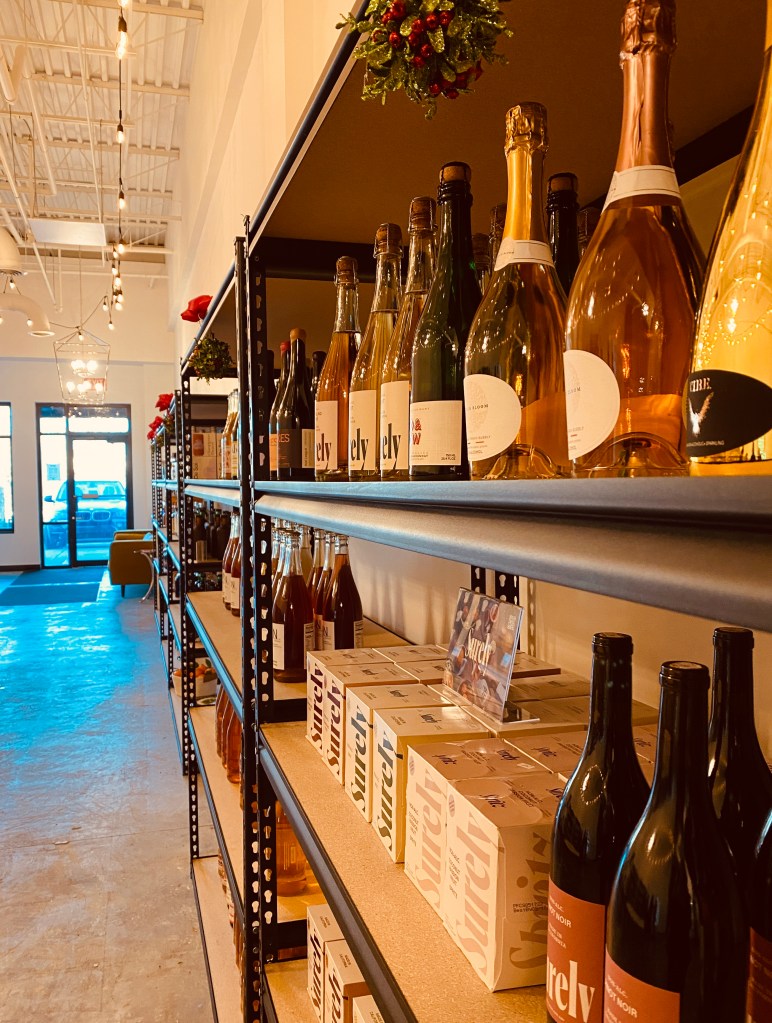
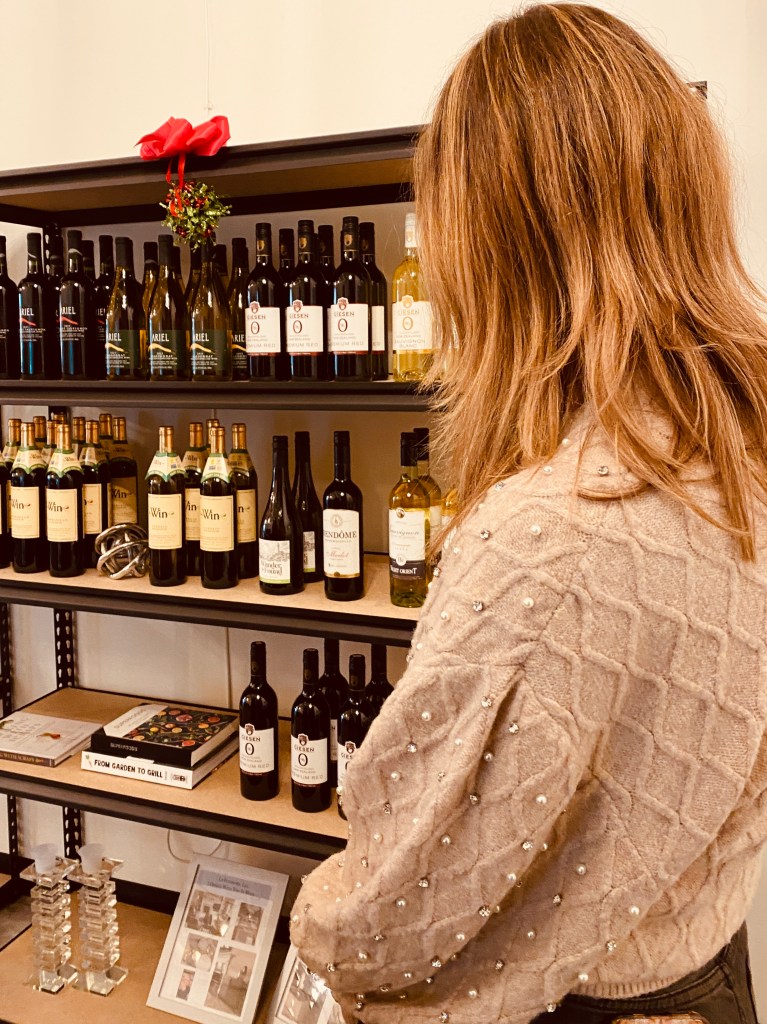
    Attractive displays at Loren’s AF Beverages
    in Carmel, Indiana
    Alcohol-free Tequila?! Is the world ending?

    Before the restaurant, we visited a sleek alcohol-free beverage store (I know, what a concept) where we sampled a distilled botanical “gin alternative” and did warming shots of spirit-less cinnamon “schnapps” out of tiny plastic cups. It was heartening to learn that the shop is thriving and that non-alcoholic beer sales grew by 23 percent in the U.S. in 2019. There is a sense of camaraderie and enjoyment that comes from cradling a refreshment in your hand as well as browsing in a shop with friends and we welcomed the chance to do both.

    When I was drinking, I saw the world differently. I imagined that all of us imbibers belonged at one long festive table, laughing, telling stories, and planning trips. We were the interesting ones, the adventurous ones, and the entertaining ones. In my view, the non-drinkers belonged at a separate slab entirely, far off in the corner keeping themselves company with their boring conversations, their vanilla clothing/hairstyles, and their staid and mostly uneventful lives (apparently alcohol fueled my judgmental side as well).

    I did form many lasting friendships and connections over my decades as a drinker, and I acknowledge without judgement that there are many adults in the world for whom alcohol is not a problem. However, I’ve also come to understand that much of what I thought was deep and meaningful while drinking was in reality often fleeting and circumstantial. One of the greatest gifts of being free of alcohol is that I settle entirely into each moment of my life, I am truly present in a way I haven’t been since I was a child. I want nothing more than where I am, nothing more than who I am with–especially when I am around people I enjoy and love. There is a sense of savoring that infuses my days and…bonus!…I remember every single detail. No more mental fast-forwarding, gritting my teeth until I can relax later with a drink in my hand in a space momentarily free of life’s bothersome minutiae.

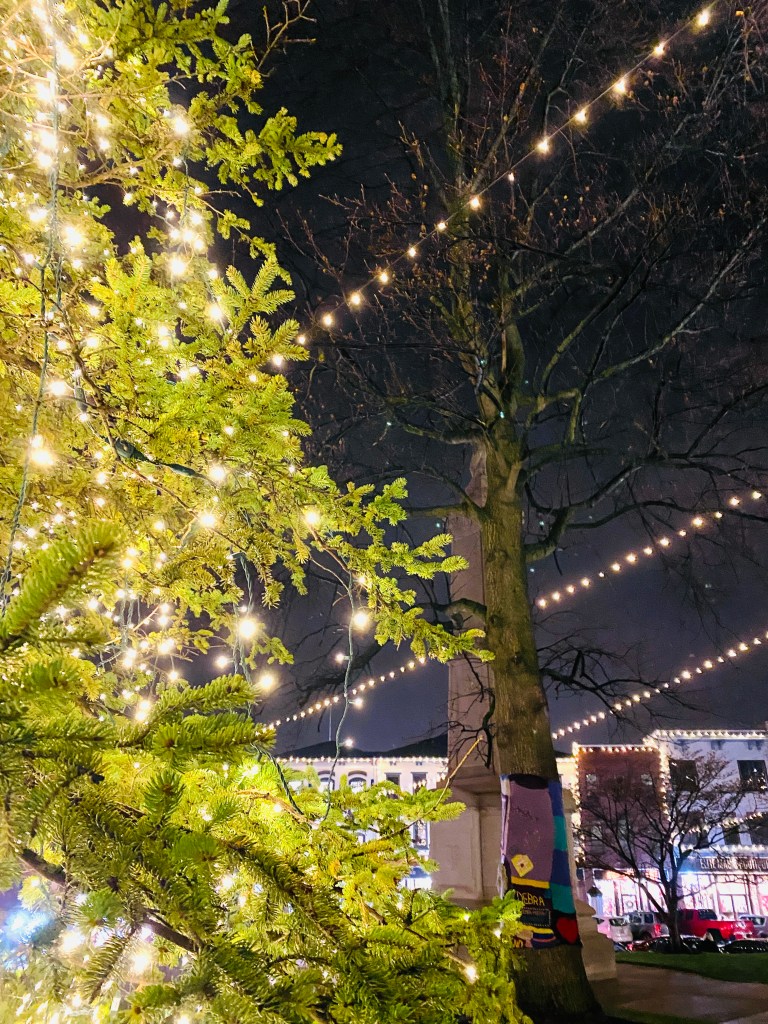
    Absorbing the unexpected beauty of a cold winter evening.

    The four of us covered a lot of subjects in our booth that afternoon. The evolution of our personal histories, friendships, relationships. The joy and pain and freedom we have in our sober lives. The pride we feel in ourselves and each other, and the shame we are still working to shed and/or embrace. Adventures we have embarked on since we got sober, ambitious plans we have for the future (sober social pop-up events, anyone?). I felt the tears well up as I described the poignant sweetness and waves of gratitude I experience daily with my family, my health, my writing, my clarity.

    I shared a recently-discovered quote with my friends;

    “Not drinking has lifted a veil on every part of my life including the bonkers me, the energetic me, the creative me, the poetic me, the loving me, the joyful me, the angry me, the what-the-f*ck me, the connector me, the boundaries-me, the open me, the closed me — essentially all the me’s of me.”

    ~Susan Christina, Hola Sober

    Across the restaurant I spotted a group of friends in their twenties, drinks crowding the tabletop, laughing, and looking at their phones. If they glanced over at us, I wondered what they would see. A table of four middle-aged-ish women sharing a meal, engaged in serious conversation, sipping tea and sparkling water (side note: why are so many restaurants missing out on the potentially lucrative “mocktail” market? No, we do not want tonic water with lime thankyouverymuch, we want something designed to stand alone and taste great sans alcohol).

    Do we appear boring and colorless over here in the corner booth, living out our uneventful, dull lives?

    Now I know nothing could be further from the truth.

  • Material Abundance: Part One

    December 2nd, 2022

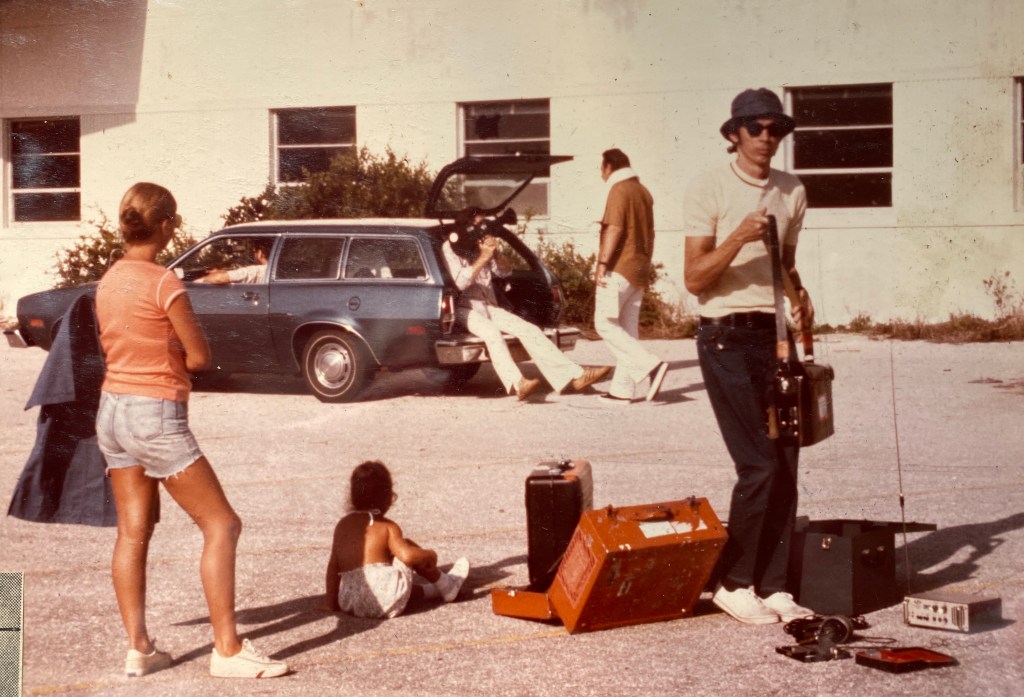
    Cocoa Beach Florida, 1974. My uncle John Holmstrom films out of the back of a station wagon
    while my father drives and my mother and I watch.

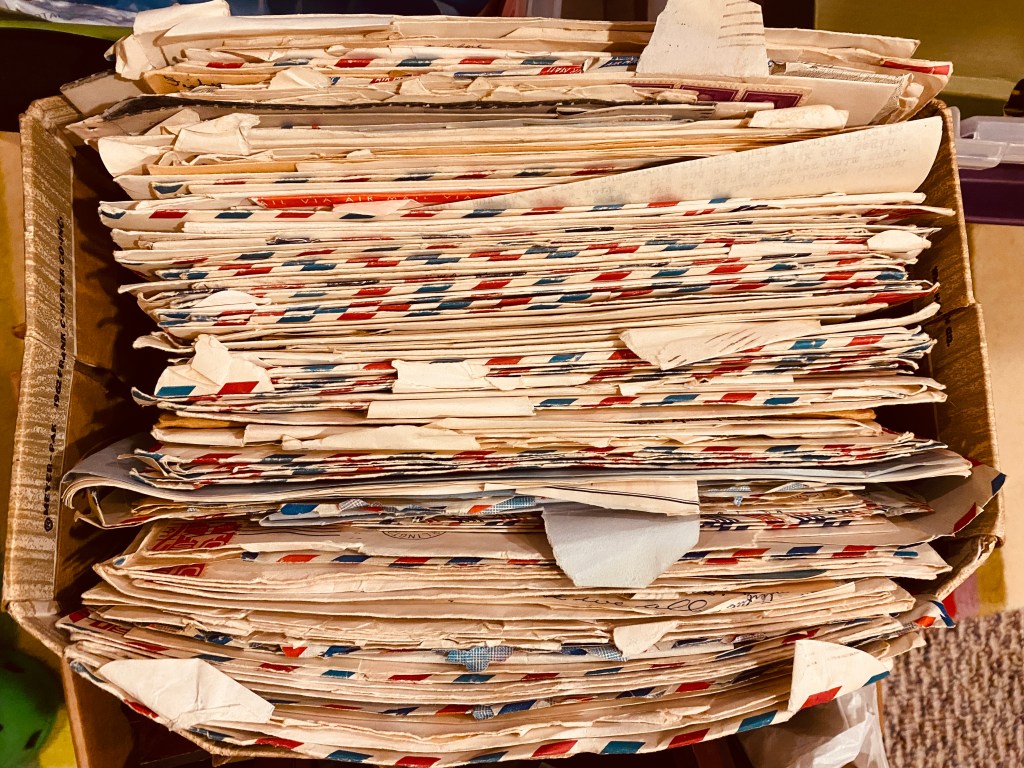
    Here I am again, sitting on the floor of my office. Boxes and bins surround me, some precariously balanced on one another, others open to expose their contents. Worn shoeboxes full of letters, dusty paper bags stuffed with film reels, and framed art of all sizes leaning against the wall. There are so many photographs that they have taken over my desk area completely, filling plastic bins and manila envelopes, spilling out over the tops and sides. I’ve decided that photographs are the hardest thing to sort and store.

    I’m making another attempt to categorize but rabbit holes are waiting for me at every turn. Read this article in a Sep 22nd, 1977 special issue of Rolling Stone about Elvis’s death? Sure! Flip through the entire inaugural 1968 Whole Earth Catalog? Why not! I could have sworn that photo of my parents trekking in Nepal was in the envelope marked “Mom and Dad Travel” but maybe it’s in the “Family 1990’s” one instead…and look at that, here’s a box of childhood photos I’ve never seen before.

    One of many shoeboxes full of letters.

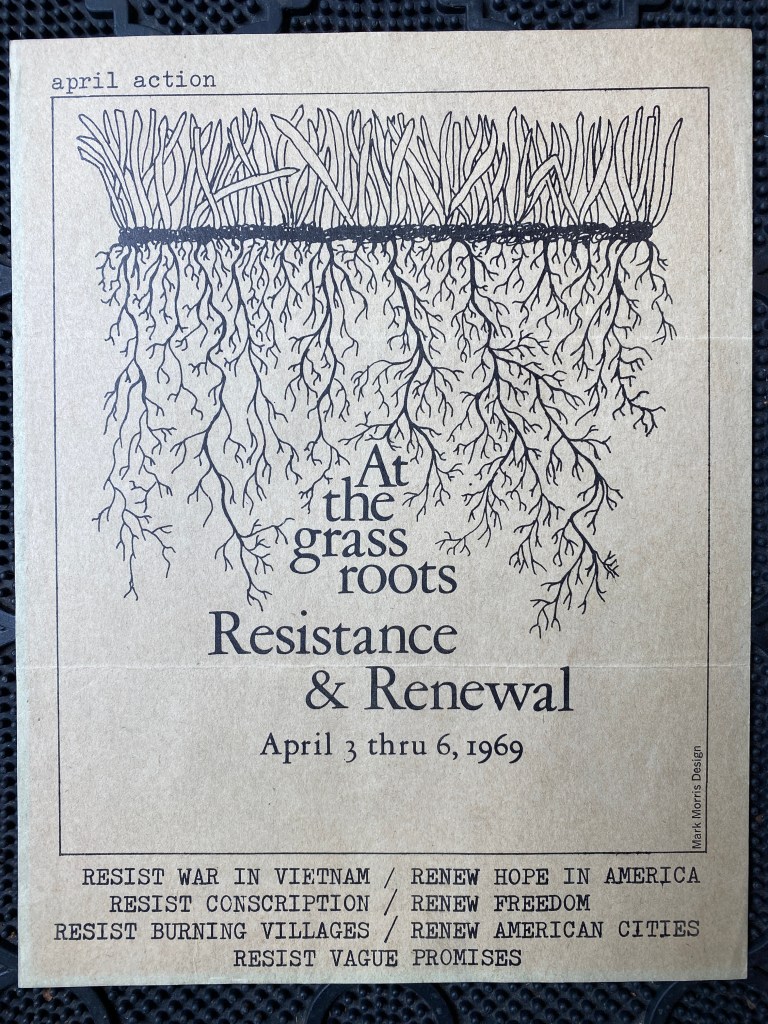
    Descending further down that rabbit hole, I don’t just gaze at family photographs. I conjur up the people. The sound of my mom’s laugh, or the smell of the purple wisteria that twined around the pole that marked the entryway to my childhood home. I wonder about the young men dodging the Vietnam draft in my dad’s poster collection and the shy young African girls in my uncle photographed in the 1960s. What are their stories? 

    This is what happens when an only child sprouts from a family of documentarians. At least that’s what happened to this only child. As I’ve mentioned, my father David Holmstrom was a journalist and a writer, but he was also an artist, photographer, and collector of a mind-bendingly-diverse array of documents, items, publications, and books. 

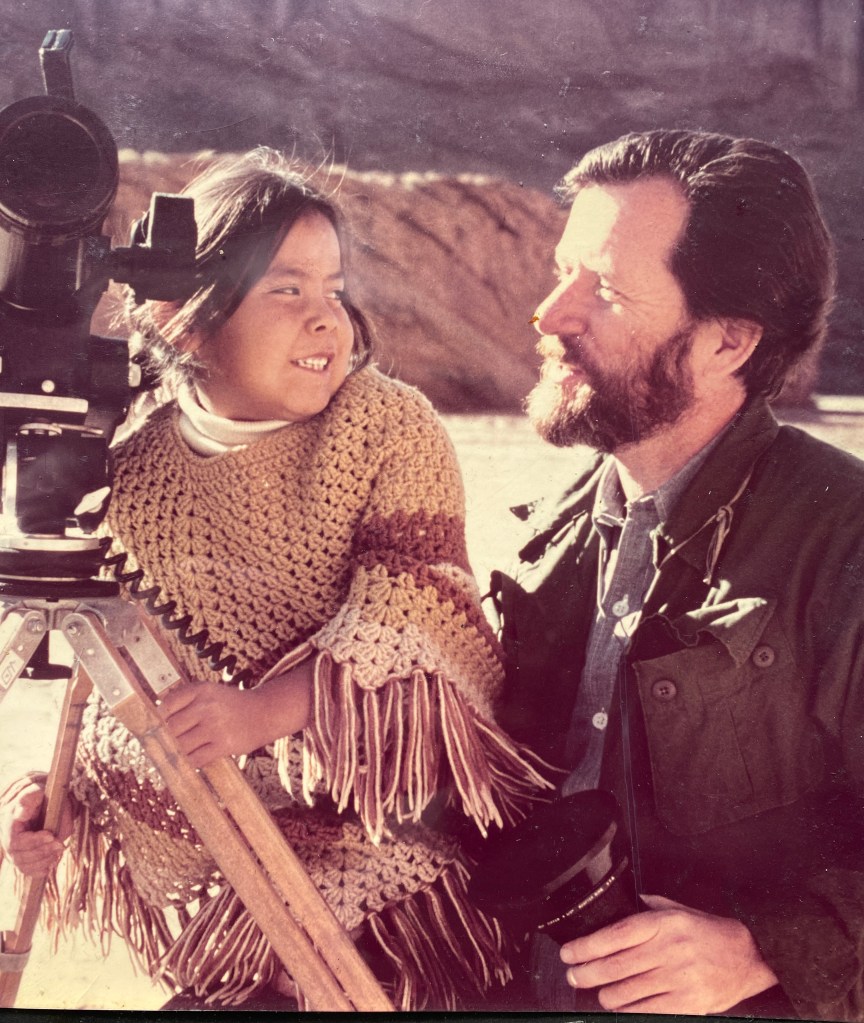
    My uncle John Holmstrom (my father’s older brother who never had children) was a successful documentary filmmaker, photographer, and writer. John and I were close and shared many interests. Both John and my father are gone now, but their presence is alive through the material they left behind…material that is now in my hands. 

    My uncle John Holmstrom, documentarian extraordinaire.

    “Get that girl a sibling!” says my dear friend Hether who sometimes helps me sort and catalog the collections. But there is no sibling to be had, so for the most part I am on my own. 

    In one sense I feel chosen; I am now the keeper, the steward, of these items. There is a banquet, a virtual feast of history, ideas, and words housed in these boxes and folders. The material is calling to me….” Tell these tales, share this rare worth, don’t let it dissolve into memory until no one is left to share.” 

    Yet, I also feel weighted down by the volume and scope of subjects too numerous to count, as well as the heft of responsibility. I worry that I can’t possibly do it all justice and won’t be able to find enough channels and means to share the stories. And once I share, will anyone be interested? 

    Overview of material (Part One)

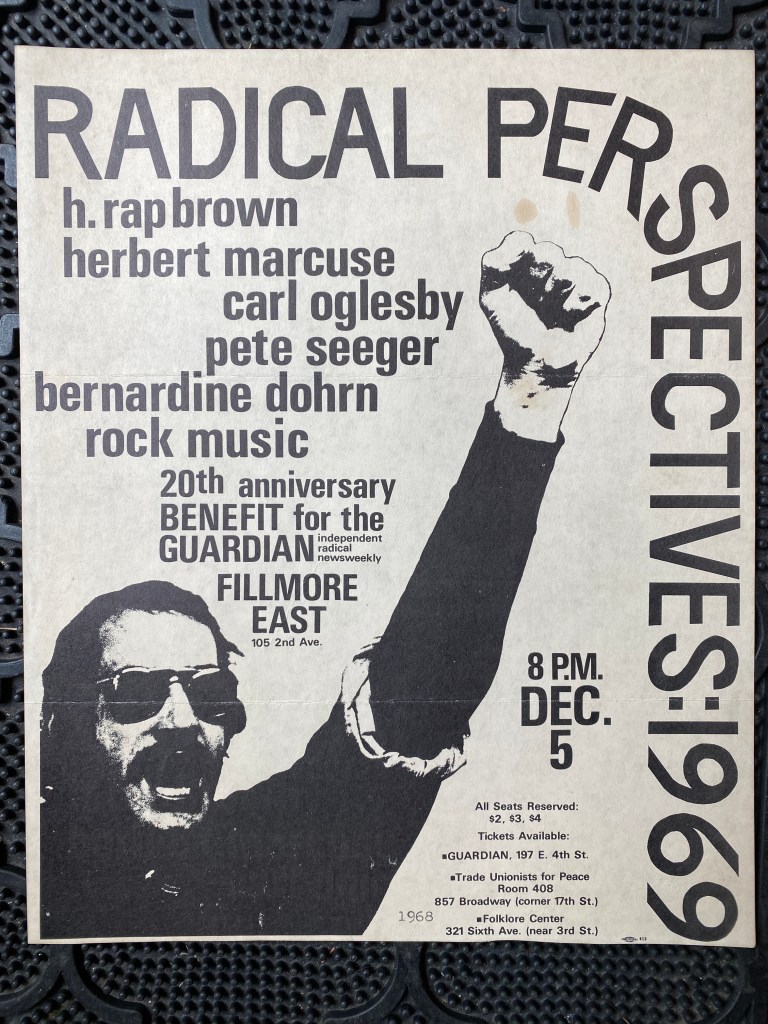
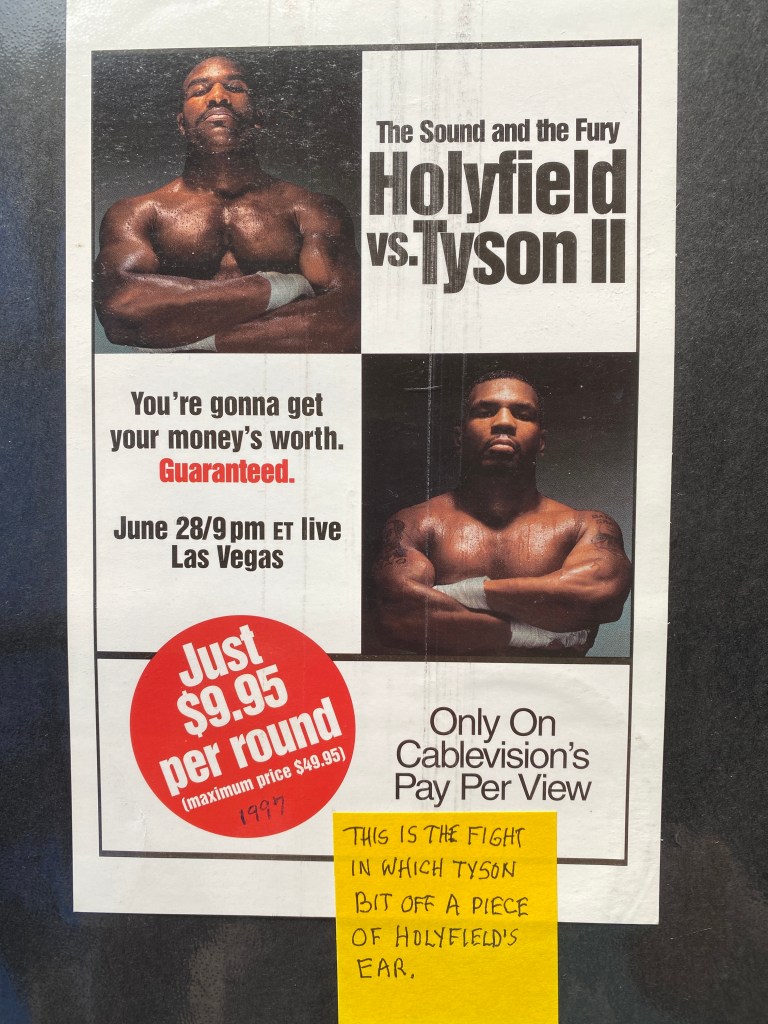
    Poster/Handbill Collection: Fourteen folios full of David Holmstrom’s poster assemblage. Starting in 1968 he gathered free posters and handbills on the streets of New York City and built his collection for the next fifty years. Featured cities include San Francisco, Chicago, Los Angeles, Las Vegas, and Santa Fe, New Mexico. 

    The handbill that started my dad’s fifty-year collection, handed to him on the streets of NYC in 1968.
    This image has an empty alt attribute; its file name is img_9976.jpg
    It’s an eclectic poster collection.

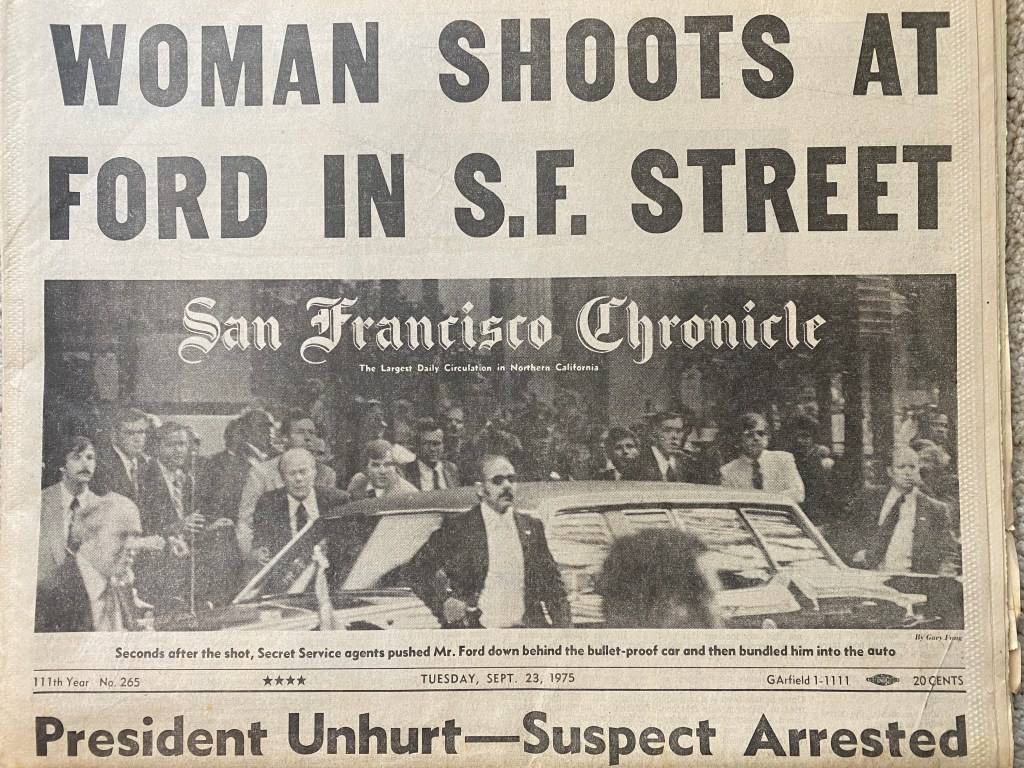
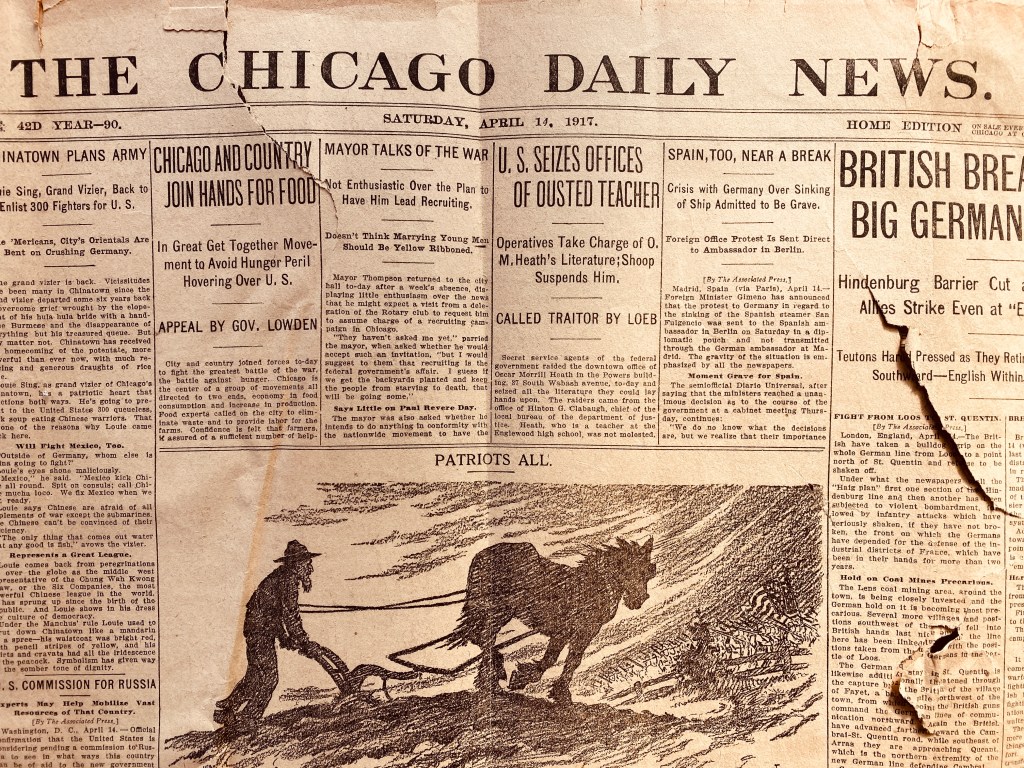
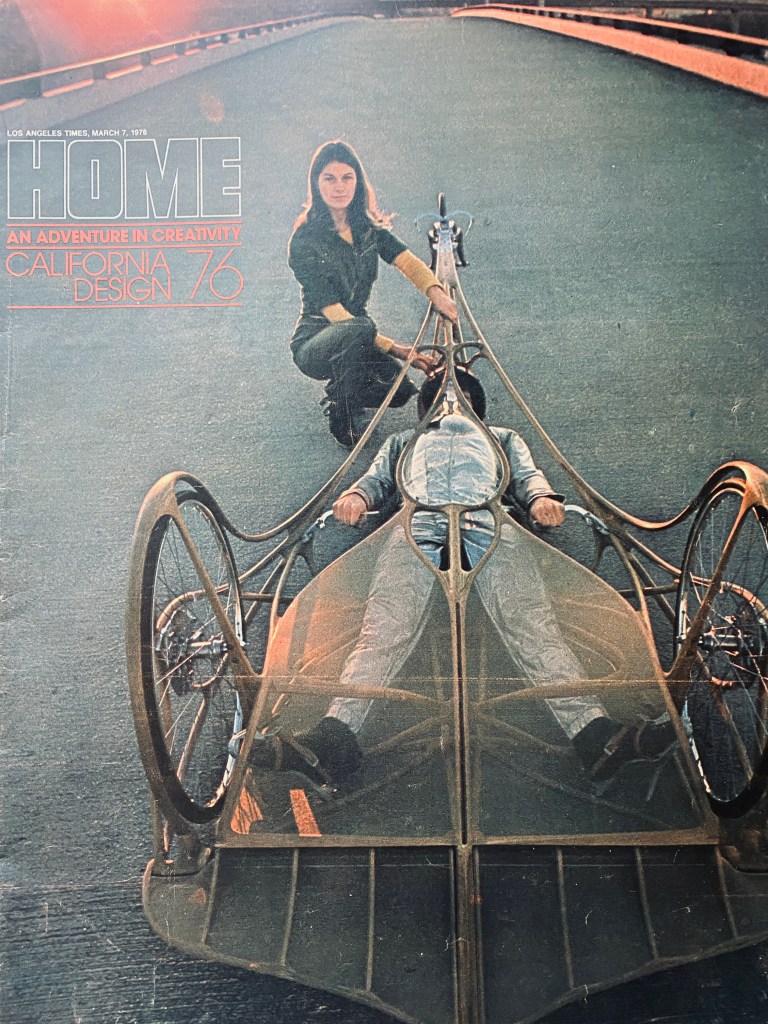
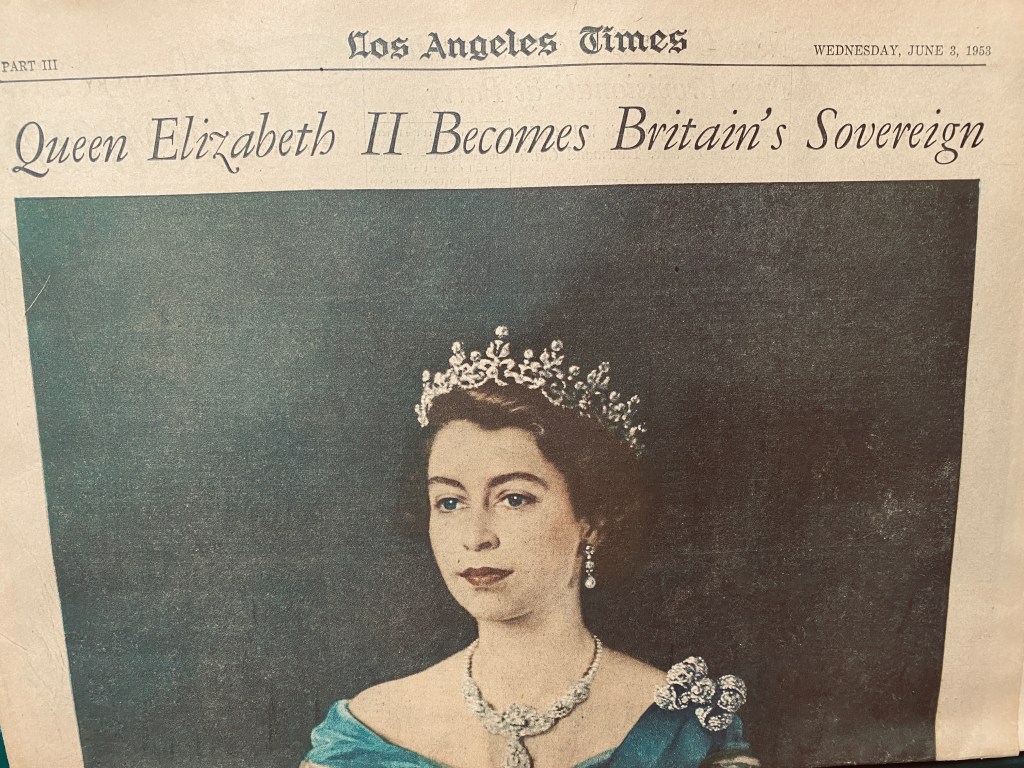
    Newspaper/Magazine Collection: My dad’s tendency to buy newspapers on important news days and strategically save certain magazines might seem like hoarding if the subjects and headlines weren’t so compelling. Spanning well over a century (the earliest one I’ve found, so far, is from 1889) and featuring headlines like “Man Walks on Moon” and “Kennedy Shot!” the collection truly brings history alive. 

    The San Francisco Chronicle, Tues. Sept. 23, 1975
    The Chicago Daily News Sat. April 14, 1917
    Los Angeles Times California Design Supplement, March 7, 1976
    Los Angeles Times Wed. June 3, 1953

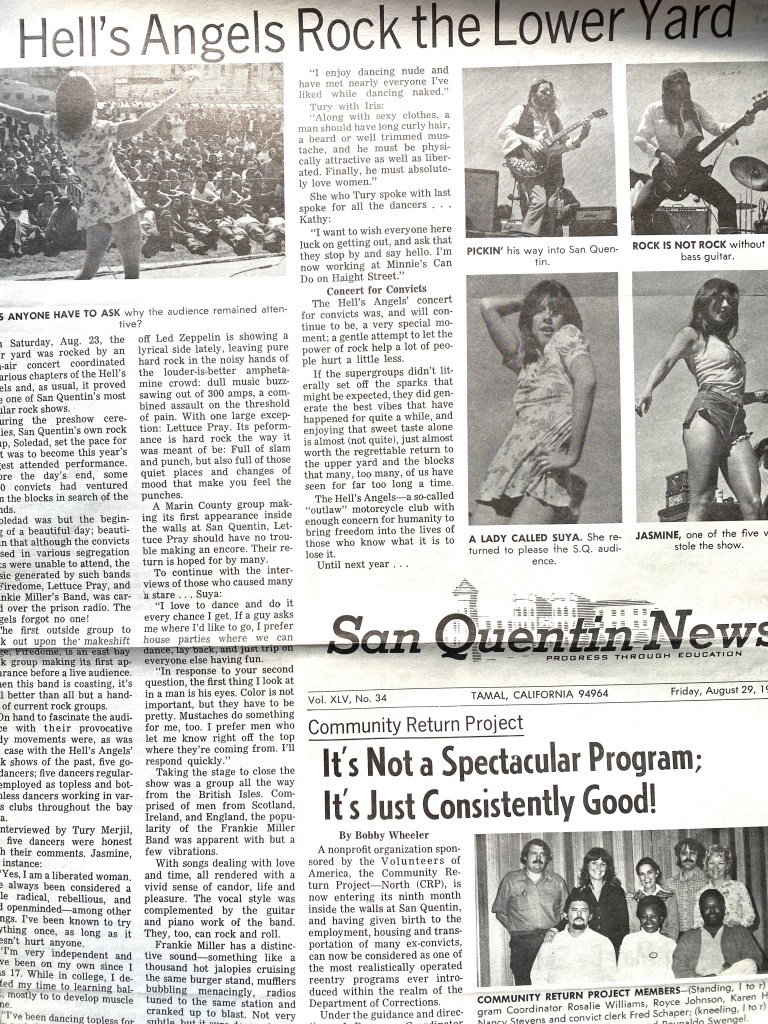
    One sub-category of the newspaper/magazine collection includes three years of issues of the San Quentin News, published out of the notorious prison in the San Francisco Bay Area. David had an almost forty-year friendship with the newspaper’s editor (and inmate) Joe Morse. Joe was the longest-serving prisoner on California’s death row and once had a cell next to Charles Manson. Guess who also inherited the bulk of Joe’s lifetime correspondence with his wife and lawyers, and his three murder trial transcripts? My dad did. 

    San Quentin News, Friday August 29, 1975

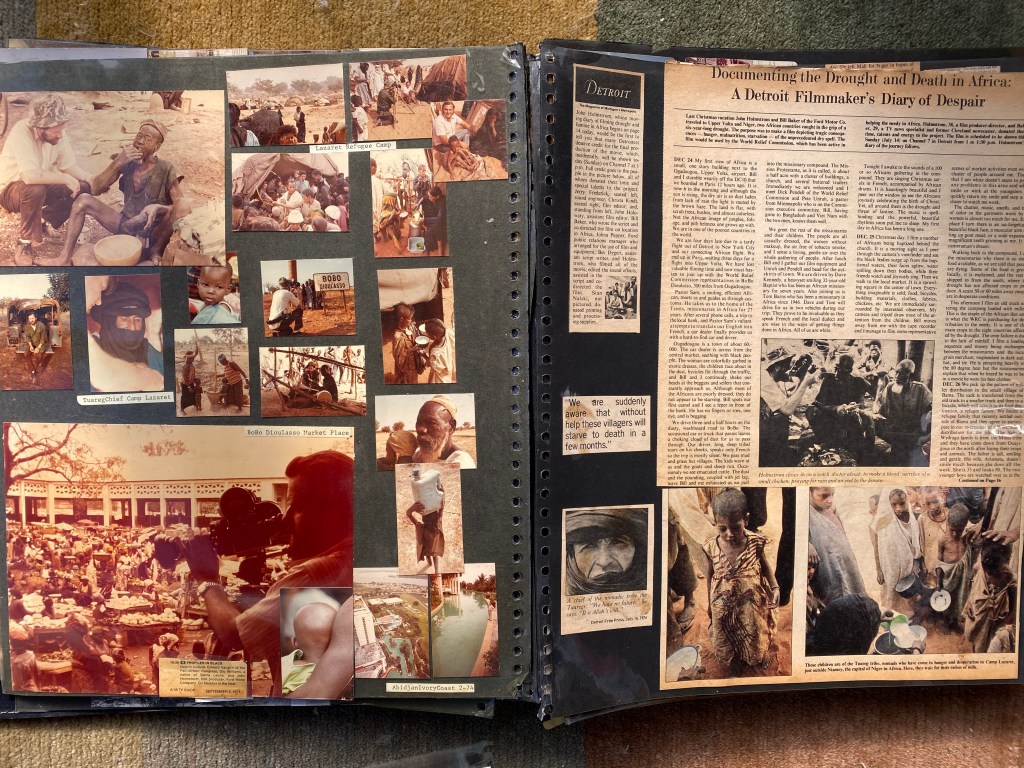
    John Holmstrom’s Career Collection: My uncle John began making films for The Ford Motor Company in 1970. He traveled the world for decades, from the Middle East to Africa to Europe to Central America to New Zealand to Scandinavia telling stories through documentary filmmaking. His 1977 film Stockcar! was the first feature-length documentary released nationwide in U.S. movie theatres. I have a lot more to share about my uncle’s life and work. 

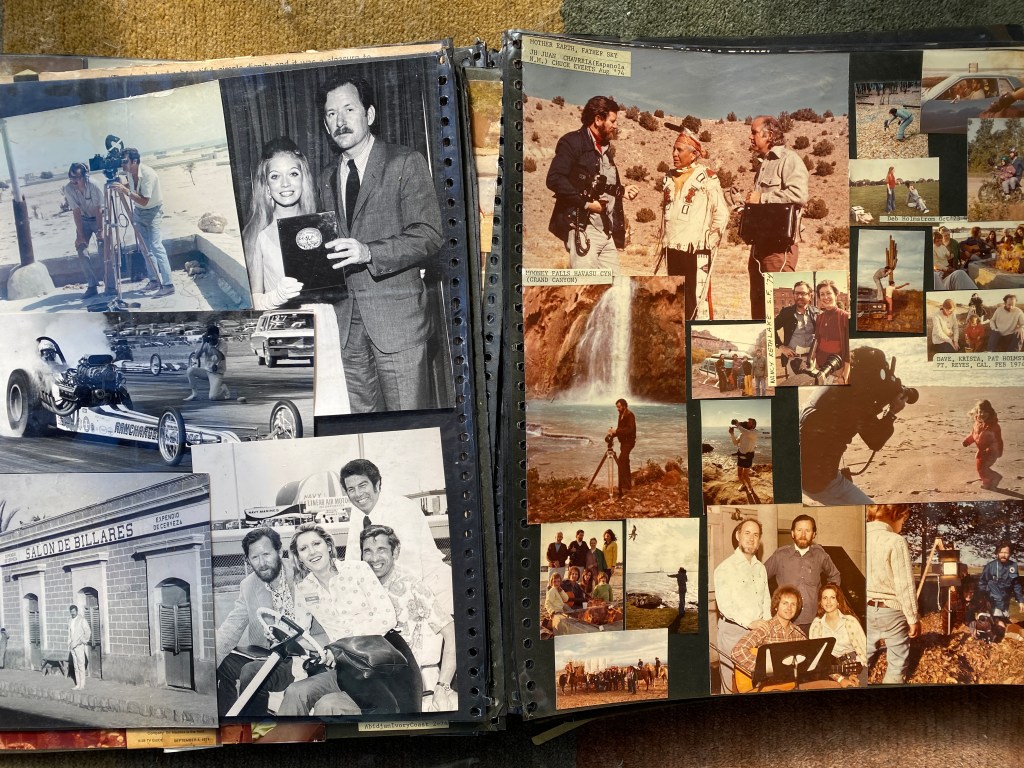
    Pages from John’s career scrapbooks. Photographs, published articles, awards.
    John was a gifted photographer.

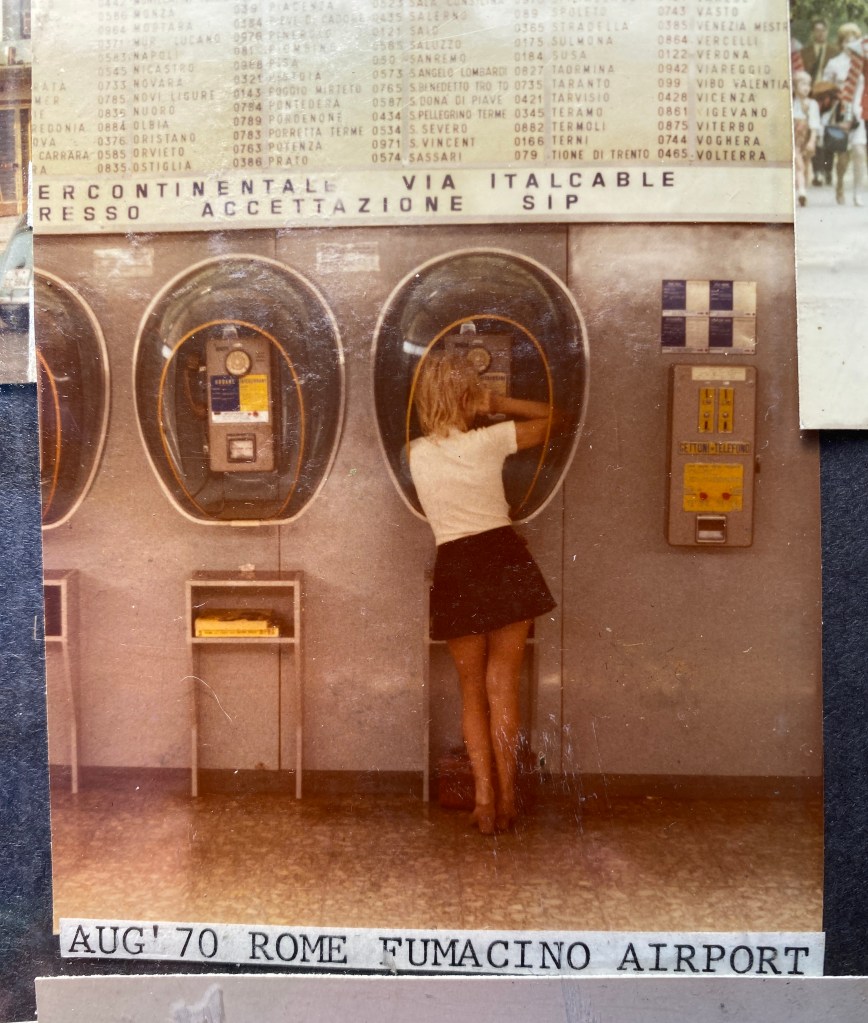
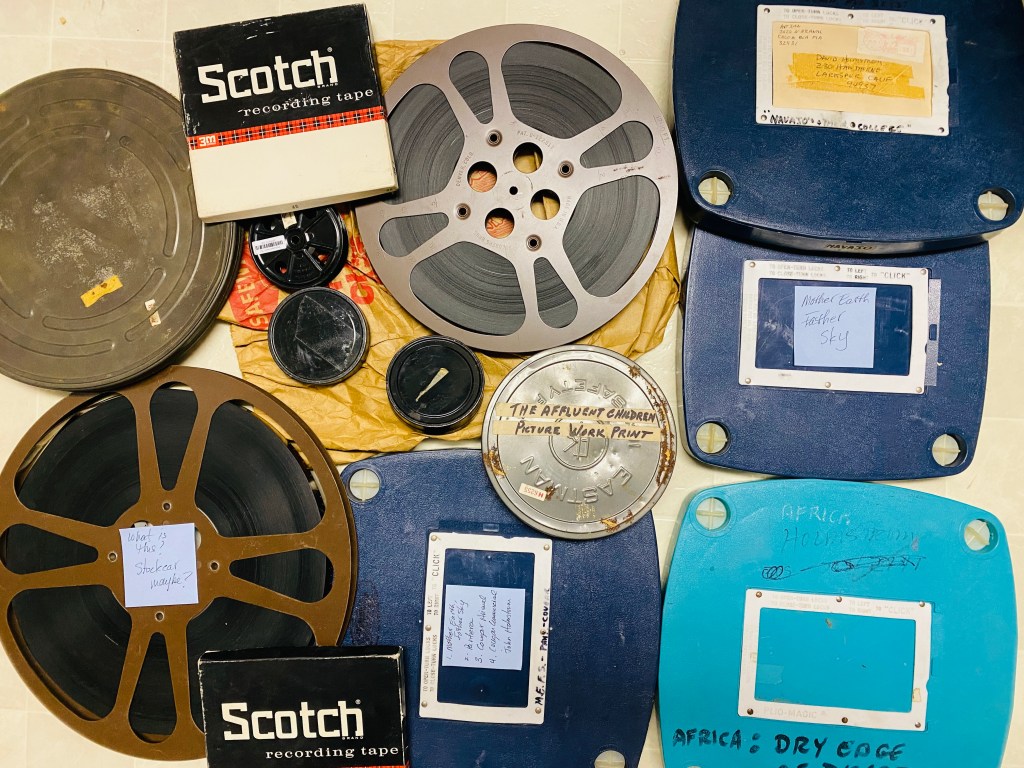
    Film: John made films. David made films. John and David made films together. It’s all here. 8 mm, 16 mm, MiniDV, VHS tapes, and audio tapes. Film footage of my grandparent’s California wedding in 1932, film of my great-grandfather’s return visit to his native Sweden in the late 1920s, and footage of my great aunts in the Sahara also from the early 1930s. I’ll be sharing some of this archived film here.

    I worry about storing this film in the midwest climate where I live
    but it seems to be holding up just fine.

    Keep visiting this space because I’m going continue this tour of the archives. After all, there is a mind-bendingly diverse array of film footage, documents, items, publications, and books to tell you about.

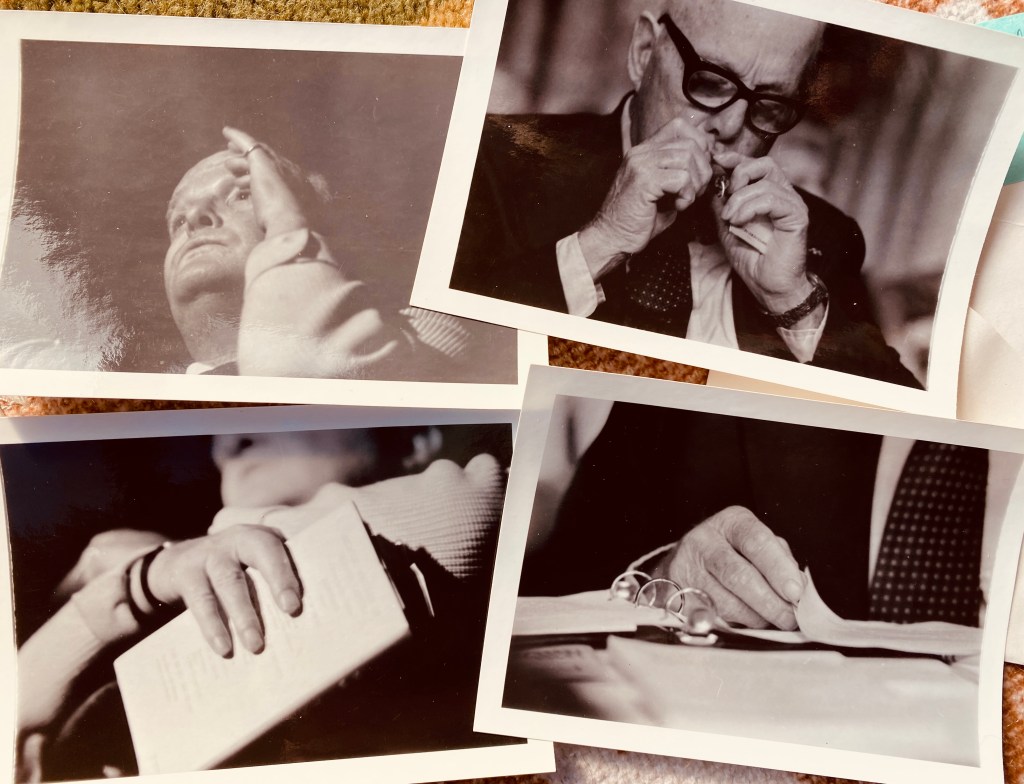
    …and stay tuned for Material Abundance: Part Two which covers more of the materials collection. Projects include David Holmstrom’s photographs of Truman Capote’s hands, candid images of Angela Davis at her June 1972 trial in Berkeley, CA, and vintage Star Trek press kits.

    Photographs my dad took of writer Truman Capote and his hands.

    Believe me, there’s probably enough for a Part Three (or more).

  • Ode to a Ghost Ranch Cottonwood

    November 18th, 2022
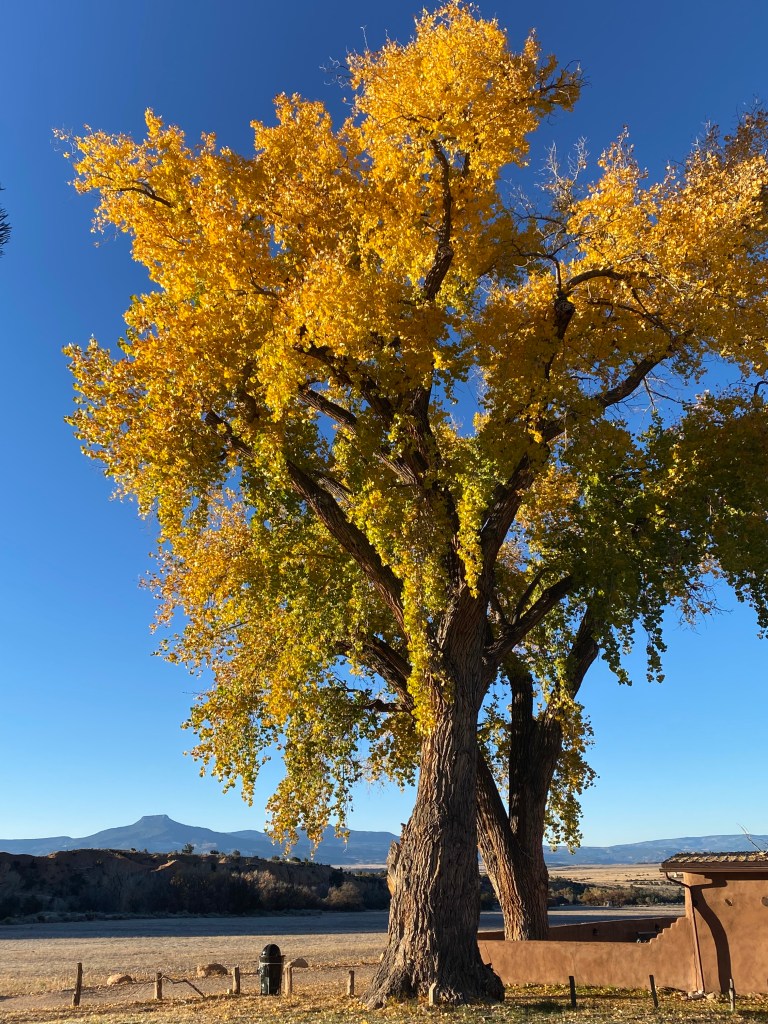
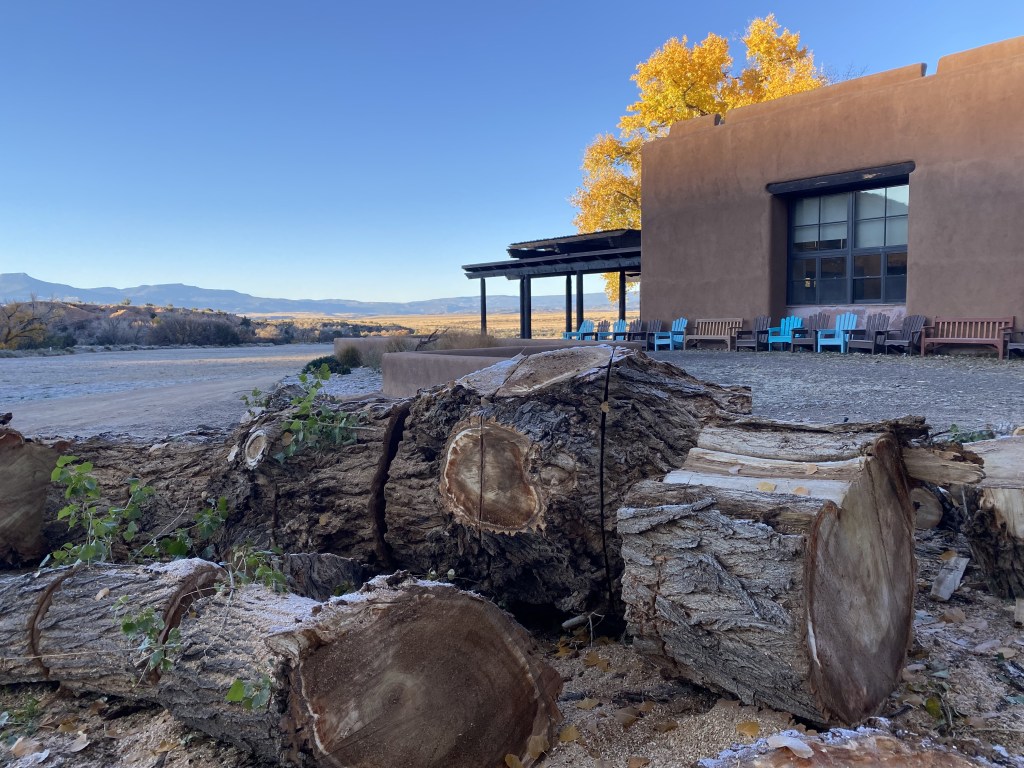
    Two Cottonwoods stand sentry at Ghost Ranch with Mt. Perdernal in the background.

    Shouldn’t there have been some sort of ceremony? A thoughtful circle of clasped hands or a joyful swirl of moving bodies, pouring forward gratitude for a life well lived, a job well done? If the animals had known this was coming would they have gathered at a distance and shook their heads in familiar disappointment at those ridiculous humans? 

    She must have been well over one-hundred hundred years old, perhaps two. I wonder if Georgia O’Keefe painted under the cover of her cottonwood branches…she was in the sight-line of Mt. Pedernal’s flattened peak, after all. How many artists have featured her in paintings and photographs? I’d like to see those works carefully laid down in a crooked line, a creative chain reaching across the open field facing her, ending at the base of the towering bluffs that reflected the sinking sun at the close of each day. 

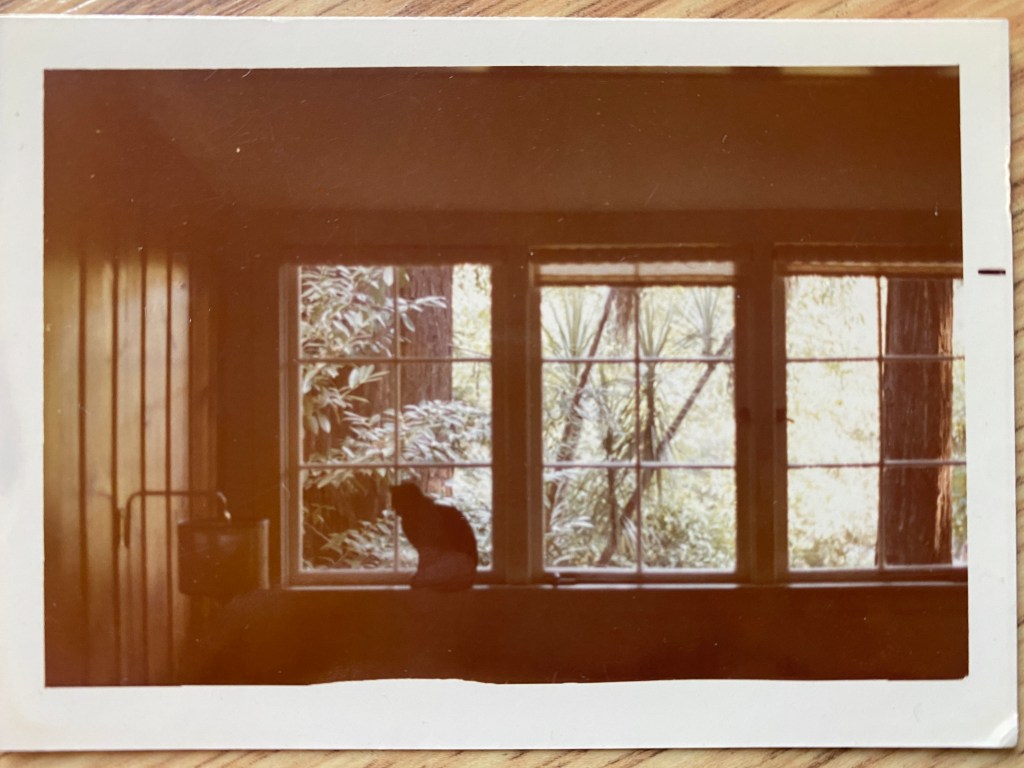
    Trees have a way of following me, or maybe I follow trees. They have played supporting roles in my life from the beginning. My earliest memory is gazing up at a towering, heart-bursting green/brown column of glory reaching for the heavens as seen by my 3-year-old eyes. The tree was a redwood, silhouetted in a skylight cut into the roof of our living room which was nestled in a Marin County grove. Climbing the walnuts, oaks, and pines of my Northern California childhood was integral to my development and appreciation of the natural world.  

    The California Redwood grove surrounding our house in Marin Country, CA.

    Instead of a conscious ceremony around her felling, there was a spontaneous eruption of clapping from a group of men gathered at a safe distance. I believe the assemblage was applauding the skill of the arborist who took great care to ensure that no one was hurt by the toppling of her gigantic trunk. But the cheering made my heart thud dully and I winced with the knowledge that this was a sacred moment, not one to be celebrated in jovial brotherhood.  

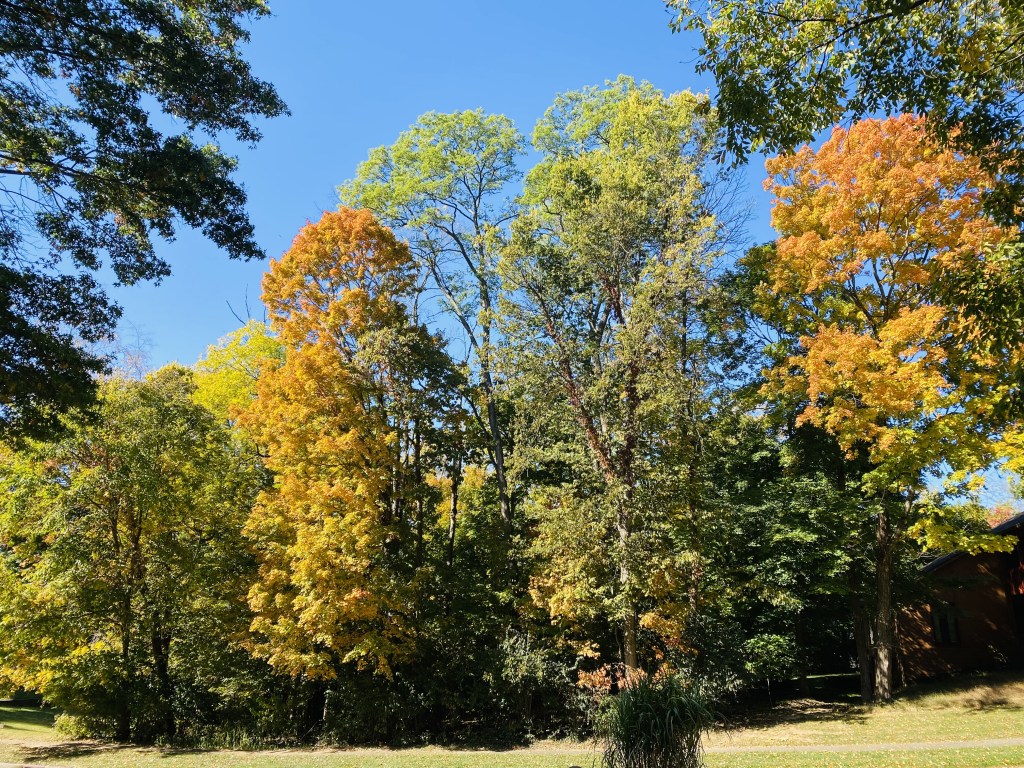
    I named my first son after the enduring, stately California Cypress. Working to stay on good terms with the Pin Oaks and Sugar Maples surrounding my current home, I am well aware that the land we are borrowing for our house plot was at one point a vibrant, crowded Midwest hardwood forest. We are in debt to these life forms…humans need trees, desperately…for shelter, warmth, food, and oxygen. 

    Today’s across the street neighbors.

    Let’s think of the thousands of seasons that passed while our Cottonwood grew and spread, seasons in which she played an integral part. The birds that needed every piece of her, the dust that was covered by her generous golden leaf snow, the countless insect lives and soil her roots held below. Children played in her shade, lovers kissed behind her trunk, and deer nibbled her bark. She survived the Ghost Ranch flood of 2015, and no doubt many other great forces of nature that have receded from present memory. 

    There she lays.

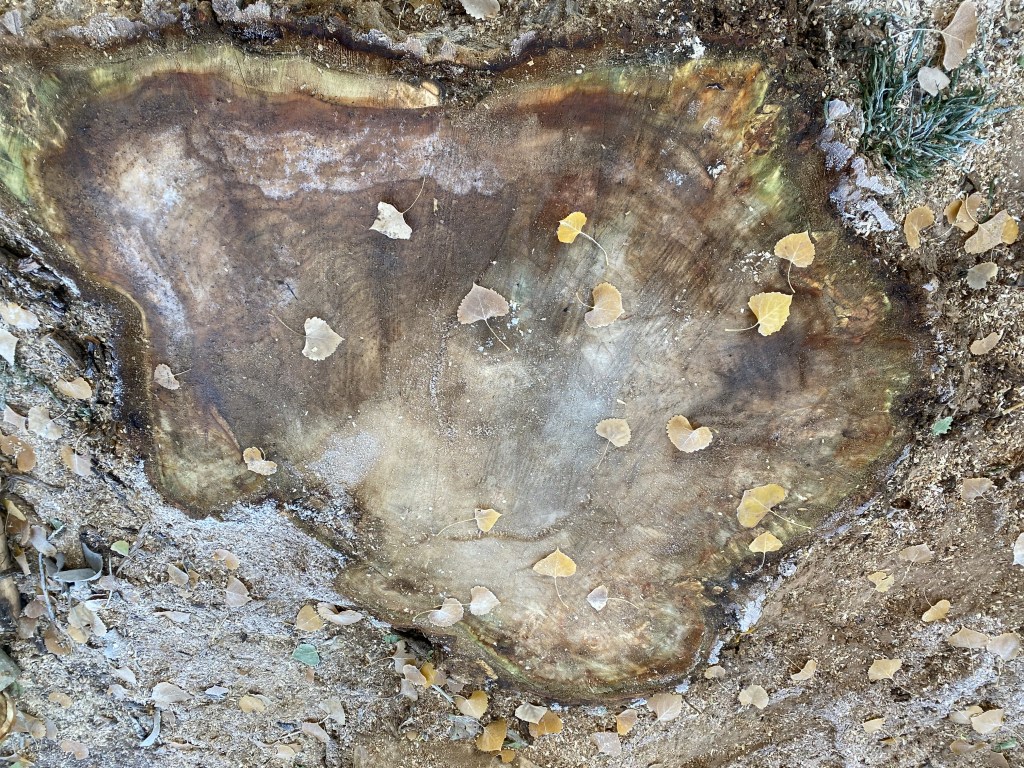
    I walked to her the next morning, unconsciously drawn to her pieces lying on the ground. Formerly grand, useful, alive, now separate, scattered, stagnant. Perhaps she carried a disease, perhaps it was her time…after all every life turns on the wheel of experience and circumstance. Deadwood supports life in ways that live wood cannot. Her trunk was sliced low to the ground, creating a smooth tabletop and infinite constellations of sawdust blanketed the ground.

    Infinite constellations of sawdust.

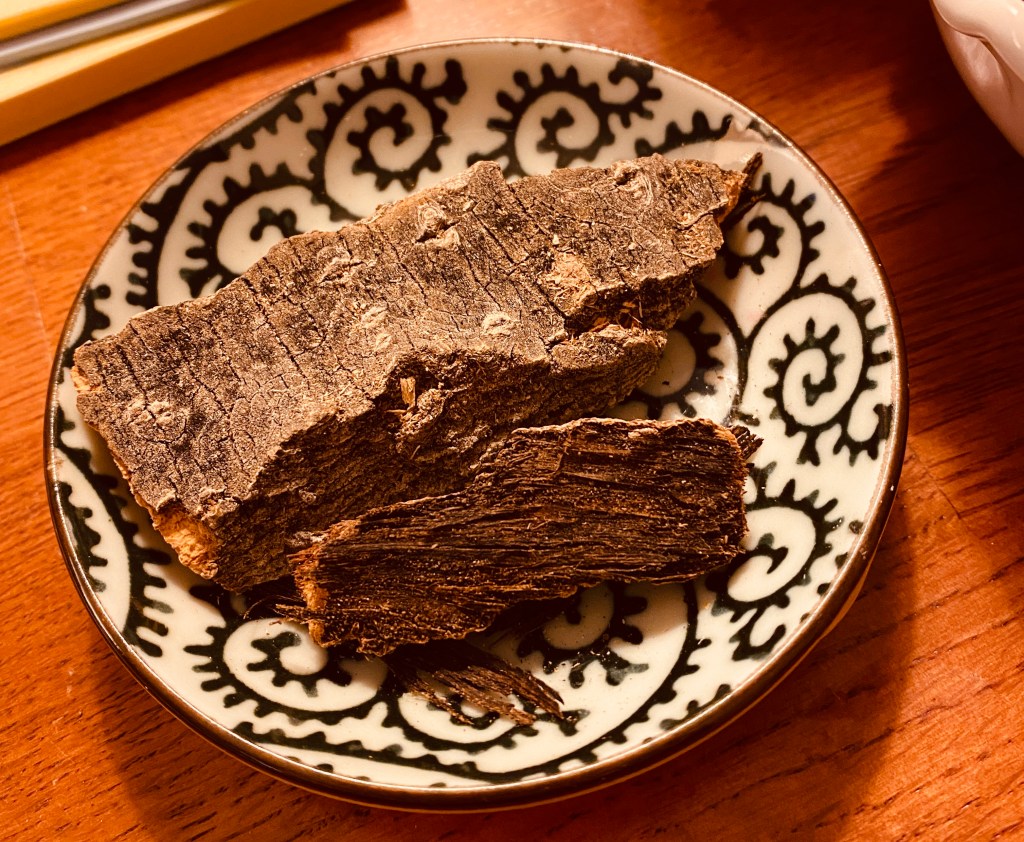
    I couldn’t easily count her rings it didn’t feel right to stand on top of what was left of her. Leaning down, I took a nugget of bark and needle-sized damp splinters scattered across my open palm. I’ll carry this piece of her with me as I journey on, knowing she played her part, allowing her a ceremony in my pocket and my heart. 

    One of her new resting places…on my writing desk.
  • A Veteran’s Awakening

    November 11th, 2022
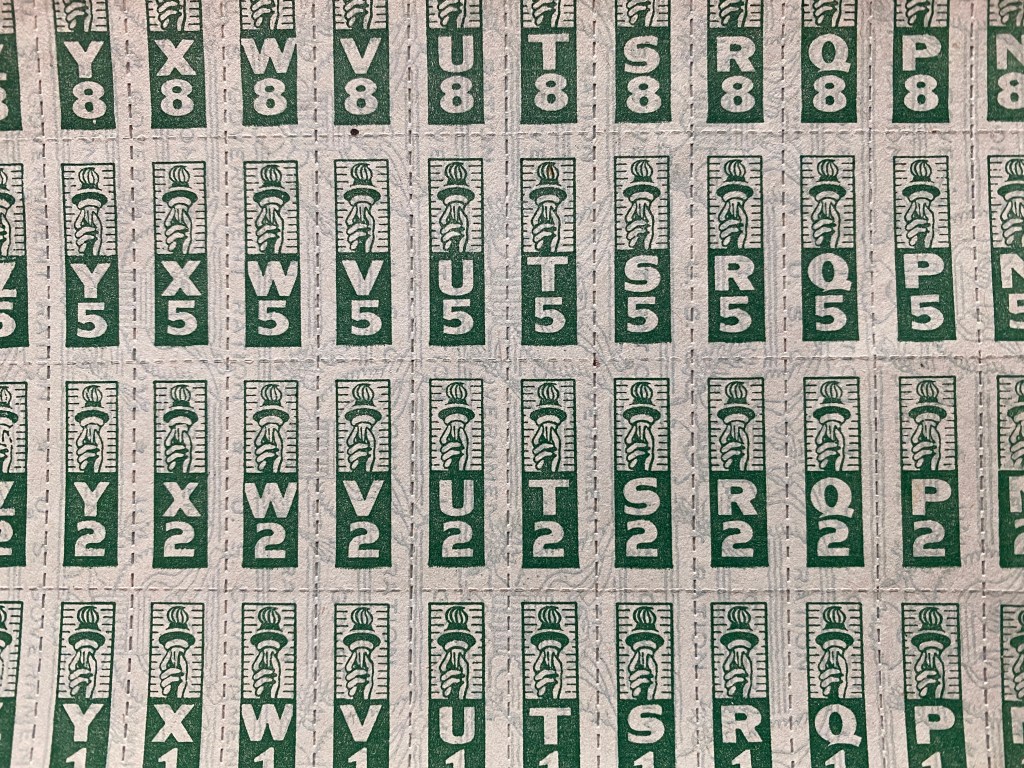
    War bonds from the 1940’s saved by my paternal grandparents.

    In 1993 I took a college course titled “Literature of the Vietnam War” at The University of Massachusetts at Boston. The class was taught by a youthful and eager Assistant Professor of English who made admirable attempts to guide frequently heated class discussions. Nearly every segment of Boston society was represented in the class, which is part of why I remember it so vividly. Young men and women from South Boston (a traditionally blue-color community that often leaned Democratic), three or four ROTC folks, a handful of both young and non-traditional aged students from Boston proper and other surrounding communities like the South Shore, one actual Vietnam Vet, and me (a restless California transplant doing her best to achieve grades that would allow a speedy transfer to the higher-profile UMass Amherst). 

    Because Bostonians are often opinionated talkers and because I am not, I hardly dared to say a word in that class. I believe the only time I spoke was to mention that my father had served in the Navy and was also vehemently against the idea of war in general. Everyone looked at me quizzically and then continued debating the true toll of PTSD and the legitimacy of draft dodgers and protestors. 

    Thinking back to that class, I wish I had done things differently and said more (truthfully, there are countless things I wish I’d done differently in my twenties but let’s stay with this one for now)… I should have shared more of my father’s story, because I now see that his tale of service is an interesting one, an important one, and most of all, a rare one. 

    David Holmstrom is promoted to “Third Class Journalist” in the Office of the Chief of Naval Information
    in a ceremony at the Pentagon in 1963.

    In 1961 my father David Holmstrom was drafted out of what had been an academically rigorous yet comfortable midwest college experience and into the Navy. His letters to his parents back home in Los Angeles glossed over the gory details of Basic Training but did mention that he “flunked the Officer Aptitude Rating (OAR) test because I kept setting the warships on a collision course.” Somehow, the Naval brass must have figured out that David could write because upon graduation he was assigned to the Pentagon in Arlington, VA. 

    Prior to being drafted, David’s opinions about war, bloodshed, and politics were budding and mild, not yet fully formed. Growing up in Los Angeles in the 1950’s, his high school classes were some of the first to be integrated, and his parents voted more conservatively than he did. He made a black and white film about racial disparity in East St. Louis in 1959 and the experience gave him a glimpse of a world outside of his own substantial privilege. His writing from that time shows his evolving moral compass and a desire to learn about injustice and entrenched politics. 

    David was no doubt shocked to find himself working in the headquarters building of the United States Department of Defense, rubbing shoulders with the top brass of the military. He remained for three full years (1961-1964), serving as a Third Class Journalist in the Office of the Chief of Naval Information. His main task was gathering the top news stories each day. He compiled the coverage, creating a kind of mini-headline newspaper for the heads of every branch of the military to review. Relying on the AP wires and copies of national and local newspapers, he made daily judgement calls about which articles to highlight. He was like Google’s Top News Stories military-style….in human form. 

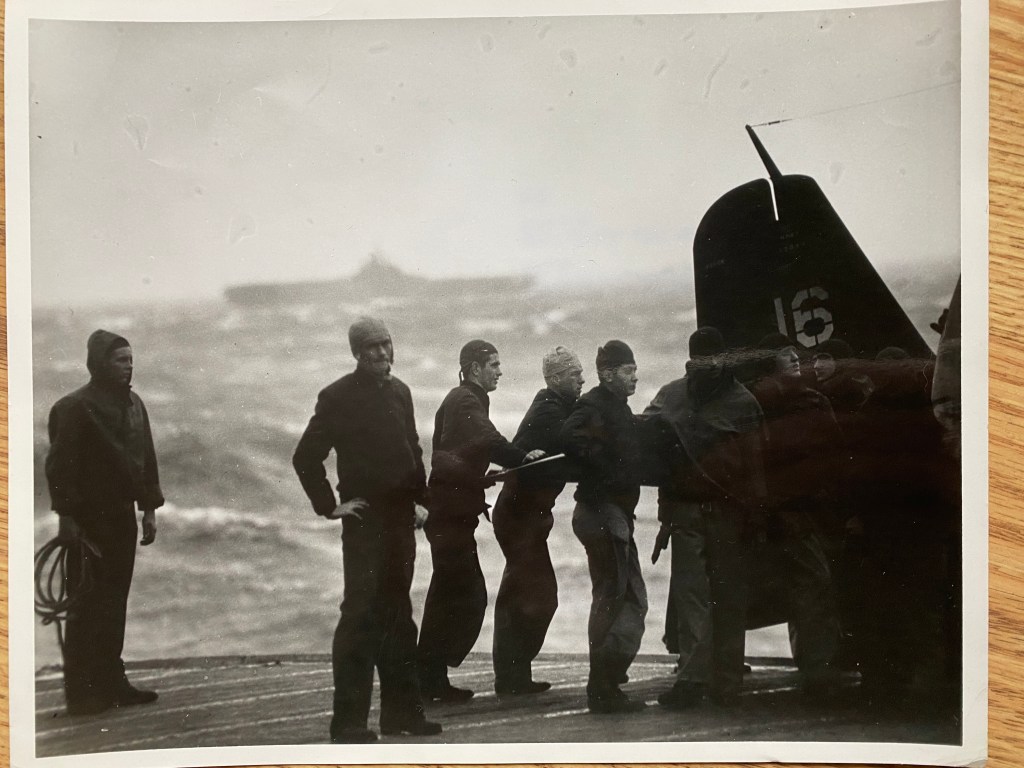
    An original Navy photograph that *might* have left the Pentagon with David. The caption says “12/17/44 Crewman on the flight deck of the USS Enterprise (6V-6) during typhoon in the South China Sea off Luzon.”
    The back of the photograph also says “No objection to publication or reproducing this photograph provided this credit line is used: Official US Navy Photo.”

    The early 1960’s were fraught days for the Pentagon as the US Military danced around involvement in the Vietnam War and a number of other communist-tinged conflicts (the U.S. officially entered the war with the Gulf of Tonkin Resolution in August 1964). In October of 1962 the Cuban Missile Crisis erupted, and David was smack in the middle of the action as military bosses strode in and out of offices and took phone calls from the White House. He wrote about that time:

    “I was a young college graduate in the Navy in the Pentagon when the Cuban Missile Crisis happened. It was chilling to hear the officers around me lusting to bomb Cuba into oblivion. I was so glad to be there, to see and hear military thinking firsthand. And when Kennedy gave Khrushchev (then-head of the Communist Party) a way out of the mess, thus avoiding unthinkable disaster, I was appalled to hear disappointment from some of those officers. This experience changed me radically. If you take a hard look at the ugly details that have evolved from sustained belief in military might, it changes you. The totality of our effort in Vietnam, Iraq, Afghanistan were enormously deadly and expensive failures and costly to millions of people and their families.” 

    Another photo from the Naval archives. “19 June 1944 VADM M.A. Mitscherr aboard The USS Lexington off Saipan” No objection to publication or reproducing this photograph provided
    this credit line is used: Official U.S. Navy Photo

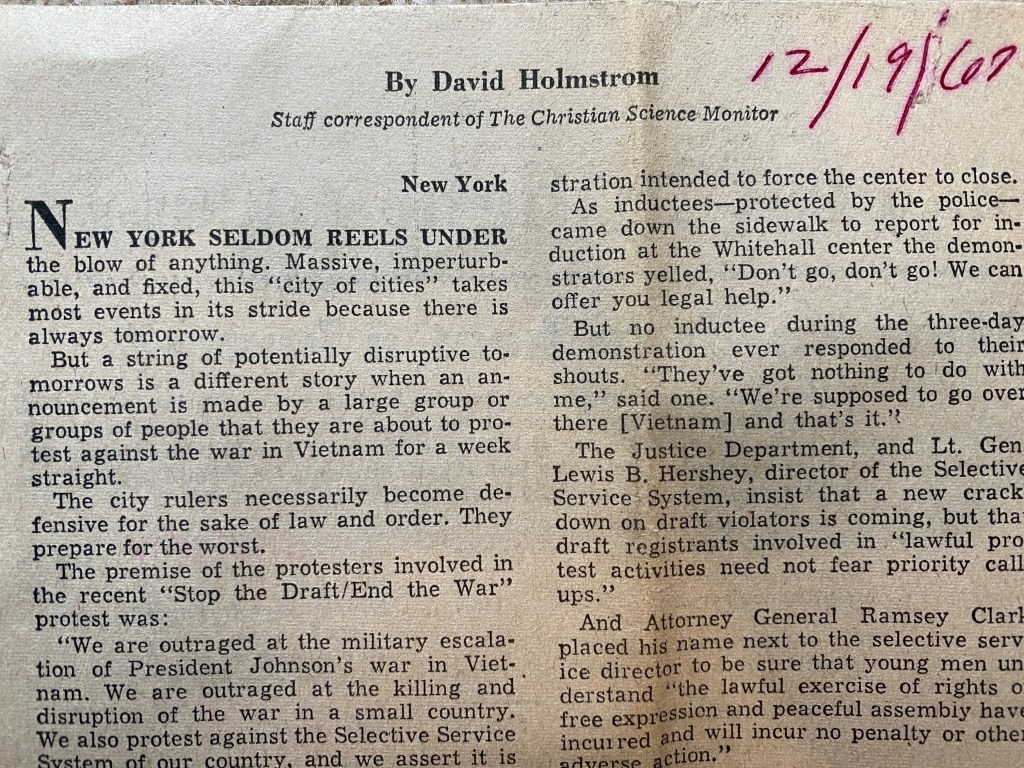
    David went on to be a lifetime journalist, and wrote countless articles about how and why individuals and organizations were working for peace, or against it, in the world. Instead of fighting in Vietnam, he wrote eloquently about the conflicts on US soil between those protesting the validity of war and those who believed in military force. He also wrote about everyone else, caught in the middle of conflict both at home and abroad (or recovering from their service) and the many brave enlisted individuals so often faced with few opportunities other than military enlistment, working to provide a livelihood for themselves and their families. He helped readers to understand the why’s and the costs of war.

    One of David’s articles about protests in New York City against the Vietnam War.
    From The Christian Science Monitor 12/19/1967.

    In 1964, during his exit interview from the Navy, when asked why he wasn’t reenlisting, David said “I’ve learned I want to live for my country, not die for it.” It’s worth noting that the US became involved in the Vietnam War that same year and had my father remained in the military his story, and as a result, my own, might have gone differently. David went on to write numerous articles about how and why individuals were working for peace in the world, in my opinion the best and most valuable use of his talents. 

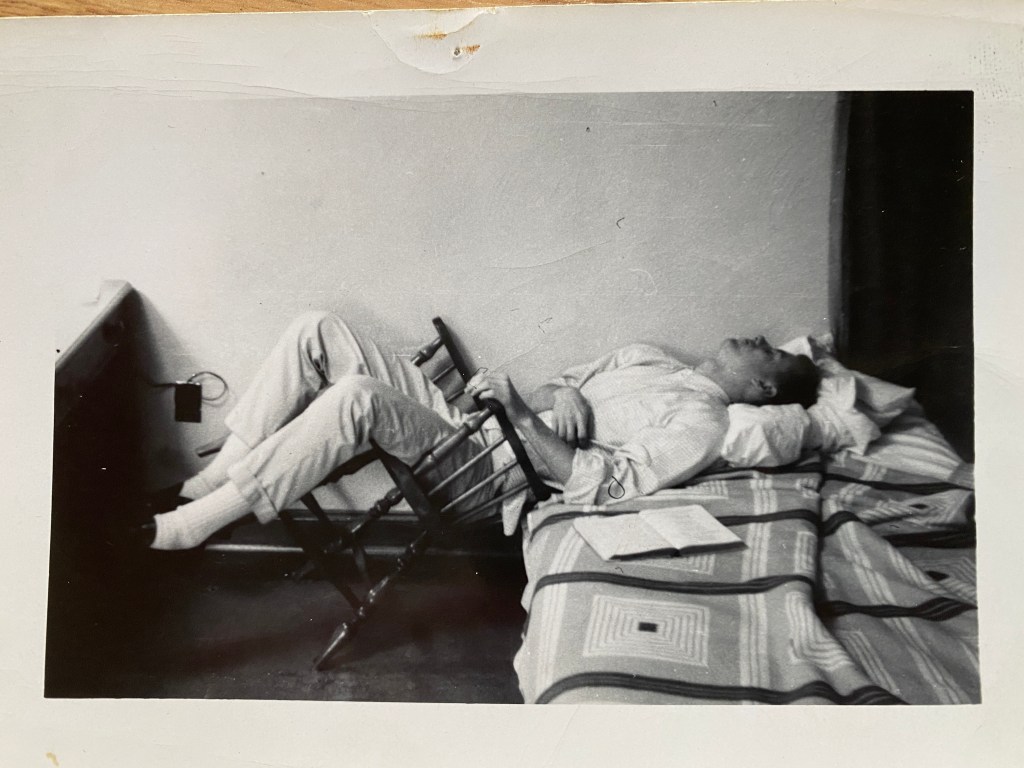
    David was given a bunk in some barracks close to the Pentagon but soon realized no one was checking on his whereabouts so he moved in with some college buddies living in DC. Here he is during those days.. hard at work.
  • Surprising and Inevitable

    November 4th, 2022

    I’ve realized that I was born to be a writer—I practically had no choice in the matter. I wonder how many people feel that way.

    A sibling-free childhood growing up in a valley dominated by grapevines and oaks and overrun by characters almost begging to be written about. Combine this with countless solitary stretches spent reading books in trees, on couches, in self-constructed forts, and among tall swaying alfalfa grass.

    After all, what was I to do with a mother who was a spiritual healer and a father who was both an artist and prolific writer? Attentive, interesting extended family and friends sent me postcards from foreign locales. I was exposed to arts and culture and all strata of privilege and lack. There was also a healthy sprinkling of danger and addiction tossed over the heap of my days.

    And still, it took me forty-nine years to accept my fate and get down to my own writing. 

    For a long time, instead of my own singular words, I wrote for others, about others, and most of all because of others. Letters and missives, articles and marketing copy, white papers, content writing, and always, always…media alerts and press releases. Hours of collaboration on the manuscripts of friends, their resume cover letters, their scribes to agents, even lovers. I shared structural and editorial advice until I couldn’t see straight. 

    My years in the publishing industry sucked me dry of my own drive to write, and by the time I finally landed to work in the world of self-publishing (don’t get me started…although the latest hybrid model is interesting), I could take no more.

    And still, it took me forty-nine years to accept my fate and get down to my own writing.

    I climbed the tree of my life, branching in and out of joy and tragedy, hope and despair, purpose and sloth. Then, at age forty-nine, exhausted by circumstance and the muting of my own voice, I found myself at the literal deathbed of my (writer) father. I pledged to him, and myself to “write, really write.” 

    The unlocking was immediate, and the words and stories have been pouring forth ever since. If you’re interested in how I moved beyond writing because of others and began writing for me, and for the world, stay tuned. 

    After forty-nine years, I’m ready to cover a lot of ground. 

←Previous Page
1 … 3 4 5

Blog at WordPress.com.


Loading Comments...
 

You must be logged in to post a comment.

    • Subscribe Subscribed
      • Still...however...maybe...
      • Join 30 other subscribers
      • Already have a WordPress.com account? Log in now.
      • Still...however...maybe...
      • Subscribe Subscribed
      • Sign up
      • Log in
      • Report this content
      • View site in Reader
      • Manage subscriptions
      • Collapse this bar